2

In crystallography, the Wigner–Seitz cell is a primitive cell which is constructed by applying Voronoi decomposition to a crystal lattice.

Some examples include

  • Simple cubic: cube,
  • BCC (body-centred cubic): truncated ocahedron,
  • FCC (face-centred cubic): rhombic dodecahedron.

I am curious about which polyhedron is constructed by he Wigner–Seitz cell of a HCP (hexagonal close-packed) structure. I searched on the internet and found this image.
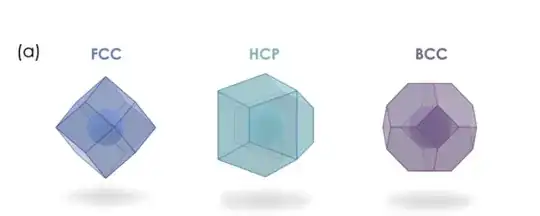
image

(This image came from this link.)

However, I don't know the name of the polyhedron. What is the name of polyhedron?

Also, according to Wkipedia, a convex polyhedron that can be translated without rotations to fill Euclidean space is a Parallelohedron and they list five solids. However, I think the Wigner–Seitz cell of HCP also must be in the list. Why is this solid not defined as a parallelohedron?

kipf
  • 2,531
  • 1
    It looks to be made of rhombi and trapezoids ... Conveniently, a web search for "polyhedron rhombus trapezoid" turns up "Trapezo-rhombic dodecahedron". – Blue May 26 '25 at 15:50
  • @Blue Thank you for your answer! It seems right! and I can also solve my one other question from the web-page you linked. the trapezo-rhombic dodecahedron should be rotated for space-filling, which is not obey the definition of parallelohedron. – guensik min May 26 '25 at 15:57
  • Glad to help! :) ... You should convert your comment to a self-answer (since you took the additional step of resolving the parallelohedron issue). This will get your question out of the Unanswered queue. ... Cheers! – Blue May 26 '25 at 16:28

1 Answers1

0

Not a parallelohedron because you don't have a lattice; the points in any hexagonal layer are not in the same environment as those in the layer immediately above and below. Only points in alternating layers are fully equivalent.

So you would need to join two of your hcp cells to make a parallelohedron. One of the polyhedra is cenrered on a point in some layer; the other, rotated 60° or 180° from the first about the threefold axis, is centered on a point in an adjacent (nonequivalent) layer.

Oscar Lanzi
  • 48,208