10

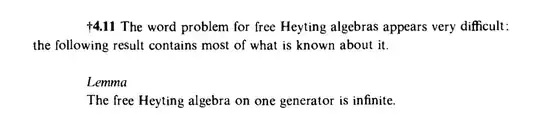
I was reading the wikipedia page for heyting algebras, and it made the claim that "it is unknown whether free complete heyting algebras exist". It came unsourced, but by tracking the edit I was able to source the claim to page 34~35 of Stone Spaces by Johnstone, where he says something which I can see how it got interpreted in that way, but is decidably not making that claim (I have pasted a copy of what Johnstone says below). In any case, I deleted the line from wikipedia for being poorly sourced and moved on.

But thinking about it, I tried looking further to see if someone else somewhere has said that it is not known whether Free Complete Heyting Algebras exist, but I can't find any information. It would make sense that they would (as frames are CHAs, and free frames are known to exist (i.e: see Section 4.4 in Topology via Logic)), but I can't find anyone discussing it. Does anyone know if they are known to exist? or if they are not known to exist, and in which case what trouble we run into?

(here is what Johnstone says, for context).
[Johnstone's first claim.1 (Then after proving this claim, this is left as an exercise) Johnstone's second claim
Glubs
  • 324
  • Thanks for the Wikipedia sleuthing and corrections – MJD Apr 27 '25 at 12:40
  • 4
    Frames "are" complete Heyting algebras only in the sense that every frame has the structure of a complete Heyting algebra and vice versa, in such a way that the two notions of isomorphism coincide. But the notion of homomorphism is different, which means that free frames and free complete Heyting algebras are characterised by different universal properties. – Zhen Lin Apr 27 '25 at 14:06

1 Answers1

15

Yes, it is known: free complete Heyting algebras on two or more generators do not exist. This is a theorem of Dick De Jongh from 1980. See A class of intuitionistic connectives.

A google search for "free complete Heyting algebra" led me to the paper The category of topological spaces and open maps does not have products by Guram Bezhanishvili and Andre Kornell, where they give a new proof of De Jongh's theorem. This is Corollary 4.3 in the arXiv version - I don't have access to the published version.

Alex Kruckman
  • 86,811
  • Thanks so much! I knew something wasn't right about this whole situation. Sorry my searching skills are subpar. – Glubs Apr 27 '25 at 22:16