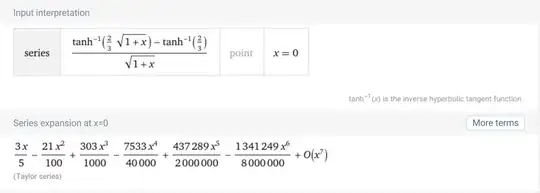
I was messing around with Wolfram Alpha and eventually found the following surprising fact:
\begin{align*}\frac{\tanh^{-1}(\frac23\sqrt{1+x})-\tanh^{-1}(\frac23)}{\sqrt{1+x}}={}&\frac35x-\frac{21}{100}x^2+\frac{303}{1000}x^3-\frac{7\,533}{40\,000}x^4\\&+\frac{437\,289}{2\,000\,000}x^5-\frac{1\,341\,249}{8\,000\,000}x^6+O(x^7)\end{align*}
So many powers of ten! What's happening? Why are they here?
If we call this function $f(x)$, it seems that perhaps $f(10x)$ is the exponential generating function of some integer sequence. That is, it seems that $f(10x)=\sum_{n=0}^\infty c_n\frac{x^n}{n!}$ for some integer sequence $c_n$. Why would this be?
(Even then we should expect the denominator of the sixth term to be $6!\cdot10^6$ rather than the much smaller $8\cdot10^6$.)
It may be useful to know that $$\frac{\tanh^{-1}(\frac23\sqrt{1+x})}{\sqrt{1+x}}=\int_0^1\frac2{1+4t-4xt^2}dt$$ though I don't immediately see how that helps (I see very few $10$s here).
EDIT: The function $f(x)$ also satisfies the differential equation $$2(1+x)f'(x)+f(x)=\frac6{5-4x}$$ with boundary condition $f(0)=0$, if that's useful.