There should be no closed form but you could write $y$ as a different series, in terms of Fresnal integral or error functions, or use some close approximations. The representation via Fresnal integral or the error function brings $y$ into a more familiar form, the series expansion further makes work "easier" and approximations possible and with approximations the possible long calculation times could be avoided.
Solution via Fresnel integrals
Using one definition of the Fresnel integrals $\operatorname{C}\left( x \right) := \int_{0}^{x} \cos\left( t^{2} \right)\, \operatorname{d}t$ let's us simplify the equation:
\begin{align*}
y\left( x \right) &= \int \cos\left( x \right) \cdot \int \cos\left( x^{2} \right)\, \operatorname{d}x\, \operatorname{d}x = \int \cos\left( x \right) \cdot \left( \operatorname{C}\left( x \right) + \text{c}_{1} \right)\, \operatorname{d}x\\
&= \int \cos\left( x \right) \cdot \operatorname{C}\left( x \right)\, \operatorname{d}x + \int \cos\left( x \right) \cdot \text{c}_{1}\, \operatorname{d}x = \int \cos\left( x \right) \cdot \operatorname{C}\left( x \right)\, \operatorname{d}x + \text{c}_{1} \cdot \int \cos\left( x \right)\, \operatorname{d}x\\
&= \int \cos\left( x \right) \cdot \operatorname{C}\left( x \right)\, \operatorname{d}x + \text{c}_{1} \cdot \sin\left( x \right) + \text{c}_{2}\\
\end{align*}
We can rewrite $\int \cos\left( x \right) \cdot \operatorname{C}\left( x \right)\, \operatorname{d}x$ to $\int \cos\left( x \right) \cdot \operatorname{C}\left( x \right)\, \operatorname{d}x = \int_{0}^{x} \cos\left( t \right) \cdot \operatorname{C}\left( t \right)\, \operatorname{d}t + \text{c}_{3}$. Using integration by parts gives us:
\begin{align*}
I_{1} &:= \int_{0}^{x} \cos\left( t \right) \cdot \operatorname{C}\left( t \right)\, \operatorname{d}t = \left[ \int \cos\left( t \right) \, \operatorname{d}t \cdot \operatorname{C}\left( t \right) \right]_{0}^{x} - \int_{0}^{x} \int \cos\left( t \right) \, \operatorname{d}t \cdot \operatorname{C'}\left( t \right)\, \operatorname{d}t\\
&= \left[ \sin\left( t \right) \cdot \operatorname{C}\left( t \right) \right]_{0}^{x} - \int_{0}^{x} \sin\left( t \right) \cdot \cos\left( t^{2} \right)\, \operatorname{d}t = \sin\left( x \right) \cdot \operatorname{C}\left( x \right) - \sin\left( 0 \right) \cdot \operatorname{C}\left( 0 \right) - \int_{0}^{x} \sin\left( t \right) \cdot \cos\left( t^{2} \right)\, \operatorname{d}t\\
&= \sin\left( x \right) \cdot \operatorname{C}\left( x \right) - \int_{0}^{x} \sin\left( t \right) \cdot \cos\left( t^{2} \right)\, \operatorname{d}t\\
\end{align*}
Integral-calculator.com can give you as step by step solution for $\int \sin\left( t \right) \cdot \cos\left( x^{2} \right)\, \operatorname{d}x$ (note: the site uses a different normalization then Wikipedia). Using $\sin\left( x \right) \cdot \cos\left( y \right) = \tfrac{\sin\left( x + y \right) - \sin\left( x - y \right)}{2}$ (Product-to-sum identity) let's us rewrite $\int \sin\left( t \right) \cdot \cos\left( x^{2} \right)\, \operatorname{d}x = \int \frac{\sin\left( x^{2} + x \right) - \sin\left( x^{2} - x \right)}{2}\, \operatorname{d}x = \frac{1}{2} \cdot \left( \int \sin\left( x^{2} + x \right)\, \operatorname{d}x - \int \sin\left( x^{2} - x \right)\, \operatorname{d}x \right)$. Let $I_{2} := \int \sin\left( x^{2} + x \right)\, \operatorname{d}x$ and $I_{3} := \int \sin\left( x^{2} - x \right)\, \operatorname{d}x$, then completing the square gives us $I_{2} = \int \cos\left( \left( x + \frac{1}{2} \right)^{2} - \frac{1}{4} \right)\, \operatorname{d}x$ and $I_{3} = \int \sin\left( \left( x - \frac{1}{2} \right)^{2} - \frac{1}{4} \right)\, \operatorname{d}x$. Substituting $t_{1} := x + \frac{1}{2} \Leftrightarrow \operatorname{d}t_{1} = \operatorname{d}x$ and $t_{2} := x - \frac{1}{2} \Leftrightarrow \operatorname{d}t_{2} = \operatorname{d}x$ gives us $I_{2} = \int \cos\left( t_{1}^{2} - \frac{1}{4} \right)\, \operatorname{d}t_{1}$ and $I_{3} = \int \sin\left( t_{2}^{2} - \frac{1}{4} \right)\, \operatorname{d}t_{2}$. Using $\sin\left( x - y \right) = \cos\left( x \right) \cdot \sin\left( y \right) - \cos\left( x \right) \cdot \sin\left( y \right)$ (angle addition identity) gives us:
\begin{align*}
I_{2} &= \int \sin\left( t_{1}^{2} - \frac{1}{4} \right)\, \operatorname{d}t_{1} = \int \left( \sin\left( t_{1}^{2} \right) \cdot \cos\left( \frac{1}{4} \right) - \cos\left( t_{1}^{2} \right) \cdot \sin\left( \frac{1}{4} \right) \right)\, \operatorname{d}t_{1}\\
&= \cos\left( \frac{1}{4} \right) \cdot \int \sin\left( t_{1}^{2} \right)\, \operatorname{d}t_{1} - \sin\left( \frac{1}{4} \right) \cdot \int \cos\left( t_{1}^{2} \right)\, \operatorname{d}t_{1}\\
&= \cos\left( \frac{1}{4} \right) \cdot \operatorname{S}\left( t_{1} \right) - \sin\left( \frac{1}{4} \right) \cdot \operatorname{C}\left( t_{1} \right)\\
I_{3} &= \int \sin\left( t_{2}^{2} - \frac{1}{4} \right)\, \operatorname{d}t_{2} = \int \left( \sin\left( t_{2}^{2} \right) \cdot \cos\left( \frac{1}{4} \right) - \cos\left( t_{2}^{2} \right) \cdot \sin\left( \frac{1}{4} \right) \right)\, \operatorname{d}t_{2}\\
&= \cos\left( \frac{1}{4} \right) \cdot \int \sin\left( t_{2}^{2} \right)\, \operatorname{d}t_{2} - \sin\left( \frac{1}{4} \right) \cdot \int \cos\left( t_{2}^{2} \right)\, \operatorname{d}t_{2}\\
&= \cos\left( \frac{1}{4} \right) \cdot \operatorname{S}\left( t_{2} \right) - \sin\left( \frac{1}{4} \right) \cdot \operatorname{C}\left( t_{2} \right)\\
\end{align*}
where $\operatorname{S}\left( x \right) := \int_{0}^{x} \sin\left( t^{2} \right)\, \operatorname{d}t$ is another Fresnal integral. Re-substituting everything gives us:
$$\fbox{$
y\left( x \right) = \cos\left( \frac{1}{4} \right) \cdot \frac{\operatorname{S}\left( x - \frac{1}{2} \right) - \operatorname{S}\left( x + \frac{1}{2} \right)}{2} + \sin\left( \frac{1}{4} \right) \cdot \frac{\operatorname{C}\left( x + \frac{1}{2} \right) - \operatorname{C}\left( x - \frac{1}{2} \right)}{2} + \left( \text{c}_{1} + \operatorname{C}\left( x \right) \right) \cdot \sin\left( x \right) + \text{c}_{2}
$}$$
You can compare the plots here on Desmos. You can write the Fresnal integrals in terms of Error functions if you like that more.
Other series solution
We know $y\left( x \right) = \int \cos\left( x \right) \cdot \int \cos\left( x^{2} \right)\, \operatorname{d}x\, \operatorname{d}x$. The Equation is transformable into a linear ODE of second order, so we can assume two initial conditions $y\left( 0 \right) =: y_{0}$ and $y'\left( 0 \right) =: y_{1}$. The Taylor series of $y$ around $x = 0$ is definiend by $y\left( x \right) = \sum_{k = 0}^{\infty}\left[ \frac{y^{\left( k \right)}\left( 0 \right)}{k!} \cdot x^{k} \right]$. Taking the derivatives:
\begin{align*}
y\left( x \right) &= \int \cos\left( x \right) \cdot \int \cos\left( x^{2} \right)\, \operatorname{d}x\, \operatorname{d}x\\
y'\left( x \right) &= \cos\left( x \right) \cdot \int \cos\left( x^{2} \right)\, \operatorname{d}x\\
y''\left( x \right) &= \cos'\left( x \right) \cdot \int \cos\left( x^{2} \right)\, \operatorname{d}x + \cos\left( x \right) \cdot \cos\left( x^{2} \right)\\
&~~\vdots\\
y^{\left( k \right)}\left( x \right) &= \sum\limits_{g = 0}^{k}\left[ \binom{k}{g} \cdot \cos^{\left( k - g \right)}\left( x \right) \cdot \operatorname{D}_{x}^{g}\left[ \int \cos\left( x^{2} \right)\, \operatorname{d}x \right] \right]\\
\end{align*}
where $\operatorname{D}_{x}^{g} := \frac{\operatorname{d}^{g}}{\operatorname{d}x^{g}}$. You can that formula by induction or by using the general Leibniz rule. It's trivial that $\operatorname{D}_{x}^{g}\left[ \int \cos\left( x^{2} \right)\, \operatorname{d}x \right] = \operatorname{D}_{x}^{g - 1}\left[ \cos\left( x^{2} \right) \right]$ and by using Faà di Bruno's formula we get ($f\left( x \right) := x^{2}$):
\begin{align*}
\operatorname{D}_{x}^{g - 1}\left[ \cos\left( x^{2} \right) \right] &= \sum\limits_{n = 0}^{g - 1}\left[ \cos^{\left( n \right)}\left( f\left( x \right) \right) \cdot \operatorname{B}_{g - 1,\, n}\left( f^{\left( 1 \right)}\left( x \right),\, f^{\left( 2 \right)}\left( x \right),\, \ldots,\, f^{\left( g - 1 - n + 1 \right)}\left( x \right) \right) \right]\\
\end{align*}
We know $f^{\left( n \right)}\left( x \right) = \begin{cases} \frac{2}{\left( 2 - n \right)!} \cdot x^{2 - n},\, &\text{for } n \leq 2\\ 0,\, &\text{for } n > 2\\ \end{cases}$ (you can see the proof here) and $\cos^{\left( n \right)}\left( x \right) = \cos\left( x + \frac{n}{2} \cdot \pi \right)$ which is also discused here. So (for $k \geq 2$):
\begin{align*}
y^{\left( k \right)}\left( x \right) &= \sum\limits_{g = 0}^{k}\left[ \binom{k}{g} \cdot \cos\left( x + \frac{k - g}{2} \cdot \pi \right) \cdot \sum\limits_{n = 0}^{g - 1}\left[ \cos\left( x^{2} + \frac{k - g}{2} \cdot \pi \right) \cdot \operatorname{B}_{g - 1,\, n}\left( 2 \cdot x,\, 2,\, \ldots,\, 0 \right) \right] \right]\\
y^{\left( k \right)}\left( 0 \right) &= \sum\limits_{g = 0}^{k}\left[ \binom{k}{g} \cdot \cos\left( \frac{k - g}{2} \cdot \pi \right) \cdot \sum\limits_{n = 0}^{g - 1}\left[ \cos\left( \frac{n}{2} \cdot \pi \right) \cdot \operatorname{B}_{g - 1,\, n}\left( 0,\, 2,\, \ldots,\, 0 \right) \right] \right]\\
\end{align*}
Approximation
We can say $\int_{0}^{x} \cos\left( t^{2} \right)\, \operatorname{d}t \approx \sqrt{\frac{\pi}{8}} + \frac{\sin\left( x^{2} \right)}{\sqrt{2 \cdot \pi} \cdot x} \wedge x \geq 1$ (see formula $11$ here). It follows $y\left( x \right) = \int \cos\left( x \right) \cdot \int \cos\left( x^{2} \right)\, \operatorname{d}x\, \operatorname{d}x \approx \int \cos\left( x \right) \cdot \left( \text{c}_{1} + \frac{\sin\left( x^{2} \right)}{\sqrt{2 \cdot \pi} \cdot x} \right)\, \operatorname{d}x = \text{c}_{1} \cdot \sin\left( x \right) + \int \frac{\cos\left( x \right) \cdot \sin\left( x^{2} \right)}{\sqrt{2 \cdot \pi} \cdot x}\, \operatorname{d}x$. We could use this for numeric integration. We could also rewrite the solution in terms of Fresnal integrals (if we use formula $12$ too) to:
\begin{align*}
y\left( x \right) &\approx \cos\left( \frac{1}{4} \right) \cdot \frac{\frac{\cos\left( \left( x + \frac{1}{2} \right)^{2} \right)}{\sqrt{2 \cdot \pi} \cdot \left( x + \frac{1}{2} \right)} - \frac{\cos\left( \left( x - \frac{1}{2} \right)^{2} \right)}{\sqrt{2 \cdot \pi} \cdot \left( x - \frac{1}{2} \right)}}{2} + \sin\left( \frac{1}{4} \right) \cdot \frac{\frac{\sin\left( \left( x + \frac{1}{2} \right)^{2} \right)}{\sqrt{2 \cdot \pi} \cdot \left( x + \frac{1}{2} \right)} - \frac{\sin\left( \left( x - \frac{1}{2} \right)^{2} \right)}{\sqrt{2 \cdot \pi} \cdot \left( x - \frac{1}{2} \right)}}{2} + \left( \text{c}_{1} + \sqrt{\frac{\pi}{8}} + \frac{\sin\left( x^{2} \right)}{\sqrt{2 \cdot \pi} \cdot x} \right) \cdot \sin\left( x \right) + \text{c}_{2}\\
\end{align*}
This is a little plot for this approximation ($c_{1} := 0.1 \wedge c_{2} := 0$): The red line is the Solution via Fresnel integrals minus it's value at zero and the blue line is the approximation.
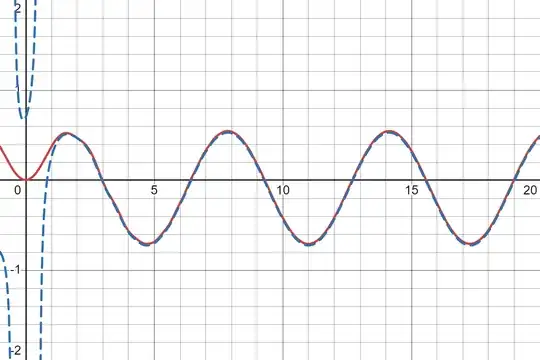
You can check it here on Desmos.


