1. Question Restatement to Reference its Equations and Link
We know the global maxima of the function
$$f\left(n,x\right)
=\frac{\sin(nx)}{\sin(x)} \text{ is } n $$ $$\tag{Eq. 1.1}$$
(thanks to this question), but what is the global maxima of
$$g\left(n,a,x\right)
=\frac{\sin(n(x+a))}{\sin(x+a)} + \frac{\sin(n(x-a))}{\sin(x-a)}, \text{ where $a$ is a constant term?}$$ $$\tag{Eq. 1.2}$$
Not stated directly, but instead by the linked reference, of course $n \in
\{\text{Set of Integers}\}$ and $n>0$. The $n$ positive integer requirement results in a finite series in the answer.
Notice that $g(n,a,-x)=\frac{\sin(n(-x+a))}{\sin(-x+a)} + \frac{\sin(n(-x-a))}{\sin(-x-a)}=
\frac{\sin(n(-x+a))}{\sin(-x+a)} + \frac{\sin(n(x+a))}{\sin(x+a)}$ $=
\frac{\sin(n(x-a))}{\sin(x-a)} + \frac{\sin(n(x+a))}{\sin(x+a)}$, so that $g(n,a,x)=g(n,a,-x)$ and $g$ is an even function of $x$. That means that locally $g$ can be expanded as an even Taylor series in $x$, being $g(n,a,x)\approx g_0+g_1\,x+g_2\,x^2+...$. But since $g$ is even in $x$ then $g_1\to 0$ and only $g(n,a,x)\approx g_0+g_2\,x^2+...$ with a local minimum or maximum at $x=0$.
2. Solution Steps
All of the graphs show that a maximum occurs at $x=0$. But why?
From the article Prove that $\sin n\theta=n\sin \theta-\frac{n(n^2-1)}{3!}\sin^3\theta+\frac{n(n^2-1)(n^2-3^2)}{5!}\sin^5\theta+\cdots$. From the answer given by Paramanand Singh is quoted:
$$\sin n\theta = n\sin \theta - \frac{n(n^{2} - 1^{2})}{3!}\sin^{3}\theta + \frac{n(n^{2} - 1^{2})(n^{2} - 3^{2})}{5!}\sin^{5}\theta - \cdots\tag{2}$$
Thus for $\sin n\theta$ all terms are divisible by $\sin \theta$, even in the limit that $\theta \to 0$ but not of course for $\theta=0$. Now the quantity $\frac{\sin n \theta}{\sin \theta}$ can be calculated:
$$\frac{\sin n \theta}{\sin \theta}
=n - \frac{n(n^{2} - 1^{2})}{3!}\sin^{2}\theta + \frac{n(n^{2} - 1^{2})(n^{2} - 3^{2})}{5!}\sin^{4}\theta - \cdots$$
Similarly,
$$\frac{\sin n \left(x+a\right)}{\sin \left(x+a\right)}
=n - \frac{n(n^{2} - 1^{2})}{3!}\sin^{2}\left(x+a\right) + \frac{n(n^{2} - 1^{2})(n^{2} - 3^{2})}{5!}\sin^{4}\left(x+a\right) - \cdots$$
And,
$$\frac{\sin n \left(x-a\right)}{\sin \left(x-a\right)}
=n - \frac{n(n^{2} - 1^{2})}{3!}\sin^{2}\left(x-a\right) + \frac{n(n^{2} - 1^{2})(n^{2} - 3^{2})}{5!}\sin^{4}\left(x-a\right) - \cdots$$
So,
$$
\frac{\sin n \left(x+a\right)}{\sin \left(x+a\right)}+
\frac{\sin n \left(x-a\right)}{\sin \left(x-a\right)}
=
n - \frac{n(n^{2} - 1^{2})}{3!}\sin^{2}\left(x+a\right) + \frac{n(n^{2} - 1^{2})(n^{2} - 3^{2})}{5!}\sin^{4}\left(x+a\right) - \cdots
\\+
n - \frac{n(n^{2} - 1^{2})}{3!}\sin^{2}\left(x-a\right) + \frac{n(n^{2} - 1^{2})(n^{2} - 3^{2})}{5!}\sin^{4}\left(x-a\right) - \cdots
$$
$$\tag{Eq. 2.2}$$
Now evaluate the derivative of the quantity
$sin^{2\,m}\left(x+a\right)+sin^{2\,m}\left(x-a\right)$ at $x \to 0$ using the Taylor Series Expansion for $\sin\left(y\right) \to y-\frac1{6}y^3+...$ :
$$\left.\frac{d}{d\,x}
\left(
sin^{2\,m}\left(x+a\right)+sin^{2\,m}\left(x-a\right)
\right)\right|_{x\to 0}
=$$
$$\to \left. \left(
n \left(x+a\right)^{2\,m-1}+\left(\text{Higher Order Terms of x}\right)+
n \left(x-a\right)^{2\,m-1}+\left(\text{Higher Order Terms of x}\right)
\right)\right|_{x\to 0}$$
Given that $2m-1$ is always odd then *the terms in $a$ cancel in the limit $x\to 0$, resulting in a maximum there since $n>0$ and it is an integer. This is the same result as in the graphs which all show the global maximum at $x=0$. Note that both $\sin\left(n\,x\right)$ and $\sin\left(x\right)$ over a period of $x \to q\,2\pi$, where $q$ is some arbitrary integer. However, the global maximum value itself does not change.
The maximum is simply $g_{maxiumum}=g |_{x=0}$:
$$g\left(n,a,x\right)_{maximum}
=\left.\left(
\frac{\sin(n(x+a))}{\sin(x+a)} + \frac{\sin(n(x-a))}{\sin(x-a)}
\right)\right|_{maximum\,x\to 0}$$
The maximum is given by:
$$
\boxed{g\left(n,a,x\right)_{maximum}
\to \left.\left(
\frac{\sin(n(a))}{\sin(+a)} + \frac{\sin(n(-a))}{\sin(-a)}
\right)\right|_{maximum\,x\to 0} \to
\left. \left(2\,\frac{\sin(n(a))}{\sin(a)}\right)\right|_{maximum\,x\to 0}
}
$$
Note: that this result was referencing the graphs in the question that all had local maxima at $x=0$. A local minimum is also possible at $x=0$.
3. Example plot of $
y=\frac{\sin\left(4\cdot\left(x+1\right)\right)}{x+1}+\frac{\sin\left(4\cdot\left(x-1\right)\right)}{x-1}
$with $n=4$ and $a=1$
In the comments section, there is a link to the plot of
$$
y=\frac{\sin\left(4\cdot\left(x+1\right)\right)}{x+1}+\frac{\sin\left(4\cdot\left(x-1\right)\right)}{x-1}
$$
The Desmos plots of the same equations show a difference as pictured (and quoted) below:
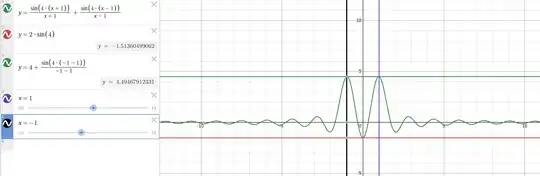
Looking at the equations within the above plot, it is easy to see what is happening. The function $g$ is at a minimum at $x=0$. In this case there are two maxima, one at $g=a$ and the other at $g=-a$. Plugging either of these and taking the appropriate limit results in the maximum for $g$ just like the equations in the linked plot. Comparing the result for $g$ between $x=0$ and $x=a$ allows for determining the absolute maximum.
4. Maxima Discussion for $y=g\left(n=6,a=1.5,x\right)_{maximum}
=\left.\left(
\frac{\sin(n(x+a))}{\sin(x+a)} + \frac{\sin(n(x-a))}{\sin(x-a)}
\right)\right|_{n=6,a=1.5}
$
When $n>0$ as in this case, then the maximum or maxima are positive. Also, since $g(n,a,x)$ is an even function, then for the purposes of calculating the second derivative $g(n,a,x)$ can be approximated as a Taylor series (where $g_1=0$ since g is an even function) for the first powers of $x$ as:
$$g(n,a,x)\approx g_0 + g_2\,x^2+\,\text{Higher order powers of x}$$
$$\tag{Eq. 4.1}$$
which according to Equation 2.2 is:
$$
\begin{align}
\frac{\sin n \left(x+a\right)}{\sin \left(x+a\right)}+
\frac{\sin n \left(x-a\right)}{\sin \left(x-a\right)}
&=\\
&= n - \frac{n(n^{2} - 1^{2})}{3!}\sin^{2}\left(x+a\right) + \\
&+ \frac{n(n^{2} - 1^{2})(n^{2} - 3^{2})}{5!}\sin^{4}\left(x+a\right) - \cdots +\\&+
n - \frac{n(n^{2} - 1^{2})}{3!}\sin^{2}\left(x-a\right) + \\ &+\frac{n(n^{2} - 1^{2})(n^{2} - 3^{2})}{5!}\sin^{4}\left(x-a\right) - \cdots
\end{align}
$$
$$\tag{Quoted Eq. 2.2}$$
Applying the Taylor expansion for $\sin x \approx x +\, \text{Higher order terms of $x$}\, $ then:
$$
\begin{align}
\frac{\sin n \left(x+a\right)}{\sin \left(x+a\right)}+
\frac{\sin n \left(x-a\right)}{\sin \left(x-a\right)}
&\approx\\
&\approx
n - \frac{n(n^{2} - 1^{2})}{3!}\sin^{2}\left(x+a\right) +\cdots \\
&+ n - \frac{n(n^{2} - 1^{2})}{3!}\sin^{2}\left(x-a\right) +\cdots \\
\end{align}
$$ $$\tag{4.2}$$
$$
\frac{\sin n \left(x+a\right)}{\sin \left(x+a\right)}+
\frac{\sin n \left(x-a\right)}{\sin \left(x-a\right)}
\approx
n - \frac{n(n^{2} - 1^{2})}{3!}\left(x+a\right)^2 +\cdots
+ n - \frac{n(n^{2} - 1^{2})}{3!}\left(x-a\right)^2 +\cdots
\\ \approx 2\,n-2\,\frac{n(n^{2} - 1^{2})}{3!}\left(x^2+a^2\right)+\cdots
$$
$$
\begin{align}
\frac{d^2}{d\,x^2}\left.\left(
\frac{\sin n \left(x+a\right)}{\sin \left(x+a\right)}+
\frac{\sin n \left(x-a\right)}{\sin \left(x-a\right)}
\right)\right|_{x \to 0}
&\approx
\frac{d^2}{d\,x^2}\left.
\left(
2\,n-2\,\frac{n(n^{2} - 1^{2})}{3!}\left(x^2+a^2\right)+\cdots
\right)\right|_{x\to 0}
\\ &\approx \left.
\left(
-2\frac{n(n^{2} - 1^{2})}{3!}\left(1\right)+\cdots
\right)\right|_{x\to 0}
\end{align}$$
$$\tag{Eqs. 4.3}$$
When the second derivative in Equation 4.3 is negative, then there is a local maximum at $x=0$ since in this case $g_2$ in Equation 4.1 $g(n,a,x)\approx g_0 + g_2\,x^2+\,\text{Higher order powers of x}$ is negative, indicating locally around $x\to 0$ an upside down parabola. The other case, occurs when there is a local minimum at $x=0$, in which case there are two maxima for $g(n,a,x)$, each of equal value since $g(n,a,x)$ is an even function of $x$.
Thus the result is to calculate two values, and take the maximum of the two of them to be the global maximum for $n > 0$ of course. Because all of the minima of $\frac{sin n\,x}{x}$ are less in magnitude than $n$, the maxima (if two) for $g(n,a,x)$ are always positive as for $g(n,a,x=0)$.
5. Maxima Calculation for $y=g\left(n=6,a=1.5,x\right)_{maximum}
=\left.\left(
\frac{\sin(n(x+a))}{\sin(x+a)} + \frac{\sin(n(x-a))}{\sin(x-a)}
\right)\right|_{n=6,a=1.5}
$
Consider now the problem referenced in the comments section:
$$g\left(n=6,a=1.5,x\right)
=\frac{\sin(6\cdot (x+1.5))}{\sin(x+1.5)} + \frac{\sin(6\cdot (x-1.5))}{\sin(x-1.5)}$$ $$\tag{Eq. 5.1}$$
To determine the global maximum,
$g(6,1.5,x)$ needs to be evaluated at two limits,
$x\to 0$ and
$x\to 1.5$ to find for which of these limits
$g(6,1.5,x)$ is a global maximum. Of course, if
$g(6,1.5,x)$ turns out to be the maximum between the two, then because
$g$ is an even function of
$x$, then there are actually two maxima, each of equal value, namely
$g_{maximum\,1}=g_{maximum\,2}=g(6,1.5,x)\lim_{x\to 1.5}$.
Hence, Equation 5.1 is first evaluated (using
$sin()$ with
$()$ being Radians) for the limit
$x\to 0$:
$$g_1\left(n=6,a=1.5,x \to 0\right)
=\left.
\frac{\sin(6\cdot (x+1.5))}{\sin(x+1.5)} + \frac{\sin(6\cdot (x-1.5))}{\sin(x-1.5)}\right|_{\lim x \to 0}=$$
$$
=\frac{\sin(6\cdot (1.5))}{\sin(1.5)} + \frac{\sin(6\cdot (-1.5))}{\sin(-1.5)}=0.549 \, \text{from the Desmos online calculator}
$$
$$g_2\left(n=6,a=1.5,x \to 1.5\right)
=\left.
\frac{\sin(6\cdot (x+1.5))}{\sin(x+1.5)} + \frac{\sin(6\cdot (x-1.5))}{\sin(x-1.5)}\right|_{\lim x \to 1.5}=$$
$$
=\frac{\sin(6\cdot (3))}{\sin(3)} + 6=5.749670917743
\,\,\text{And $g_2=5.749670917743$ is the expected }\textbf{maximum}.
$$
$$\tag{Eqs. 5.2}$$
6. Plots for $y=g\left(n=6,a=1.5,x\right)_{maximum}
=\left.\left(
\frac{\sin(n(x+a))}{\sin(x+a)} + \frac{\sin(n(x-a))}{\sin(x-a)}
\right)\right|_{n=6,a=1.5}
$
Consider now the problem referenced in the comments section:
$$g\left(n=6,a=1.5,x\right)
=\frac{\sin(6\cdot (x+1.5))}{\sin(x+1.5)} + \frac{\sin(6\cdot (x-1.5))}{\sin(x-1.5)}$$ $$\tag{Reference to Eq. 5.1}$$
Let
$g\to y$ and plot it accordingly in two dimensions using the Desmos plotter resulting in the following quoted plot:
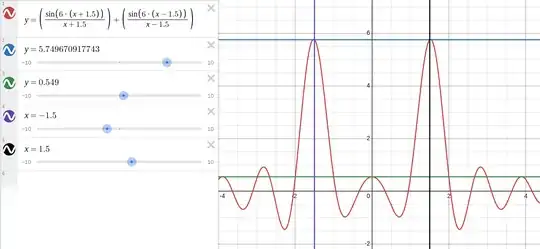
The equations used in the above plot were as follows:
$$
y=\left(\frac{\sin\left(6\cdot\left(x+1.5\right)\right)}{x+1.5}\right)+\left(\frac{\sin\left(6\cdot\left(x-1.5\right)\right)}{x-1.5}\right)\\
y=5.749670917743\,\text{ , }\,
y=0.549\,\text{ , }\,
x=-1.5\,\text{ , and }\,
x=+1.5
$$
$$\tag{Eqs. 5.1}$$
As can be seen, the results are as expected, with $y_{maximum}=5.749670917743$ which occurs at $x=-1.5$ and also the same value at $x=1.5$. Also, at $x=0$ there is a local maximum of $y_{x=0}=0.549$, but this is not a global maximum. That is why the two values need to be compared to arrive at the final result.


