Step 1. Developing from the beta function identity as pointed out by OP,
$$
\frac{1}{k\binom{n}{k}}
= \int_{0}^{1} t^{k-1}(1-t)^{n-k} \, \mathrm{d}t
= \int_{0}^{\infty} \frac{u^{k-1}}{(1+u)^{n+1}} \, \mathrm{d}u
$$
where we applied the substitution $u = \frac{t}{1-t}$. Summing both sides for $k = 1, 2, \ldots, n$,
$$
\begin{align*}
S_n := \sum_{k=1}^{n} \frac{1}{k\binom{n}{k}}
&= \int_{0}^{\infty} \sum_{k=1}^{n} \frac{u^{k-1}}{(1+u)^{n+1}} \, \mathrm{d}u \\
&= \int_{0}^{\infty} \frac{1 - u^n}{(1 - u)(1+u)^{n+1}} \, \mathrm{d}u \\
&= \text{PV}\!\!\int_{0}^{\infty} \frac{1}{(1 - u)(1+u)^{n+1}} \, \mathrm{d}u - \text{PV}\!\!\int_{0}^{\infty} \frac{u^n}{(1 - u)(1+u)^{n+1}} \, \mathrm{d}u \\
&= 2 \, \text{PV}\!\!\int_{0}^{\infty} \frac{1}{(1 - u)(1+u)^{n+1}} \, \mathrm{d}u, \tag{1}
\end{align*}
$$
where we applied the substitution $u \mapsto \frac{1}{u}$ in the last line.
Step 2. Now let $f(z) = \frac{1}{(1 - z)(1+z)^{n+1}}$ be the integrand in $\text{(1)}$, and let $\operatorname{Log}(z)$ denote the complex logarithm with the branch satisfying $\operatorname{Arg}(z) \in [0, 2\pi)$. We then consider the residue computation
$$
\frac{1}{2\pi i} \int_{\mathcal{C}} f(z) \operatorname{Log}(z) \, \mathrm{d}z = \mathop{\underset{z=-1}{\text{Res}}} f(z)\operatorname{Log}(z) \tag{2}
$$
along the keyhole contour $\mathcal{C}$src)
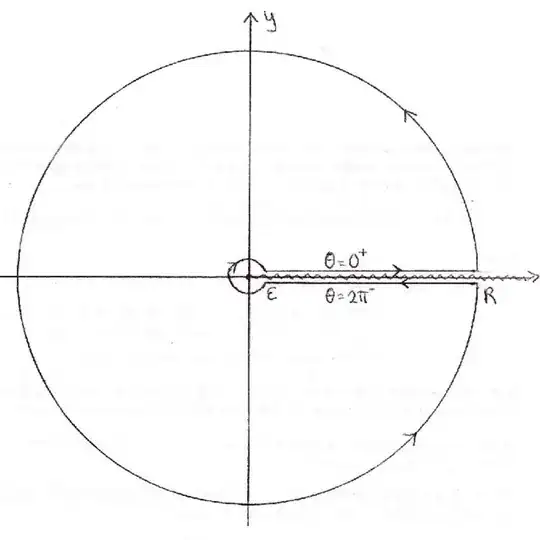
wrapping the positive $x$-axis. Letting the outer radius $R \to \infty$ and using the fact that the jump size across the branch cut satisfies
$$ {\color{blue}{\operatorname{Log}(x + 0^+i)}} - {\color{red}{\operatorname{Log}(x + 0^-i)}} = -2\pi i$$
for $x > 0$, the identity $\text{(2)}$ reduces to
$$
\begin{align*}
\mathop{\underset{z=-1}{\text{Res}}} f(z)\operatorname{Log}(z)
&= \frac{1}{2\pi i} \int_{0}^{\infty} f(z)[{\color{blue}{\operatorname{Log}(z + 0^+i)}} - {\color{red}{\operatorname{Log}(z + 0^-i)}}] \, \mathrm{d}z \\
&= -\text{PV}\!\!\int_{0}^{\infty} f(z) \, \mathrm{d}z - \frac{1}{2} \, \mathop{\underset{z=1}{\text{Res}}} \, (2\pi i) f(z).
\end{align*}
$$
(The half-residue comes from lower part of the keyhole contour in the vicinity of $z = 1$.) Hence,
$$
\begin{align*}
\text{PV}\!\!\int_{0}^{\infty} f(z) \, \mathrm{d}z
&= - \mathop{\underset{z=-1}{\text{Res}}} f(z)\operatorname{Log}(z) - \frac{1}{2} \mathop{\underset{z=1}{\text{Res}}} (2\pi i) f(z) \\
&= - \mathop{\underset{w=0}{\text{Res}}} \frac{i\pi + \log(1-w)}{(2 - w) w^{n+1}} - i \pi \mathop{\underset{w=0}{\text{Res}}} \frac{1}{(-w)(2+w)^{n+1}}
\end{align*}
$$
Since the left-hand side is real, the same is true for the right-hand side, leading to the equality
$$
\begin{align*}
\text{PV}\!\!\int_{0}^{\infty} f(z) \, \mathrm{d}z
&= - \mathop{\underset{w=0}{\text{Res}}} \frac{\log(1-w)}{(2 - w) w^{n+1}}
= -[w^n]\frac{\log(1-w)}{(2 - w)} \\
&= [w^n]\left( \sum_{j=0}^{\infty} \frac{w^j}{2^{j+1}} \right)\left( \sum_{k=1}^{\infty} \frac{w^k}{k} \right)
= \sum_{k=1}^{n} \frac{1}{k 2^{n+1-k}}.
\end{align*}
$$
Finally, plugging this back into $\text{(1)}$ completes the proof.


