8

Recently I am reading a book by Arnol'd et. al.. In this text I did not find the definition of discriminant $\Delta(a,b,c,d)$ :

Arnold

I wonder what is the meaning of the discriminant here ? The following is the discriminant of the cubic.

cubic

I also found some clues. For instance: $$x^3 + a x^2 y + b x y^2 + y^3 = y^3 ( t^3 + a t^2 + b t +1), \quad \mbox{for}\ \ t = x/y,$$

then $Δ(a, b)≠0$ means the cubic $t^3 +a t^2 + b t +1 = 0$ in t has no multiple roots.

But I still do not know what is the counterpart for $\Delta(a,b,c,d)$ ?

You can just give some directions.

The reference is the book, Page 253.

Blue
  • 83,939
cbi
  • 155
  • Hi, is it possible to let us know the reference? – Siong Thye Goh May 04 '24 at 05:36
  • @SiongThyeGoh Ok. – cbi May 04 '24 at 07:49
  • It could simply mean that $a,b,c,d$ are all distinct where they are the roots of a quartic polynomial. – Somos May 05 '24 at 00:48
  • Which textbook has this ? That will give us more clues. It will enable us to give better answers. We have various Discriminants hence we must know which Particular Discriminant we are talking about. – Prem May 06 '24 at 11:04
  • @Prem The reference is in the end of the question. – cbi May 06 '24 at 12:10
  • Section 8.3 of Tignol's book "Galois' Theory of Algebraic Equations" is dedicated to the concept of discriminants. This book serves as an excellent resource for those interested in Galois' Theory and equations. I hope you will find it helpful. – Kaique Roberto May 07 '24 at 05:49
  • @KaiqueRoberto Thanks! – cbi May 07 '24 at 11:34
  • You did not give us enough context to determine the meaning of an isolated equation. Please do you in your question. Currently there is an expression in variables $x,y,z,u$ with coefficients that depend on $a,b,c,d$ but no clue what that expression is supposed to mean. – Somos May 09 '24 at 23:14

2 Answers2

3

I have good news & bad news.

The good news is that there is a method to get the Discriminant.
The bad news is that the eventual expression is going to be impractical & very hard to write out. We might have to use math Software.

(ACTION A) I would suggest you to check the earlier sections of that text to Explain/Define what a "Discriminant" is , according to Arnold et al.

(ACTION B) In case there is no mention of such Definitions , you can check this :
"Discriminants, Resultants and Multidimensional Determinants"
Authors : I.M. Gelfand , M.M. Kapranov , A.V. Zelevinsky
Publisher : Birkhauser Boston 1994

There it is given that Discriminant is a Polynomial in the co-efficients of $V(x_0,x_1,\cdots,x_n)$ where all the Partial Derivatives vanish.

In your Case , it gives :
$\partial V / \partial x = 0$
$\partial V / \partial y = 0$
$\partial V / \partial z = 0$
$\partial V / \partial u = 0$
$V=0$

Hence , we have :
$3x^2+3a(ax+by+cx+dz)^2+eyzu=0$
$3y^2+3b(ax+by+cx+dz)^2+exzu=0$
$3z^2+3c(ax+by+cx+dz)^2+exyu=0$
$3u^2+3d(ax+by+cx+dz)^2+exyz=0$
$x^3+y^3+z^3+u^3+(ax+by+cx+dz)^3+exyzu=0$

Solving this for $x,y,z,u$ , we will get some expression in terms of $a,b,c,d,e$ , which is the Discriminant here.
It will be highly cumbersome & impractical to even write it out here. Tools like Matlab / Maple / Mathematica / Macaulay can easily generate such Discriminant values automatically.

[[ Either Arnold text has a typo & it should have been $\Delta(a,b,c,d,e)$ or Authors have calculated it & checked that $e$ is unnecessary there ]]

(ACTION C) In Case that text is hard reading , I have this alternate reference , which is easy reading :
"Discriminants, resultants, and their tropicalization"
Course by Bernd Sturmfels - Notes by Silvia Adduci

Here Single variable Case is initially considered : when a function is $0$ & the Derivative is also $0$ , it implies multiple roots.
That Criteria easily gives us the Discriminants $\Delta (a,b,c)=b^2-4ac$ (Quadratic Case) & $\Delta (a,b,c,d)=27a^2d^2-18abcd+4ac^3+4b^3d-c^2d^2$ (Cubic Case)

Compare that with a Cubic Polynomial in 3 variables $x,y,z$ : According to Bernd & Silvia , it will 10 Co-efficients in Homogeneous Case & the Discriminant $\Delta$ will have 2040 terms!!!!

Hence , Arnold has not written out the Discriminant $\Delta$ when it is a function of 4 variables : it must have been a staggering expression , though automatic tools can easily compute that.

ADDENDUM :

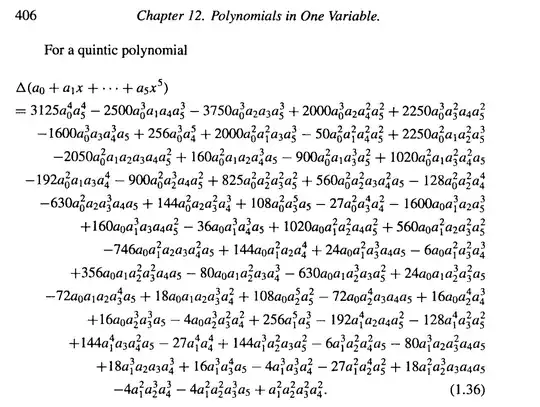
I thought I might include a snippet from Gelfand et al Page 405 :
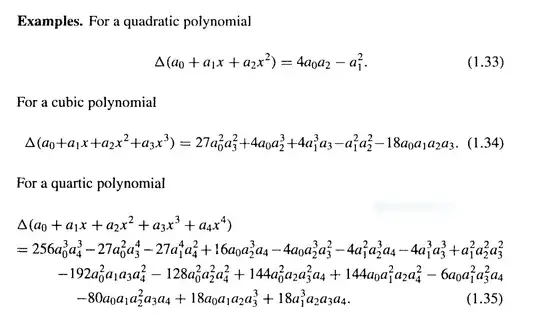
quadratic cubic quartic

Here is Page 406 :
quintic

Naturally , Arnold has not given the Discriminant $\Delta$ expressions for most such cases !!!!

Prem
  • 14,696
  • It might be a bad question but can you please explain the intuition and the aim behind taking partial derivatives? Thanks in advance. – bruno May 10 '24 at 21:15
  • Thanks! Action B is what I want. For the equation on $(x,y,z,u)$, we are supposed to solve it over $\mathbb{C}^4$ right? I want to check the case $a=b=c=d=-1$ and $e=0$, I think the discriminant is nonzero. – cbi May 11 '24 at 03:01
  • @bruno Maybe I did not provide enough information, my bad. You can check the reference. – cbi May 11 '24 at 03:11
  • 1
    Single-variable : $y = 0$ & $dy/dx = 0$ have common root when $y$ has repeated roots , which is a "Singularity" : Similarly Multi-variable : $z = 0$ & $\partial z / \partial x =0$ & $\partial z / \partial y = 0$ indicates a "Singularity" , @bruno , More Details are available online eg https://en.wikipedia.org/wiki/Singular_point_of_an_algebraic_variety – Prem May 11 '24 at 05:50
  • You might have to try it out , may be with Math Software or may be manually , @cbi , though I think ( I am not sure ) that making $e=0$ will change the Series Classification given by Arnold et al. – Prem May 11 '24 at 05:54
0

Here you can read the general definition of the discriminant of a polynomial you might be looking for, together with examples, properties and reference problems. It also includes some of the examples you mention. I hope it will help.

https://artofproblemsolving.com/wiki/index.php/Discriminant

fspa
  • 569
  • 3
  • 13