2

I asked this question to my calculus teacher and it was a frustrating experience, basically he would say, over and over again, that a tangent line at a point is a line that goes through that point and has a slope equal to the instantaneous slope of the curve at that point. I understand that, I really do, but that is not what I was asking. This all started because, geometrically, a tangent touches the circle once vs a secant touches the circle twice. This of course is no longer the case with any random curve, so I was wondering what is the difference geometrically between a secant line and a tangent line, given that they both can touch the curve multiple times. After thinking about it for a bit, I came up with one possible geometric definition for tangent of a curve, and I would like for you guys to tell me if this is ok and equivalent to the usual definition with derivatives.

So let $f(x)$ be a curve and $t(x)$ be a line. We say $t(x)$ is a tangent to $f(x)$ at point $x_0$ iff:

  1. $f(x_0) = t(x_0)$
  2. $(\exists \delta > 0)(\forall x \in \mathbb{R})(0 < \mid x - x_0 \mid < \delta \implies t(x) > f(x))$ or $(\exists \delta > 0)(\forall x \in \mathbb{R})(0 < \mid x - x_0 \mid < \delta \implies t(x) < f(x))$

In other words, a line is tangent to a curve at a point if it goes through that point and also if you look close enough (for some arbitrarily small $\delta$), all of the points of the line, except for the tangency point, are either on one side of the curve or the other (hence why I wrote two statements one with $t(x) > f(x)$ and another one with $t(x) < f(x)$).

This definition doesn't work for lines, since the tangent of a line is the line itself and this definition wouldn't allow that, but at least for the case of curves, what do you guys think? Can I modify it so that it works for lines too? I am thinking of changing the $<$ and $>$ for $\leq$ and $\geq$ maybe that would make it work for lines. Regardless of whether that definition works or not, it is an example of what I mean when I say "a more geometrical definition of tangent line".

zlaaemi
  • 1,535
  • For a curve given by polynomials, like $y-x^3=0,$ the tangent cone is the terms of lowest degree, here $y=0.$ A second example: the Trott curve where we shift the point $(1,0)$ on the curve to the origin: $144((x+1)^4+y^4)-225((x+1)^2+y^2)+350(x+1)^2y^2+81=0$ expanding gives $\ldots +126x=0$ so that the tangent cone is $x=0.$ This means that for the original curve, where we shift back, the line $x-1=0$ is tangent there. And finally for the nodal curve $y^2=x^2(x+1)$ or $-x^3-x^2+y^2=0$ with tangent cone $-x^2+y^2=(-x+y)(x+y)=0$ giving both tangents at the origin. – Jan-Magnus Økland Apr 06 '24 at 15:44
  • Well, The issue comes up with saddle points and sharp corners and what we mean by tangent. A tangent line in our mind's eye is a line that gentle touches the curve but then the curve gently bends away so the line touches exactly once. This assumes the curve is uniformly concave or convex and smooth. If the curve has a saddle point then a line that touches gently and matches slope and goes through as the curve changes convexity is not tangent. Meanwhile any of the infnite lines that teeter totter on a sharp point would be. .... to be continued.... – fleablood Apr 06 '24 at 16:04
  • 1
    You run into further problems with rapidly oscillating curves. Try $$f(x)=\begin{cases} x^2\sin(1/x), & x\ne 0 \ 0, & x=0\end{cases}.$$ – Ted Shifrin Apr 06 '24 at 16:07
  • It seems to me that the concept of tangent is that it gently lands and grazes and take off is more pertinent than that it doesn't cross sides. And I really think the only way to express that concept is if the a tangent line is where the slopes match. – fleablood Apr 06 '24 at 16:08
  • 1
    This answer to this post explains why the answer to your title question is *No*, and it uses the same rapidly oscillating example as in the comment just above. – Lee Mosher Apr 06 '24 at 16:15
  • Also, I see that in your comments to this answer below you say that you would not call the line $y=0$ a tangent line to $f(x)=x^3$. That being so, it highlights the vagueness of your question: What *do* you mean by tangent line? – Lee Mosher Apr 06 '24 at 16:19
  • @LeeMosher Because to me it doesn't make sense to call a line that goes through a tangent. To me, a line is tangent if by zooming in sufficiently you find that it doesn't go through the curve and it only touches it at the point of tangency. After reading the replies in here I realize this doesn't match with the standard definition of tangent. Maybe it's just a waste of time to argue this further to be honest, since to me it just feels like a misnomer to call $y = 0$ a tangent of $f(x) = x^3$ at $x_0 = 0$. Unless of course, there is a really good reason why we call that line a tangent. – zlaaemi Apr 06 '24 at 16:33
  • Okay, but in that case I have to vote to close your post for lack of clarity. Asking for a "really good reason" for a choice of terminology is not a mathematical question, it is instead a question of linguistics. – Lee Mosher Apr 06 '24 at 16:44
  • One thing to keep in mind: when a mathematical concept models a "real world" phenomena, such as a graph drawn on a piece of paper, the precision of the mathematical concept can sometimes be anti-intuitive. The intuition test of the model should not be whether it matches our a priori intuition. It should instead be that by further understanding the model and how it applies to real world situations, our intuition can be adequately adjusted. If you put in the work to study calculus for a while, I think that may happen for you. – Lee Mosher Apr 06 '24 at 16:45
  • @LeeMosher I don't see why the post should be closed, the question that I asked in the OP that others have already answered was valid and clear. The questions I have now, after reading the replies, of wanting to know a really good reason for the terminology was not the question in the OP. It's just what I would like to know now. Also a discussion about why a concept is defined as it is can be very mathematical, no just linguistics. – zlaaemi Apr 06 '24 at 16:50
  • @LeeMosher Either way, I wouldn't mind if it gets closed since I now know my answers: No, there is no geometrical intuition based definition of tangent and No, you definition of tangent doesn't match with the standard definition using derivatives. Those were the two questions I wanted answered when I made the post. – zlaaemi Apr 06 '24 at 16:52
  • Maybe of interest: https://math.stackexchange.com/questions/1495100/can-someone-provide-the-formal-definition-of-the-tangent-line-to-a-curve – Andrew D. Hwang Apr 06 '24 at 17:12

7 Answers7

2

If you consider the curve $y=x^3$ then by your definition there would be no tangent line at the point $(0,0)$ on the curve. With the standard definition there is a tangent through this point, namely $y=0$.

quarague
  • 6,505
  • The more so, $y=(( -(x+1)^3,x.<-1) ,( 0,-1<=x<=1) , ((x-1)^3 , x:>1 )$ with more than one point on the tangents $y=0$ – Roland F Apr 06 '24 at 15:06
  • You can make it even more extreme $f(x)=x^3\sin(1/x)$ for $x \neq 0$ and $f(0) = 0$. Then the tangent does not cross just one, but infinitely many points. – ioveri Apr 06 '24 at 15:23
  • Yes, as another poster said, it doesn't work for inflection points. My dilemma is that I can't make sense of what a tangent line is at an inflection point, I mean the line $y = 0$ isn't what I would normally call a tangent of $f(x) = x^3$. I can accept it as a generalization using derivatives, but it doesn't make intuitive sense to call that a tangent at least for me. – zlaaemi Apr 06 '24 at 15:48
  • Also if $f(x) = |x|$ then at $x=0$ there an infinite many lines $y = mx$ where $-1< m < 1$ that satisfy. Not just one. I call these "teeter-totter" lines. – fleablood Apr 06 '24 at 16:11
  • "My dilemma is that I can't make sense of what a tangent line is at an inflection point," What the heck is wrong with "a line that at the moment of contact has an equal slope"? Why is that a difficulty and why is that not an adequate definition? – fleablood Apr 06 '24 at 16:12
  • @fleablood The reason is because it doesn't match with my intuitive idea that a tangent line doesn't go through the curve. I mean, I can accept it and just move on, but something feels off for me. The only way I can accept it without feeling amiss is if someone gives me a really good reason why we should call a line that goes through the curve a tangent, instead of just saying that there is no tangent at inflection points (even though there is derivative). – zlaaemi Apr 06 '24 at 16:18
  • Maybe I have a highly tactile sense of geometry but for me to imagine a line as a straight bar of steel and a curve as a rail road track and I'm told "place the bar on the track so that $x=x_0$ is the single point of contact" it's very easy for me to imagine. Okay if I have steel passing through railroad track at an inflection curve... that's okay as it's only the point of contact I care about. The whole material can turn to mist at all the other points as far as I care. Is that... difficult to picture...? For me it is obvious. – fleablood Apr 06 '24 at 16:18
  • 2
    Then change your concept. It's not that a tangent line doesn't go through. It's that a tangent "kisses" and "skis" and "meld" with the curve in just the right slope alignment. After all "tangent" is just a word and it can mean anything we want. – fleablood Apr 06 '24 at 16:21
1

Your definition does not work for any inflection point; that is, points where the second derivative is zero. Consider $\sin(x)$ at the origin.

Jbag1212
  • 1,698
  • Thanks, I can see that now. Would it be safe to assume that for non inflection points, this definition and the usual definition coincide? – zlaaemi Apr 06 '24 at 15:38
  • @zlaaemi I think an example of a rapidly oscillating function was given. More importantly: how would you define what an inflection point is if you are trying to avoid the usual concept of “derivative=slope”? – Jbag1212 Apr 06 '24 at 16:54
1

With your definition, a linear function would not be differentiable at any point, which is pretty odd to me. Indeed, one motivation to consider the tangent line at a point is to approximate a curve by a line near that point.

Taladris
  • 12,203
  • 5
  • 35
  • 61
0

See here and here. Try implementing derivatives into your definition.

This is also a duplicate, see here.

wasu
  • 109
  • Thanks for the links, however they mostly talk about stuff we already saw in class, about using the limit as $h$ approaches $0$. I was looking for something more akin to the definition I proposed. I wouldn't say it's a duplicate of that post since I also provided my own attempt at a definition of tangent and asked for feedback, which that post doesn't do. – zlaaemi Apr 06 '24 at 15:43
  • @zlaaemi What exactly are you looking for? Your attempt doesn't seem more "geometric" than the standard definition. Anyways, try $t'(x)$ and $f'(x)$. :) – wasu Apr 06 '24 at 15:52
  • What my attempt essentially says is that, for it to be a tangent line, it must not go through the curve and only be equal at the tangency point. This is exactly the same as the geometrical definition of tangent of a circle, it doesn't go through it and only touches at one point. The only difference is that the geometry definition requires this condition on the entire curve (the tangent can only touch the entire circle once), whereas my attempt at generalizing it only requires this at a neighborhood of points that can be arbitrarily small. Hence why I call it a "more geometrical" approach. – zlaaemi Apr 06 '24 at 16:09
  • But it's never going to work because non-circular curves have completely different properties than circles. Circles are finite in size and uniform concavity. curves in general are not. That a tangent line doesn't pass through on a circle is of no consequence and utterly irrelevant. The only relevance is that at the moment of contact the slopes are equal. To insist that it can penetrate a curve because it can't penetrate a circle, is like me insisting all polygons must have four sides because a square does. – fleablood Apr 06 '24 at 16:58
0

The notion of a tangent line, representing a line that intersects the graph of a function at a single point, is typically applied locally within the function's domain. However, in a global context, this tangent line may intersect the curve elsewhere, which introduces complexity when dealing with arbitrary curves. To ensure the tangent line touches the function's graph at precisely one point, constraints on the functions and sets under consideration are necessary. Which I guess is the problem you are encountering.

$\textit{Convexity}$ is the key concept. A set $C$ is $\textit{convex}$ if $tx_1 + (1-t)x_2 \in C$ whenever $x_1,x_2 \in C$ and $t \in (0,1)$, or in words: any line segment connecting two points within the set lies entirely within it (Image taken from Wikipedia). enter image description here

A function $f$ is $\textit{convex}$ if its domain, $\text{dom}(f)$, is a convex set and if for all $x_1,x_2 \in \text{dom}(f)$, and $t \in (0,1)$, it holds that \begin{equation}\label{convexity} f(tx_1 +(1-t)x_2) \leq t f(x_1) +(1-t)f(x_2). \end{equation} or in words: for all points within its domain, the function value lies below the line connecting any two points. This condition holds true for convex functions, while $\textit{strictly convex}$ functions enforce strict inequality in this relationship. A line is a convex function but not a strictly convex function. So the idea of tangent lines touching the graph of a function at a single point works for strictly convex functions.

enter image description here

In higher dimensions, the concept of a tangent line is generalized by the concept of $\textit{supporting hyper-planes}$ to sets $C$. If you want to learn more about the idea of tangency and convexity I recommend reading $\textit{Convex Analysis}$ by R. Tyrrell Rockafellar, this is an excellent book.

ConEd
  • 124
  • 1
    Thanks! I'll be sure to check out convex analysis once I am better prepared, right now it seems a little too advanced for me. – zlaaemi Apr 06 '24 at 17:13
0

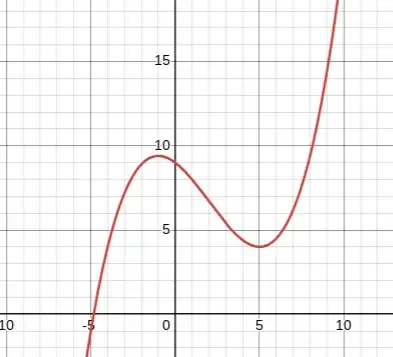
Here's one way you can visualize it. If you have a function, for example...

$f(x)=\frac{1}{20}(x+4)(x-5)^2+4$

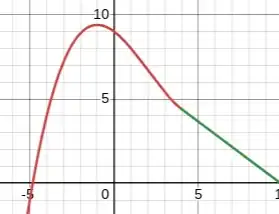
and you want to find the tangent line at the point $(4,f(4))$, then imagine that the portion of the graph to the right of $x=4$ was erased, and try to draw a straight line that continues the slope of $f(x)$:

$\Rightarrow$$\Rightarrow$$\Rightarrow$$\Rightarrow$

Now extend the straight line and $f(x)$ to their full domains:

As you can see, even though the tangent line intersects $f(x)$ at more than one point, it is still tangent to the graph at $x=4$ because it follows the instantaneous slope of $f(x)$ at that point. But on a general scale, you could consider the green line as both secant and tangent to $f(x)$.

For reference, here is the Desmos graph I made: https://www.desmos.com/calculator/lmgxmx6u63

VV_721
  • 799
0

The most geometric definition of the tangent line to a curve is the one originally used by Leibniz (and probably before him). Namely, take two infinitely close (but distinct) points on the curve, and draw the (unique) line through those two distinct points. The resulting line is indistinguishable from the tangent line, in the sense that if one writes its equation as $\bar ax+\bar by=\bar c$ with $\bar a^2+\bar b^2=1$ (which can always be done via normalisation), the tangent line will have equation $ax+by=c$ where $a$ is the standard part of $\bar a$, and similarly for $b, c$. This approach needs neither derivatives nor slopes.

Mikhail Katz
  • 47,573