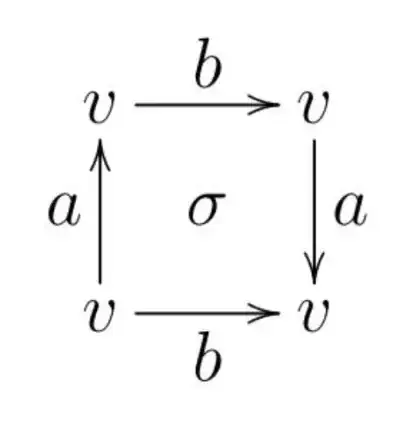
I've seen this but didn't really understand the answer. So here is what I tried:
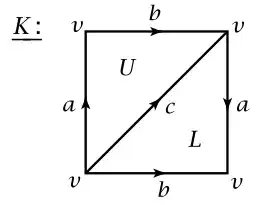
According to this picture we have one 0-simplex - $[v]$, two 1-simplices - $[v,v]_a,[v,v]_b$ and two 2-simplices - $[v,v,v]_U,[v,v,v]_L$.
The chain complexes
$C_0=\{nv:n\in\Bbb{Z}\}, C_1=\{n[v,v]_a+m[v,v]_b+k[v,v]_c:n,m,k\in\Bbb{Z}\}, C_2=\{n[v,v,v]_U+m[v,v,v]_L:n,m\in\Bbb{Z}\}$.
Boundary maps
$∂_0=0, ∂_1([v,v]_a)=[v]-[v]=0$,
$∂_2([v,v,v]_U)=[v,v]_a+[v,v]_b-[v,v]_c=[v,v]_a$ and $∂_2([v,v,v]_L)=[v,v]_a-[v,v]_b+[v,v]_c=[v,v]_a$.
I think $\operatorname{Im}∂_2$ is the set of multiples of $[v,v]$ which is isomorphic to $\Bbb{Z}$ but I'm not sure about this. Once I know $\operatorname{Im}∂_2$ it's easy to calculate $\ker{∂_1}/\operatorname{Im}∂_2=H_1(K)$ as $\ker{∂_1}=\Bbb{Z}^3$.
Could you explain what is $\operatorname{Im}∂_2$?