10

Find the possible remainders of $(1-3i)^{2009}$ when divided by $13+2i$ in $\mathbb{Z}[i]$.

I'm having a hard time understanding remainders in $\mathbb{Z}[i]$. I'm gonna write my solution to the problem above just to give some context, but you can skip this part and read the question below if you want. We start by noticing that $N(13+2i) = 173$, which is a prime number. Therefore, $13+2i$ is irreducible in $\mathbb{Z}[i]$. This allows us to quickly calculate the number of elements of the multiplicative group $(\mathbb{Z}[i]/(13+2i))^{\times}$, namely $N(13+2i) - 1 = 172$. By Lagrange's Theorem, since $1-3i$ and $13+2i$ are coprime, $$(1-3i)^{11\cdot 172} \equiv 1\mod(13+2i).$$ We now reduced the problem to finding $(1-3i)^{117} \mod (13+2i)$. Note that $117 = 3^2\cdot 13$, so by a tedious but direct calculation (once we figure out $(1-3i)^{3^2}$ modulo $13+2i$ we get a nice expression, so the $13$th power is relatively straightforward to compute), we arrive at $6-2i$.

Question: Remainders in $\mathbb{Z}[i]$ are not uniquely determined and, from my understanding, there are $4$ possible choices. It is not difficult to find different remainders when we are working with small numbers and can test various quotients. In this case, however, how would I determine the other possible choices? Are they somehow related? For instance, when I was calculating $(1-3i)^{3} = -26+18i$, I found that $$(1-3i)^{3} = (-2+i)(13+2i) + (2+9i) = (-1+2i)(13+2i) + (-9-6i).$$ The remainders above have norms $N(2+9i) = 85$ and $N(-9-6i) = 117$. I thought they would have to be associates, but the example above shows they are not and, even worse, $\operatorname{gcd}(85, 117) = 1$.

huh
  • 1,017
  • 1
    I am confused by $N(13+2i)$ is a prime, therefore irreducible; is that a theorem? Isn't $N(5)$ a prime, but is clearly reducible, $5=(2+i)(2-i)$. I think the $i$ is throwing you off, maybe it would be better to use $x$, in general the remainder should be of less degree than the divisor (which would be all real I would think). – Bobby Ocean Feb 24 '24 at 02:14
  • 1
    $N(5)$ is the norm, so $N(5) = 5^2$. – huh Feb 24 '24 at 02:16
  • Oh right, is that a theorem? I also thought about my second comment, the polynomial is $x^2+1$ so the remainder would be linear not constant. – Bobby Ocean Feb 24 '24 at 02:18
  • Something is wrong. I thought remainders from polynomial division are always unique. Are you sure your calculations are correct? I see that $(13+2j)^3 = (2041+1006j)$, that appears to be different than what you have. – Bobby Ocean Feb 24 '24 at 02:21
  • You're confusing the Gaussian integers with polynomial rings. The euclidean division in a polynomial ring $K[X]$ is given by the degree of the polynomial (when $K$ is a field). In $\mathbb{Z}[i]$ the euclidean function is $N(a+ib) = a^2 + b^2$. – huh Feb 24 '24 at 02:23
  • I'll edit that, it is supposed to be $(1-3i)^3$. – huh Feb 24 '24 at 02:24
  • Sorry, I am still not understanding. You talk about division and remainder of elements in $\mathbb{Z}[i] \approx \mathbb{Z}[x]/<x^2+1>$. What exactly do you mean by "division" and "remainder" if not in the same meaning as polynomial division and remainder? – Bobby Ocean Feb 24 '24 at 02:28
  • Again, as I said in the comment above, euclidean division in a polynomial ring is given by the degree of the polynomial only when $K$ is a field. In fact, $D[X]$ is an euclidean domain if and only if $D$ is a field. It doesn't make sense to talk about division in $\mathbb{Z}[X]$. – huh Feb 24 '24 at 02:33
  • Sure, but that still doesn't tell me what you mean by "remainder"? I am clearly not as familiar with Gaussian integers as you and mistakenly assumed that "remainder" had some obvious meaning, this appears to not be the case. – Bobby Ocean Feb 24 '24 at 02:37
  • https://www.wolframalpha.com/input?i=%281%2B3i%29%5E2009+mod+13%2B2i – Bob Dobbs Feb 24 '24 at 08:02

2 Answers2

3

Posting this because the existing examples I could easily find, indeed, use small numbers only, and that does allow the law of small numbers to kick in and ruin examples (most notably when looking at the remainders modulo $2+i$, when we can always find a remainder of norm $\le1$). Below is how I (and undoubtedly most, if not all, the other teachers) explain remainders in $\Bbb{Z}[i]$.


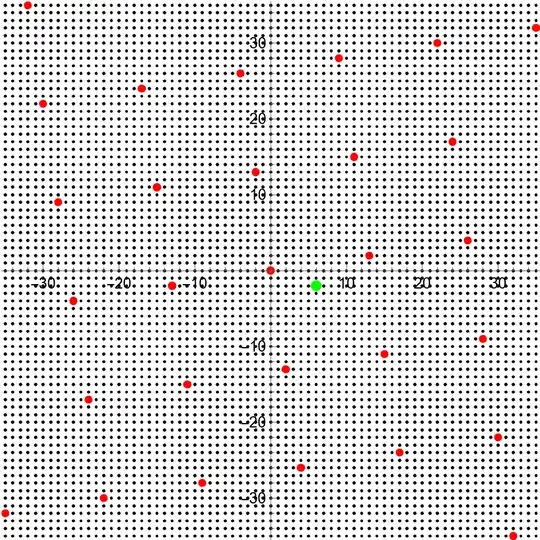
Write $p=13+2i$ for short. Look at the picture:

The black dots are the grid of Gaussian integers. The red dots mark the elements of the ideal generated by $p$. They also form an infinite pattern of repeating squares with sides given (as vectors) by $p$ and $ip=-2+13i$.

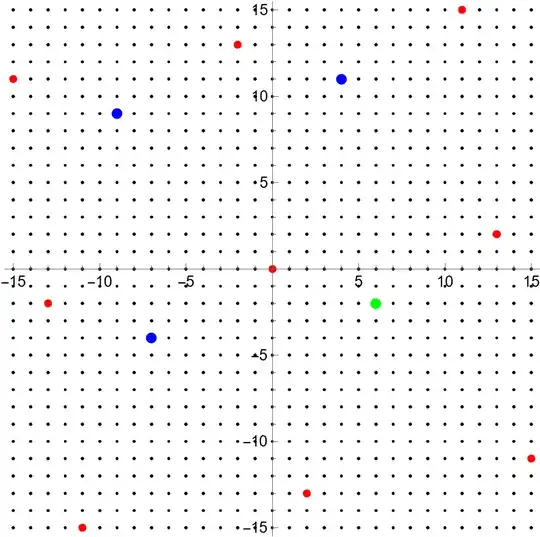
You see that the remainder $r=6-2i$ (marked by a green dot) falls into a square with corners at $0$, $p$, $-ip$ and $(1-i)p$. The four possible remainders are the separation of $r$ from each of these: $r=6-2i$, $r-p=-7+4i$, $r+ip=4+11i$, and $r-(1-i)p=-9+9i$. All of those happen to have norms $<173$, but this is only because the green dot is not very close to any of the four corners.

It may be even more natural to see where those alternative remainders lie on the plane. You see, they are elements of the coset $r+p\Bbb{Z}[i]$, each in one of the "red" squares touching the origin. The alternatives are marked by blue dots in the accompanying (enlarged) figure below with their coset relation hopefully apparent.


You asked about the norms of the alternative remainders. There is no need for them to be equal. This does not hold in $\Bbb{Z}$ either. When you find the remainder of $a$ modulo $b>0$, the alternatives are $r\in[0,b-1]$ and $r-b$, and more often than not $|r|\neq |r-b|$. It won't surprise me if we can find a relation tying the norms of the four possible remainders together, after all they are the distances from a point inside a square to the four corners. But I don't recall one right away.


As has been explained earlier on this site, the difference between $\Bbb{Z}$ and $\Bbb{Z}[i]$ is that in the case of integers there are only "two regions of remainders touching the origin" as opposed to four. Furthermore, in the integer case we can (artificially) only use one of them (=the non-negative remainders) as no point within is too far from the origin. Here the size of the dividend is the length of the side of the square, and we need to exercise a modicum care not to pick remainder too close to an opposite corner.

Jyrki Lahtonen
  • 140,891
  • Typically teachers use only smaller numbers when explaining this in class. That's why I posted. The theme has been discussed earlier, but I couldn't find pictures. Will delete, if a good duplicate visualizing the idea is located. – Jyrki Lahtonen Feb 24 '24 at 07:37
  • Thank you! Your explanation really cleared things up for me. Now I've got a better grasp on what's going on geometrically in $\mathbb{Z}[i]$. – huh Feb 24 '24 at 20:18
2

The map $\mathbb{Z}\hookrightarrow \mathbb{Z}[i]$ induces an isomorphism of fields

$$\mathbb{Z}/173 \simeq\mathbb{Z}[i]/(13+2i)$$

So we could work with representatives in $\mathbb{Z}$, which is sometime easier. By the above $ {80}\mapsto i$, and $107\mapsto 1-3i$. Note that $107$ is a primitive root $\mod 173$.

About remainders : it seemed to me that for the Gaussian integers the remainder of $a \in \mathbb{Z}[i]$ $\mod b$ is obtained as follows: consider a closest element $b q$ of $b \mathbb{Z}[i]$ to $a$. Then $b$ will be the "quotient", and the remainder is $a- b q$. In the case $N(b)$ odd, the closest element is unique, and so is the remainder. (We need the closest so the Euclidean algorithm works). Note that one could do the closest multiple also in $\mathbb{Z}$ ( so the remainder is at most half of the divisor, in absolute value).

Example:

1.

$$\frac{107}{13+2i} = \frac{1391}{173} -\frac{214}{173}i$$

2.

$$(\frac{1391}{173}, -\frac{214}{173})\simeq(8,-1)$$

3.

$$107 - (13+2i)(8-i) = 1-3i$$

Therefore, the remainder of $107$ under division by $(13+2i)$ is $1-3i$.

Now we can complete the answer, working mod $173$. We have

4. $$107^{2009} \equiv 19 \pmod {173}$$

5.

$$\frac{19}{13+2i} = \frac{247}{143}-\frac{38}{173}i \simeq 1 - 0 \cdot i$$ (the quotient)

6.

$$19 - (13+2i) \cdot 1 =6-2 i$$

(the remainder)

Note:( $b q$ closest to $a$) is equivalent to ($q$ closest to $\frac{a}{b}$), since multiplication by $b$ increases norms (distances) by $|b|$.

orangeskid
  • 56,630