14

For each $n\in\mathbb{N},$ let $x_n:= \displaystyle\min_{1\leq k < n} \lvert\sin n - \sin k\rvert.\ $ Does $\displaystyle\sum_{n=1}^{\infty} x_n $ converge?

Consider instead, $a_1 = 0,\ a_2=1, a_3 = \frac{1}{2}, a_4 = \frac{1}{4}, a_5=\frac{3}{4}, a_6 = \frac{1}{8}, a_7 = \frac{3}{8},\ldots . $ Then for each $n\in\mathbb{N},$ let $x_n:= \displaystyle\min_{1\leq k < n} \lvert a_n - a_k\rvert.\ $ This is an example of a bounded sequence $(a_n)_{n\in\mathbb{N}}$ with the property that $\displaystyle\sum_{n=1}^{\infty} x_n $ diverges.

The question is: does the convergence of $\displaystyle\sum_{n=1}^{\infty} x_n $ occur if we instead define $(a_n) = (\sin n). $ But it seems unlikely that $\sin$ behaves similar enough to the sequence in the previous paragraph to enable $\displaystyle\sum_{n=1}^{\infty} x_n $ to diverge, although I don't know how to prove this, although it could be as simple as applying a trigonometric identity in a specific way.

Adam Rubinson
  • 24,300
  • 1
    No, because if you look at any 3 consecutive terms you will see that at least one of them is "large". Draw a picture first and then use some simple algebra. – Salcio Jan 15 '24 at 23:55
  • 2
    @Salcio That's false. You may be observed that behavior in the few first terms but that change later. – jjagmath Jan 16 '24 at 11:10
  • 1
    @Salcio It may be the case that for every $n$ there is $N>n$ s.t. $x_N:= \displaystyle\min_{1\leq k < N} \lvert\sin N - \sin k\rvert$ is "large", but this is not clear or obvious, and maybe even false. – Adam Rubinson Jan 16 '24 at 11:21
  • 2
    may be even false - It is false indeed. Natural angles are dense on the circle, so for any $n$ there is $k$ such that $]n-k| \mod 2\pi < \frac{2\pi}{n}$. The question is "how much smaller" it is. The problem feels related to a rational approximation of $2\pi$. – user58697 Jan 16 '24 at 17:54

1 Answers1

1

The series $\sum x_n$ diverges.

First, we may assume $(a_n)$ has all distinct terms. For this, the repeating terms of $(a_n)$ contribute zero toward $\sum x_n$. Let $(a_n)$ be dense in an interval $(a,b)$. We prove that $(x_n)$ constructed by $x_1=0$, $x_n:= \displaystyle\min_{1\leq k < n} \lvert a_n - a_k\rvert$ gives the divergence of $\sum x_n$. Since $a_n=\sin n$ is dense in $(-1,1)$, $\sum x_n$ is divergent.

To see this, assume that $\sum x_n$ converges. Then there is $N\in\mathbb{N}$ such that $\sum_{n>N} x_n < (b-a)/2$.

Let $b_1<\cdots <b_N$ be the numbers $a_1,\ldots, a_N$ in an increasing order. For $a_{N+1}$, it is closest to some number $a_1, \ldots, a_N$. Find the smallest index $k\leq N$ such that $a_{N+1}$ is closest to $a_k$. Then color red over the interval $[\min(a_{N+1},a_k),\max(a_{N+1},a_k)]$. The red interval has the length $x_{N+1}$. We repeat the procedure. Given $a_1,\ldots, a_{N+j}$, Find the smallest index $m\leq N+j$ such that $a_m$ is closest to $a_{N+j+1}$. Then color red over $[\min(a_{N+j+1},a_m),\max(a_{N+j+1},a_m)]$.

In this procedure, the new red interval is either contained in the already existing red interval or extends the already existing red interval. Repeating the procedure for $j\rightarrow\infty$, the red intervals are formed over $b_1,\ldots, b_N$. That is, we have at most $N$ red intervals, each containing some $b_i$.

The following figure is an illustration after $j\rightarrow \infty$ in this procedure. enter image description here
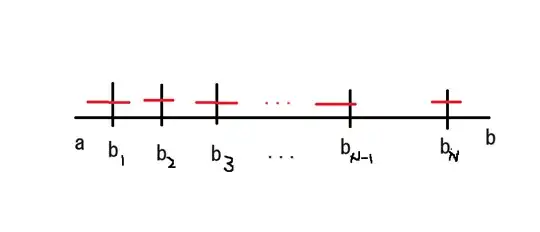
The sum of measures of the red intervals is at most $\sum_{n>N}x_n <(b-a)/2$. Note also that we have at most $N$ disjoint red intervals here (each of those can be any of the forms $(c,d)$, $(c,d]$, $[c,d)$, or $[c,d]$ after $j\rightarrow\infty$ in the process). All members of $\{a_n: n>N\}$ are in the union of these red intervals, and it is dense in $(a,b)$. However, the sum of measures less than $(b-a)/2$ contradicts the density of $(a_n)$.

Sungjin Kim
  • 20,850