1

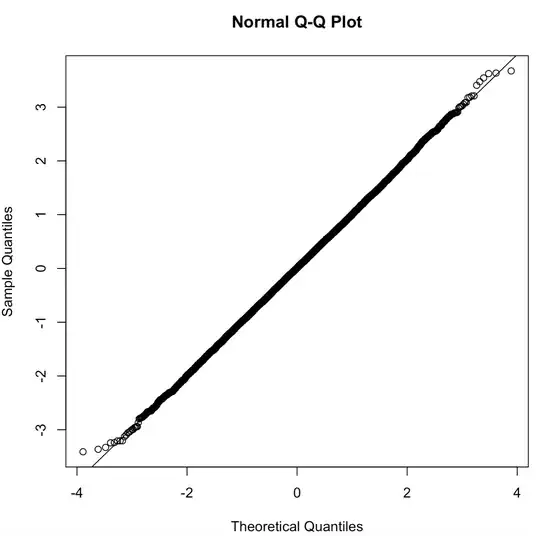
In this answer, it was shown that the product of two i.i.d. standard normal r.v.s is not normally distributed. What if we scale one of them? In other words, if $X, Y \text{ i.i.d } \sim N(0, 1)$, what is the distribution of $Z := X\frac{Y}{|Y|}$? By looking at he distribution function of $Z$ (though I didn't finish the calculation), $Z$ is unlikely to be normal. However, the simulation seems to suggest that $Z$ is normal (the QQ plot of $10,000$ realizations of $Z$ is shown below). Is there a clever way to prove or disprove $Z$ is normally distributed?
Zhanxiong
  • 15,126

2 Answers2

2

Conditional on $Y = y$, $Z$ is $\mathcal N(0,1)$. Since the regular conditional distribution of $Z$ is the same for all $y$, we conclude $Z$ is independent of $Y$. In particular, $Z\sim \mathcal N(0,1)$.

Generalizing, if $X\sim \mathcal N(0,\sigma^2_1),Y\sim \mathcal N(0,\sigma^2_2)$ one still has $Z\sim \mathcal N(0,\sigma_1^2)$. It is easy to see that this fails if $E(Y)\neq 0$.

Zhanxiong
  • 15,126
Andrew
  • 2,257
  • 1
  • 7
  • 13
0

As an alternative method to the accepted answer, the proof can be completed by the following two steps:

  1. $U := Y/|Y|$ takes values $\pm 1$ almost surely, and $P(U = -1) = P(U = 1) = \frac{1}{2}$.
  2. If $P(U = -1) = P(U = 1) = \frac{1}{2}$ and $X \sim N(0, 1)$ are independent, then $UX \sim N(0, 1)$.

Note that property $1$ holds for any r.v. $Y$ such that $P[Y < 0] = P[Y > 0] = 1/2$ (this condition implies that $Y$ has no mass at $0$: as $P[Y = 0] = 1 - P[Y > 0] - P[Y < 0] = 0$ -- it can be seen that the $Y \sim N(0, 1)$ in the OP trivially satisfies this condition). Indeed, \begin{align*} & P[U = 1] = P[Y > 0] = \frac{1}{2}, \\ & P[U = -1] = P[Y < 0] = \frac{1}{2}. \end{align*}

Property 2 holds because for any $x \in \mathbb{R}$: \begin{align*} P[UX \leq x ] &= P[UX \leq x, U = 1] + P[UX \leq x, U = -1] \\ &= P[X \leq x, U = 1] + P[X \geq -x, U = -1] \\ &= P[X \leq x]P[U = 1] + P[X \geq -x]P[U = -1] \tag{by independence} \\ &= \Phi(x) \times \frac{1}{2} + (1 - \Phi(-x)) \times \frac{1}{2} \\ &= \Phi(x). \end{align*}

Zhanxiong
  • 15,126