For any real $x$ and positive integer $n$, is it true that:
$$\left|\sum_{k=1}^n\frac{\sin(kx)}k\right|<2\sqrt{\pi}\quad ?$$
Please justify.
For any real $x$ and positive integer $n$, is it true that:
$$\left|\sum_{k=1}^n\frac{\sin(kx)}k\right|<2\sqrt{\pi}\quad ?$$
Please justify.


Hint:
The sum inside the absolute value is the partial sum of the Fourier series of:
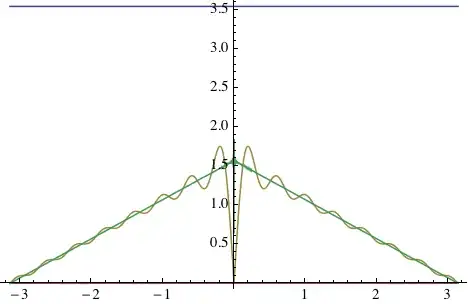
$$y = \frac{\pi}{2} - \frac{x}{2}$$ Gibbs phenomenon tells you that the maximum value of the sum is: $$f(0_+) + \pi\cdot0.08949 = \frac{\pi}{2}+0.08949\pi\sim1.85<2\ll2\sqrt{\pi}$$ So, $2\sqrt{\pi}$ is a very loose bound.
Looks like it. $|\sum_{k=1}^n\frac{\sin(kx)}k|$ is a partial sum of the Fourier series of the function $y=\frac{\pi-|x|}{2}$. Here are the sums for $n$=15 (gold) and $n$=1350 (green) along with the graph of $y=2\sqrt{\pi}$ (blue). Maybe this will help? The Gibbs effect seems to be the only thing that moves the sum anywhere towards $2\sqrt{\pi}$, but does so ever so slightly.