Consider a generic right triangle $\triangle ABC$ right angle at $C$. Define $a := |BC|$, $b := |CA|$, $c := |AB|$ as usual. Let $A'$, $B'$, $C'$ complete external equilateral triangle $\triangle A'BC$, $\triangle AB'C$, $\triangle ABC'$.
It is "known" that lines $AA'$, $BB'$, $CC'$ concur at the Fermat-Torricelli point $T$. Define $p := |TA|$, $q := |TB|$, $r := |TC|$.
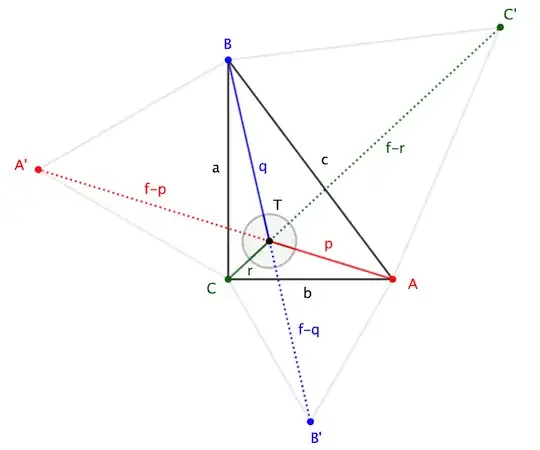
Pivoting $\triangle ACA'$ about $C$ causes it to align with $\triangle B'CB$; likewise at other vertices. This implies $|AA'|=|BB'|=|CC'|$; call the common length $f$. (The length is readily calculated —see Note 3 below— but turns out to be irrelevant here, as it will cancel on the way to the final expression.)
Let's setup a system of equations calculating the areas of "$|\triangle ABC| + \text{equilateral}$":
$$\begin{align}
|\triangle ABC| + |\triangle A'BC| &= |\triangle ABA'|+|\triangle ACA'| = \frac12 f ( q + r )\sin 60^\circ \tag1\\
|\triangle ABC| + |\triangle AB'C| &= \phantom{|\triangle ABA'|+|\triangle ACA'|} = \frac12 f ( r + p )\sin 60^\circ \tag2 \\
|\triangle ABC| + |\triangle ABC'| &= \phantom{|\triangle ABA'|+|\triangle ACA'|} = \frac12 f ( p+q )\sin 60^\circ
\tag3 \end{align}$$
These equations become
$$\begin{align}
2ab + a^2\sqrt{3} &= f ( q+r )\sqrt{3} \tag4\\
2ab + b^2\sqrt{3} &= f ( r+p )\sqrt{3} \tag5 \\
2ab + c^2\sqrt{3} &= f ( p+q )\sqrt{3} \tag6 \end{align}$$
Solving for $p$, $q$, $r$, and simplifying with $a^2+b^2=c^2$ gives
$$
p = \frac{b (a + b \sqrt{3})}{f \sqrt{3}} \qquad
q = \frac{a (a \sqrt{3} + b)}{f\sqrt{3}} \qquad
r = \frac{a b}{f\sqrt{3}} \tag7$$
For the problem at hand, we have $a=4$, $b=3$, $c=5$, so that
$$
p = \frac{3 (4 + 3 \sqrt{3})}{f \sqrt{3}} \qquad
q = \frac{4 (4 \sqrt{3} + 3)}{f\sqrt{3}} \qquad
r = \frac{12}{f\sqrt{3}} \tag8$$
and we can calculate
$$\frac{9q+7r}{p} = \frac{36(4\sqrt{3}+3)+84}{3(4+3\sqrt{3})} = \frac{48(4+3\sqrt{3})}{3(4+3\sqrt{3})}= 16 \tag{$\star$}$$
I suspect there's an easier path to this result.
Note. Writing $(\star)$ as
$$ 9 q + 7 r = 16 p$$
it's interesting that the coefficients on $p$, $q$, and $r$ are $a^2$, $b^2$, and $a+b$ ... but the last of these is a bit of an illusion: it's really $a^2-b^2$ (with the coincidence that $a-b=1$). The general relation might be written as
$$\frac{a^2}{q-r} = \frac{b^2}{p-r} \tag{$\star\star$}$$
Note 2. Even if we don't assume $a^2+b^2=c^2$, we still have that $(1-3)$ hold; the expression for $|\triangle ABC|$ doesn't reduce simply to $\frac12ab$, though.
Okay, so writing $|\triangle ABC|$ as the most-convenient form $\frac12bc\sin A$, $\frac12ca\sin B$, $\frac12ab\sin C$ as needed, we can find that
$$p:q:r \;=\; (1 + \cot A \sqrt3) :
(1 + \cot B \sqrt3) :
(1 + \cot C \sqrt3)$$
If we wanted, we could find $P$, $Q$, $R$ such that
$$Pp+Qq+Rr=0$$
by having the "$1$" terms and "$\sqrt{3}$" terms vanish individually. After some simplification, we find
$$\begin{align}
P:Q:R &\;=\; (\cot B - \cot C) : (\cot C- \cot A) : (\cot A - \cot B) \\
&\;=\; \sin A \sin(B-C): \sin B \sin(C-A) : \sin C \sin(A-B)
\end{align}$$
Note 3. In general, we have
$$f^2 = \frac12\left(a^2+b^2+c^2+4\,|\triangle ABC|\,\sqrt{3}\right)$$


