25

I have recently been thinking about the following question:

Why is $\emptyset$ considered as a set?

The definition of a set is: a well-defined collection of "elements". So my question arose, that $\emptyset$ is well defined but does not contain any elements which should be there according to the set's definition.

Amit Verma
  • 470
  • 4
  • 11
  • 3
    A null set is still a collection of elements. –  Jun 10 '23 at 07:58
  • @IraeVid how is it still a collection of elements? – Amit Verma Jun 10 '23 at 08:00
  • @SassatelliGiulio your language is a bit to strong for me to understand, could you please answer it in an easier way? – Amit Verma Jun 10 '23 at 08:02
  • 17
    I believe the mathematician RL Moore, and perhaps some other mathematicians at that time, took the view that there was no such thing as an “empty set”. My impression is that Moore thought the idea of a “set” with no elements did not make sense. So he had to phrase certain theorems more awkwardly. It can be done, but it makes life more difficult. It should be possible to find some old point set topology books written this way. – littleO Jun 10 '23 at 08:03
  • 40
    I think the empty set is just as intuitive as the number zero. You are first used to numbers such as $1,2,3,4,5,\ldots$ (1 finger, 2 fingers, 3 fingers ...). So you are accustomed to using numbers to count things. How come there is a number (supposed to count things) which counts no things? And - then you get over that hurdle, you accept that zero exists and is, moreover, very useful, and then you move on. (And further onto negative numbers and the like!) The same thing with the empty set. –  Jun 10 '23 at 09:23
  • 5
    What @SassatelliGiulio likely meant was this: whenever you have a set (say $X$) and you have a condition ("predicate") $P$, then you can always make a subset of elements of $X$ satisfying $P$: ${x\in X\mid P(x)}$. Now what happens if $P$ is false for all $x\in X$? Say, $X=\mathbb R$ (the set of all real numbers) and $P(x)\iff x^2<0$ –  Jun 10 '23 at 09:28
  • 3
    It's a set because it's defined as a set. Sets and mathematics are abstract, and not a matter of our understanding of what the English word set means. If it doesn't make sense to you, give it a different name. – jlawler Jun 10 '23 at 19:51
  • 3
    The definition you give, 'a well-defined collection of "elements"', is not the real definition in math. In ZFC for example, a set is primitive notion and is not given a definition. – Jair Taylor Jun 10 '23 at 20:30
  • 4
    FYI - your "definition" of a set is not a definition at all, as it relies on the concepts of a "collection" and an "element", But in mathematics, a "collection" is just another name for a set, and an "element" is a member of a set. So your "definition" is circular. Like a "point" in geometry, mathematically we usually consider "set" to be an undefined term, whose meaning derives from the axioms of set theory, rather than a definition. (I see Jair beat me, but I'll still leave my longer explanation up.) – Paul Sinclair Jun 10 '23 at 20:32
  • 2
    @StinkingBishop That begs the question, what's a negative set? :) – pipe Jun 10 '23 at 20:58
  • @pipe Indeed, but I believe the answer would be trivial. Each set would be its own negative set, for any Boolean ring is of characteristic $2$. For each set, $X\Delta X=\emptyset$, where $\Delta$ is the additive operation (symmetrical difference: $X\Delta Y:=(X \setminus Y)\cup(Y\setminus X)$). –  Jun 10 '23 at 22:10
  • There are many ways to define what a set is, and some axiomizations simply assert that the empty set exists. – chepner Jun 10 '23 at 23:33
  • 1
    That's very much like asking why zero is considered to be a number. The simplest answer is, in the case of numbers there are numeric operations like 2-2 that sometimes produce zero, and in the case of sets there are operations like A intersect B that sometimes produce an empty set. – Michael Kay Jun 11 '23 at 22:00
  • Related, if not duplicate: https://math.stackexchange.com/q/2214696/42969, https://math.stackexchange.com/q/1255726/42969. – Martin R Jun 12 '23 at 04:21
  • A connected question could be "Why is there only one empty set", or is the empty set of the universe of pizzas the same as the empty set of the integers the same as the empty set of some Hilbert space? Mathematically there is no difference between these sets with no elements, but from a "common sense" point-of-view one could have difficulties. – Lutz Lehmann Jun 12 '23 at 07:18
  • This entire question, comments, and answer section appear to be analogous to what the ancients likely debated when first introducing the concept of zero to their peers. – David S Jun 12 '23 at 15:36
  • Does this answer your question? What is an Empty set? – stickynotememo Jun 13 '23 at 06:43
  • Why is an empty box considered a box? – NotThatGuy Jun 13 '23 at 15:08
  • @NotThatGuy well dont mix math with literal real life, there are things in math that when implied to real life have different affects – Amit Verma Jun 22 '23 at 14:35
  • Comments have been moved to chat; please do not continue the discussion here. Before posting a comment below this one, please review the purposes of comments. Comments that do not request clarification or suggest improvements usually belong as an answer, on [meta], or in [chat]. Comments continuing discussion may be removed. – Alexander Gruber Aug 06 '23 at 04:02

9 Answers9

75

It's also considered a set for more practical reasons: We can specify sets without knowing whether they actually contain any elements or not. Having to distinguish between the two cases makes everything awkward. For instance, consider this: Let $S\subseteq \mathbb N^3$ be the set of positive integer solutions of the equation $x^4+y^4=z^4$. We can reason that it must be a subset of $\mathbb N^3\backslash(E^2\times O)$, where $E$ is the set of even integers and $O$ that of odd integers, simply because if $x$ and $y$ are even, then so is $x^4+y^4$ and thus also $z^4$, and a power of an integer is even iff the integer itself is even.

But all these statements presuppose that $S$ is indeed a set. And it turns out that there is no such solution to the equation (it's a special case of Fermat's last theorem), so if we don't allow for an empty set, then all of our deliberations should have come with the caveat: "unless there is no solution". But that's cumbersome and easily dealt with by allowing for an empty set. The empty set is still a subset of $\mathbb N^3\backslash(E^2\times O)$, so our statement is true without cumbersome special cases.

  • 8
    +1 well explained! –  Jun 10 '23 at 09:01
  • 19
    This is a special case of a general principle which non-mathematicians would do well to learn about math, and is the answer to a lot of other questions. For instance Q: "why isn't 1 prime? it has [blah blah blah]", A: "because our theorems about primes work better if 1 is excluded." Q: "Why is zero a number? It's not really like [blah blah]." A: "Because working with numbers is simpler if zero is included." Q: "Why is 0!=1? Why not [blah blah]" A: "Because a bunch of formulas work better if we define it that way." – Richard Rast Jun 12 '23 at 14:24
  • 6
    Mathematical definitions aren't handed down on stone tablets; they're hard-won and perfected through experience and difficult, error-prone work. If you continue into advanced mathematics you'll see cases where definitions are still up to continuous argument, ripe for improvement, and still disagreed on between fields, research groups, or even individual authors. – Richard Rast Jun 12 '23 at 14:27
  • 1
    @RichardRast "... because it is convenient. ... because it is convention." Got it! –  Feb 20 '24 at 15:27
41

A set is something where for any object, like $ 1 $ or $ 23 $ or "orange", the answer to the question "is the object in the set?" is a definite yes/no. The empty set is just the set where the answer is "no" for every object.

In practice, you often want to do operations on sets like union $ \cup $ or intersection $ \cap $ and it's convenient for the result to always be a set. For example, the intersection of the sets $ \{ 1, 2, 3 \} $ and $ \{ 4, 5, 6 \} $ is the empty set, because no number appears in both sets. It would be cumbersome to always say "when we combine these sets we either get a set or this other thing".

The empty set is like the "zero" of sets. Again, it would be cumbersome to say "when you add or subtract numbers, the result is always a number except this special thing zero". We just use the word "number" to define the collection of things we're interested in combining and move on.

A Kubiesa
  • 748
27

The definition of a set as a "well-defined collection of elements" does not impose any restrictions on the presence or absence of elements in the set. It simply means that for any given set, its elements must be well-defined and distinguishable. Hence, even though there is no elements in an empty set, it is still well-defined and is thus a set.

  • so what actually does the definition wants to say to us? – Amit Verma Jun 10 '23 at 08:05
  • Well, the definition says that a set must be well defined, for example if a set says "The set of all elegant Math theorems". This is not well defined! How do we judge if a Math theorem is elegant? Another not well-defined set is the famous $R$, the set of all sets that do not contain themselves. This is the famous Russell's paradox and $R$ is not defined. The definition wants to tell us that our sets must not be ambiguous/contradictory. –  Jun 10 '23 at 08:09
  • 1
    so there are no restrictions about the number of elements imposed by the definition ? – Amit Verma Jun 10 '23 at 08:10
  • 1
    No! You can have an empty set $\emptyset={}$, a set ${1}$, a set ${$ all pizza types sold in dominoes $}$ and $\mathbb{Z}$. These, despite having different numbers of elements, are clearly all well-defined sets. –  Jun 10 '23 at 08:12
  • 1
    ok i understand the concept now, thanks – Amit Verma Jun 10 '23 at 08:14
  • 19
    @AmitVerma The point of a set is that we should be able to tell for any particular element whether it belongs to it or not. For an empty set, we can tell about any particular element that it doesn't. An empty set is naturally obtained, for example, from an intersection of two sets which have no common elements. – blakkwater Jun 10 '23 at 17:36
14

The focus here is the collection itself, not the elements. A collection of 0 elements is still a valid collection.

Suppose there are three baskets of fruit on a table. The first one contains 2 oranges. The second one contains 3 apples. The third one is empty. If the first two baskets are valid baskets under the definition of basket of fruit, then the third one is valid too.

11

I just want to add a bit of historical context to the two answers already given.

Kanamori's paper "The Empty Set, the Singleton, and the Ordered Pair" (The Bulletin of Symbolic Logic, Vol. 9, No. 3 (Sep., 2003), pp. 273-298) has this to say:

For the modern set theorist the empty set $\emptyset$, the singleton $\{a\}$, and the ordered pair $\langle x, y\rangle$ are at the beginning of the systematic, axiomatic development of set theory, both as a field of mathematics and as a framework for ongoing mathematics. ... So it is surprising that, while these notions are unproblematic today, they were sources of considerable concern and confusion among leading pioneers mathematical logic like Frege, Russell, Dedekind, and Peano. ....

Kanamori devotes a whole section to discussion of the empty set, a little over two pages. From the first paragraph of this section:

Viewed as part of larger philosophical traditions the null class serves as the extensional focus for age-old issues about Nothing and Negation, and the empty set emerged with the increasing need for objectification and symbolization.

10

Proof by axiomatic system of set theory & Venn Diagrams

According to the axioms of set theory, a set is defined as a collection of distinct objects, which can include other sets as well. As stated by @IraeVid, the null set, denoted by $\emptyset$ or $\{\}$ satisfies this definition because it is a well-defined and distinct mathematical object, even if it lacks elements.

Venn Diagrams

Certainly! Here's a kind of visual proof to demonstrate that the null set is considered a set. We can represent sets using Venn diagrams, which use circles or regions to represent sets and their relationships.

In this case, we'll use a simple Venn diagram with one circle to represent the null set ($\emptyset$). Since the null set has no elements, the circle representing it will be empty.
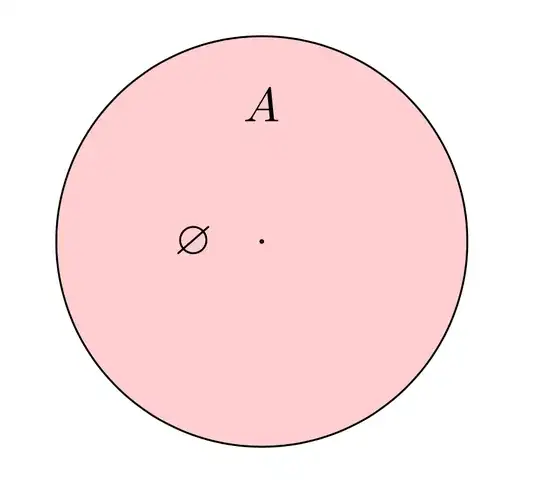
circle with no area1

As you can see, the circle representing the null set is distinct and well-defined, despite not containing any elements. It fulfills the basic criteria of being a set, as it is a well-defined collection of objects (in this case, no objects) enclosed within a boundary.

By its very nature, the null set ($\emptyset$) is different from the empty space outside the circle. It represents a specific concept within set theory, and its inclusion as a set is essential for the consistency and completeness of mathematical reasoning.

Axiom of empty set

Speaking in the same tone as earlier,

One of the fundamental axioms in set theory is the axiom of empty set, which states the existence of a set with no elements. Represented as: $\exists \emptyset\ \forall x\ x\notin\emptyset$, this axiom asserts the existence of the null set, $\emptyset$, such that for every element $x$, $x$ is not a member of $\emptyset$.

Axiom schema of specification

Furthermore, we can justify this classification of null set as a set by utilizing the comprehension axiom.

The comprehension axiom states that, for any condition P(x), there exists a set $\{x | \text{P}(x)\}$ that contains all elements x satisfying the condition. Applying this axiom to the null set we get $\{ x\ |\ x ∉ x \}$, that represents the set of all elements $x$ such that $x$ is not a member of itself.

In simple words, as well-demonstrated by Vercassivelaunos, there exists a set of elements satisfying $\text{P}(x)$ even if there's not a single element satisfying the same, i.e. the case of a null set. Moreover, since the null set $\emptyset$ has no elements, it follows that any set with no elements must be equal to $\emptyset$. Therefore, the null set is unique and well-defined by the Axiom of Extensionality.

Further proving by Contradiction

Now looking to this problem with a different and easier approach, let us pave our ways to a proof by contradiction.

To show that the null set is indeed a set, we can prove it indirectly using the assumption that it is not a set. Let's assume that the null set, $\emptyset$, is not a set. In such a case, we would have: $\nexists \emptyset\ \forall x\ x\notin\emptyset$

This statement asserts that there is no set, $\emptyset$, such that for every element $x$, $x$ is not a member of itself. However, this contradicts the comprehension axiom and the definition we derived earlier.

By contradiction, we can conclude that the null set must be considered a set according to the axioms of set theory.

However, further proving by contradiction seems redundant tho. "-"

Paul Sinclair
  • 45,932
  • It is very good of you that you invested slot of your precious time just to give me the complete idea, i am very thankful to you – Amit Verma Jun 11 '23 at 07:09
  • Well explained! Just remember to use LaTeX next time. I have already edited the post for you –  Jun 11 '23 at 10:16
  • I don't get how can an element $x$ be or not be a member of itself? – Integreek Apr 08 '25 at 04:06
2

Because otherwise the algebra of sets becomes unnecessarily complicated.

For any pair of sets $A,B$ we have the operations of union and difference, $A \cup B$ and $A \setminus B$. If we were to exclude the empty set then the union remains well-defined, but the difference is ill-defined if $A$ is contained in $B$. Similarly, the symmetric difference $A \triangle B = (A \setminus B) \cup (B \setminus A)$ is ill-defined if $A \neq B$, and has to be separately defined in the cases where $A \subseteq B$ or $B \subseteq A$.

More generally, exclusion of the empty set breaks the axiom schema of specification, which is not something we want to break unless absolutely necessary.

2

There are several good reasons why the empty set is indeed a set.

  1. If the empty set were not a set, then the power set of a finite set of $n$ elements would have $2^{n} - 1$ elements, instead of $2^{n}$, thus destroying the term "power set"!
  2. There would be violations of closure and complementation, such as the complement of the universal set no longer being a set at all.
  3. As others have also noted, there would have to be many modifications to theorems about sets to cover the possibility of what amounts to the empty set.
TShiong
  • 1,270
1

One important factor is that it's convinient and fits with other stuff. Similar to how 0! = 1. There's often a lot of possibilities in how you could define edge cases, but very often there's also pretty good reasons to do it a particular way, because it better follows behaviors of other seemingly unrelated mathematical constructs.

One thing the empty set allows you, for example, is to use that to construct number theory inside set theory, because it serves as a starting point of being an actual thing. So you can define 0 as the empty set ∅, 1 as the set that contains the empty set {∅}, 2 as the set set that contains 1 and the empty set {{∅},∅}, and so on.

BurnNote
  • 111