The equation of the circle can be written as $(x-12)^2+y^2=4^2$, so its center is $(12,0)$.
As you wrote, the required shortest distance will lie along the normal of circle and the curve given by locus of $P$.
So, let $Q(12+4\cos\theta,4\sin\theta)$ be a point on the circle.
Also, let $R(12+p\cos\theta,p\sin\theta)$ be a point on the curve given by the locus of $P$.
As you wrote, we have
$$ct^4-ht^3+kt-c=0\tag1$$
We also have
$$h=12+p\cos\theta\qquad\text{and}\qquad k=p\sin\theta\tag2$$
As a result, our problem is reduced to finding the minimum value of $QR=|p-4|$ under the condition that $(p,\theta)$ is such that
$$ct^4+(-12-p\cos\theta)t^3+(p\sin\theta)t-c=0\tag3$$
has four distinct real roots $t$.
So, according to wikipedia, our problem is reduced to finding the minimum value of $|p-4|$ under the condition that
$$\begin{cases}-256c^{6}+192c^{4}(12+p\cos\theta)p\sin\theta-27c^{2}p^4\sin^4\theta
\\\quad +6c^2(12+p\cos\theta)^2 p^2\sin^2\theta-27(12+p\cos\theta)^4c^{2}
\\\quad +4(12+p\cos\theta)^3p^3\sin^3\theta\gt 0
\\\\p\cos\theta\not=-12
\\\\64c^4-16(12+p\cos\theta)c^2p\sin\theta+3(12+p\cos\theta)^4\gt 0\end{cases}$$
Example : Taking $p=4$ and $\theta=\frac{\pi}{2}$, we get
$$0\lt c\lt 2\sqrt{3 (1 - 2^{4/3} + 2^{2/3})}\approx 0.900393$$
So, one can at least say that for $0\lt c\lt 2\sqrt{3 (1 - 2^{4/3} + 2^{2/3})}\approx 0.900393$ and $(h,k)=(12,4)$ which is on the circle, there are four normals, and the shortest distance is $0$.
the answer given is $4(\sqrt5-1)$
From what I've got, I don't think that the answer is $4(\sqrt5-1)\approx 4.944272$.
Added :
Can we make use of the following link? As I am trying to avoid the discriminant method because that's not in the syllabus. Where would the four normals be?
The OP of the question says "I managed to prove that if $y>0$, then this quartic has 4 distinct real roots if $y<-\frac{1}{4c^2}x^3$ ".
However, this is not true. For $(c,h,k)=(2,12+20\cos\frac{8\pi}{9},20\sin\frac{8\pi}{9})$ which satisfies both $k>0$ and $k<-\frac{1}{4c^2}h^3$, the equation has only two real roots. (see here)
The OP says "I have attached a computer generated diagram for the case when $c=2$ at the bottom of this post".
However, the diagram is not correct. As pointed out in a comment there, taking the point $(−2,0)$ in the blue area, the equation has only two real roots. (see here)
Also, I think that none of the answers there shows a necessary and sufficient condition.
Therefore, I don't think that we can make use of the link.
You are saying "I am trying to avoid the discriminant method". Fine, but then, I think that you cannot get a necessary and sufficient condition. We may be able to get a necessary (not sufficient) condition without using the discriminant, but if you want to get a necessary and sufficient condition (which is needed to solve your question), I think that you cannot avoid the discriminant method.
You might want to consider the following point :
You wrote "the statement is complete" and "the answer given is $4(\sqrt5-1)$". I would say that at least one of the two comments is incorrect (or textbook typo?) since for $c=\frac 12$ and $(h,k)=(12,4)$ which is on the circle, there are four normals, and the shortest distance is $0$.
In the following, let us consider the case $c=2$.
For $c=2$, writing $p=y$ and $\theta=x$, we want to find the minimum value of $|y-4|$ under the condition that
$$\begin{cases}-16384+3072(12+y\cos x)y\sin x-108y^4\sin^4x
\\\quad +24(12+y\cos x)^2 y^2\sin^2x-108(12+y\cos x)^4
\\\quad +4(12+y\cos x)^3y^3\sin^3x\gt 0
\\\\y\cos x\not=-12
\\\\1024-64(12+y\cos x)y\sin x+3(12+y\cos x)^4\gt 0\end{cases}$$
WolframAlpha gives
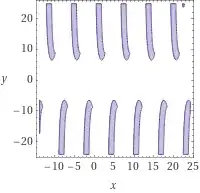
If $y=6.5$, there is no such $x$.
If $y=6.525$, then is no such $x$.
If $y=6.55$, $x=\frac{17}{30}\pi$ satisfies the condition.
These should imply that there is $6.525\lt y_0\leqslant 6.55$ such that the minimum value of $|y-4|$ is $y_0-4$.


