Indeed, the subshift $\sigma:\Omega_M\to \Omega_M$ of finite type defined by the transition matrix $M$ is topologically transitive but not topologically mixing (neither strongly nor weakly; see Topological weakly mixing implies totally transitive for the definitions). Below are two methods to see this.
First Method ($\sigma$ is not topologically strong mixing):
First some definitions and preliminaries. Let $A$ be an anonymous $d\times d$ matrix with entries in $\{0,1\}$. Call $A$ irreducible if for any $i,j\in\{1,2,...,d\}$, there is a positive integer $n$ such that $(A^n)_{ij}>0$.
For $i\in\{1,2,...,d\}$, define the period of state $i$ w/r/t $A$ to be
$$\text{period}(i;A)=\gcd\{\ell\in\mathbb{Z}_{\geq1}\,|\, (A^\ell)_{ii}>0\}\in\mathbb{Z}_{\geq1}\cup\{\infty\}.$$
(The period of a state is $\infty$ iff the associated set of returns is empty.)
Next define the period of $A$ to be the greatest common divisor of periods of all those states whose periods are finite.
$$\text{period}(A)=\gcd\{\text{period}(i;A)\,|\, i\in\{1,2,...,d\},\, \text{period}(i;A)<\infty\};$$
if there are no states with finite period then we define the period of $A$ to be infinite.
Here is a useful fact (that we don't really need):
Fact: If $A$ is irreducible, then for any two states $i,j\in\{1,2,...,d\}$ we have that $\text{period}(i;A)=\text{period}(j;A)<\infty$.
As a reference this is Lem.4.5.3 in Lind and Marcus' An Introduction to Symbolic Dynamics and Coding, p.126.
Drawing the diagram associated to $M$ one sees that $M$ has period $2$:

(Alternatively one could argue as coudy.)
Next observe that $\sigma:\Omega_M\to\Omega_M$ being topologically strong mixing implies that $M$ has to be irreducible and of period $1$; indeed irreducibility follows from using cylinder sets defined by the entry at the $0$-th coordinate and "period equals $1$" follows from the infinitude of primes.
(In fact $\sigma:\Omega_M\to\Omega_M$ is topologically strong mixing iff $M$ is irreducible and of period $1$; see Prop.4.5.10 in the aforementioned book, p.129.)
Second Method ($\sigma$ is not topologically weak mixing):
For the second method we'll use the fact that topological strong mixing implies topological weak mixing. $\sigma$ being topologically weak mixing is by definition $\sigma\times \sigma:\Omega_M\times\Omega_M\to \Omega_M\times\Omega_M$ being topologically transitive. Products of two subshifts of finite type is a subshift of finite type (over the alphabet that is the product of the alphabets of the factor SFT's). A computation shows that the graph of $\sigma\times \sigma:\Omega_M\times\Omega_M\to \Omega_M\times\Omega_M$ has two connected components; and consequently $\sigma\times \sigma$ is not topologically transitive:
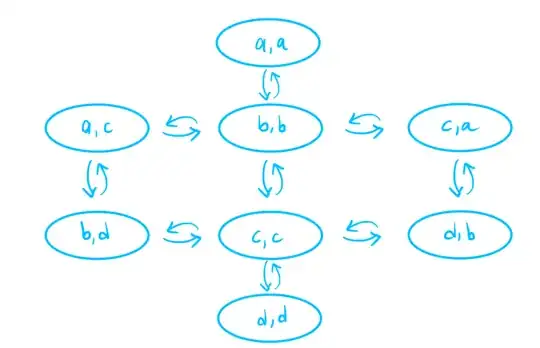
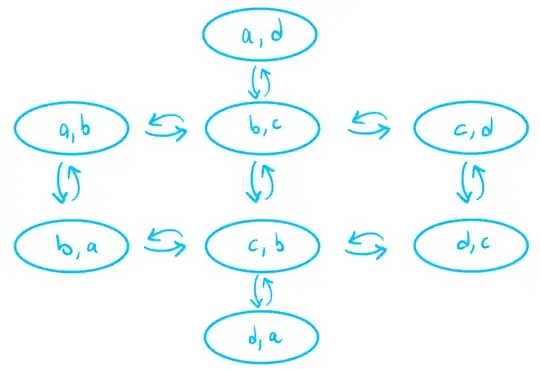
(Through the graph of $\sigma\times\sigma$, choosing an ordering of the $16$ symbols involved, one could also consider the $16\times 16$ adjacency matrix and ask whether or not it is irreducible.)


