3

This is a sequel to my highly upvoted question (at the time of writing, my third-best post).

Let there be an equilateral triangle that has $n+1$ notches on each edge (corners included) to divide each edge into $n$ equal parts. We can make cuts on the triangle from notch to notch. Is it always possible to cut out a connected piece with area $\frac{1}{2}$ the area of the original triangle if $n≥2?$ It is possible for multiples of $2$ or $3,$ but I don't know any other numbers for which this is possible. If it is possible for $n,$ it is possible for any multiple of $n.$

For simplicity, in my answers and comments (and in the solution for $3$), I'd use a transformed version of the coordinate system so that the vertices of the triangle are $(0,0), (n,0),$ and $(0,n).$ Since this is a linear transformation, it has constant determinant, so ratios of areas won't be affected.

$2$: Cut along a median.

$3$: Cut from $(0,1)$ to $(3,0)$ and $(0,3)$ to $(1,0),$ then take the piece with the diagonal side as one of its sides.

mathlander
  • 4,097

2 Answers2

3

Presenting solutions for $n=3$, $n=5$, $n=7$, and generalization to all $n=2k+1$

solutions

Note that the triangle is divided into $n^2$ triangles on a lattice. The solution for $n=3$ cuts off exactly $4.5$ of these triangles, and this cut is included in each other solution.

For $n=5$ we have $\frac{n^2}{2}-4.5=8=4(5-3)$ which is easily cut off from the lower portion of the triangle.

For $n=7$ we have $\frac{n^2}{2}-4.5=20=5(7-3)$ which is easily cut off from the lower portion of the triangle.

The generalization follows:

$$\frac{n^2}{2}-\frac{9}{2}=\frac{n^2-9}{2}=\frac{(n+3)(n-3)}{2}=(n-3)\left(\frac{n+3}{2}\right)$$

And this can always be cut from the lower portion of the triangle with a single cut.

1

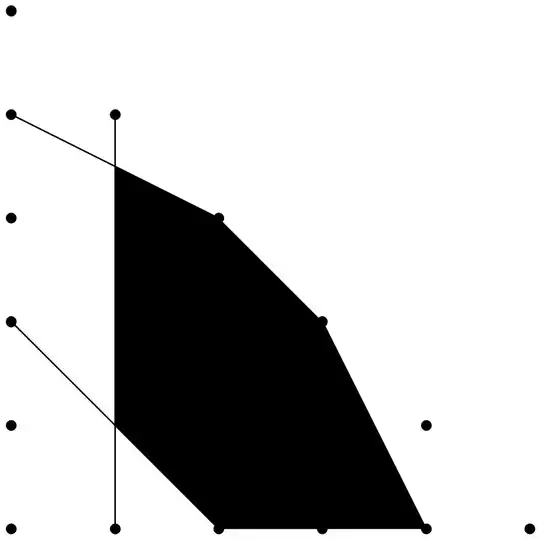
This is partly a rules question, but also an attempt to give a solution for $n=5$. In the image imagine a rectangle with vertices at $(1,0),(3,0),(3,3)$ and $(1,3)$, area $2\cdot3=6$. The original triangle and the shown cuts:

  • add a piece of area $1/4$ to the top,
  • remove two pieces, both of area $1/2$ in the bottom left as well as along the hypotenuse of the original triangle,
  • add one piece of area $1$ in the bottom right,
  • so the formed black region has area $6+\frac14-2\cdot\frac12+1=6\frac14$.

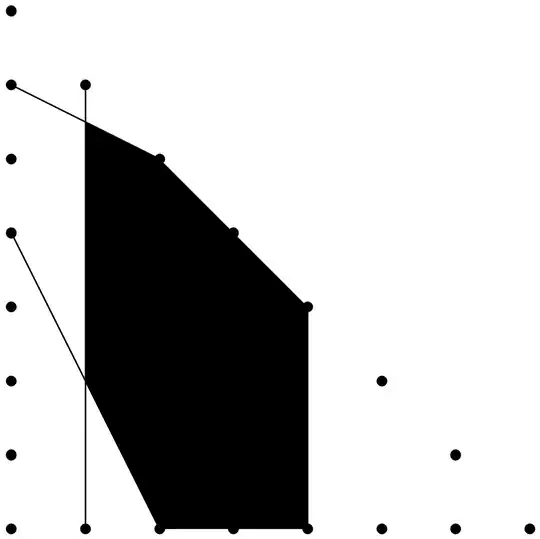
Similar ideas work for $n=7$.

This time we start with a $3\times5$ rectangle with vertices $(1,0)$, $(4,0)$, $(4,5)$ and $(1,5)$. Add $1/4$ to the top, the hypotenuse removes a piece of area two, and an extra cut in the bottom left removes a piece of area one, $15+\frac14-2-1=\frac{49}4.$


With $n=11$ the cuts A) from $(1,0)$ to $(1,10)$, B) from $(0,10)$ to $(2,9)$, C) from $(5,0)$ to $(5,6)$ and D) from $(2,0)$ to $(0,6)$ work. This time using a $4\times 9$ rectangle as a reference. Add $1/4$, remove $9/2$ (the hypotenuse), remove $3/2$, leaves $30\frac14$ as required.

With $n=13$ starting with $5\times11$ with $x\in[1,6]$, $y\in[0,11]$ works. As before, we use a cut from $(2,11)$ to $(0,12)$ to add $1/4$. This time the hypotenuse removes eight squares, leaving us $47\frac14$ and needing to remove five more. A cut from $(5,0)$ to $(6,7)$ removes $7/2$, and the cut from $(2,0)$ to $(0,6)$ removes the required $3/2$.

It seems to me that it is possible to continue like this, using the cuts along $x=1$ and from $(0,n-1)$ to $(2,n-2)$ to produce that small addition of area $1/4$. Then, if the hypotenuse doesn't cut enough from the rectangle, we use an extra cut from $(0,2)$ to $(k,0)$, allowing corrections in increments of one half. We may need to make further adjustments in the bottom right also, but those are larger than the adjustments available in the bottom left.

Jyrki Lahtonen
  • 140,891
  • You hit the nail right on the head for 5. – mathlander Jan 14 '23 at 04:36
  • 2
    For higher odd primes $n$ we can similarly add that segment of size $1/4$ to a suitable rectangle. It feels possible to adjust the remaining borders similarly, but I haven't really thought about it. – Jyrki Lahtonen Jan 14 '23 at 04:39
  • I was thinking of using a 3 x 4 rectangle for 7, but you beat me to it. Also, the 7 diagram is missing one lattice point. – mathlander Jan 14 '23 at 05:03
  • How does 13 work? Can you please add more detail? – mathlander Jan 14 '23 at 06:27
  • @mathlander Sorry about that, I miscounted the amount I need to cut from the bottom left. We can make a cut in the bottom right to compensate. I really haven't thought at all, whether this can always be made to work. Leaving that to someone else. May be you should unaccept, so that more people are invited to join in? I can't put more time into this now. – Jyrki Lahtonen Jan 14 '23 at 06:58