Let $G$ be a $2$-connected graph with independence number $2$.
The graph $G$ has at least three vertices and has cycles.
Pick a cycle $C$ of maximal length and suppose there is a vertex $v$ outside this cycle.
Since the graph is connected, we may assume that there are edges connecting $v$ with some vertices of cycle $C$.
Let $A$ be the set of vertices of cycle $C$ adjacent to $v$.
Three cases are possible:
A) The set $A$ has two neighboring vertices in $C$.
B) The set $A$ has at least two elements and
any two vertices from $A$ are not adjacent in $C$.
C) $|A|=1$.
In the first case $v$ can be included in a longer cycle than $C$ (see the left figure).
Starting from the vertex $v$ we go first along the edge $vx$ and along the edge $yv$ we return.
If set A contains at least two vertices and $x,y\in A$, then $x$ and $y$ are not adjacent in $C$.
But then $x_0$ and $y_1$ (see the middle figure) are adjacent in $G$ otherwise the set $v,x_0,y_1$ is independent.
Now we get a cycle $vxx_1\ldots y_1x_0\ldots y_0yv$.
Let $|A|=1$ and $x\in A$.
Let us remove the vertex $x$. The graph $G-x$ is by convention connected and hence there exists a path from $v$ to some vertex $C-x$ (see the right figure). As above, there exists edges $y_0y_1$ and $y'_0x_1$ and we have a cycle $vx\ldots y'_0x_1\ldots y_1y_0yz\ldots v$.
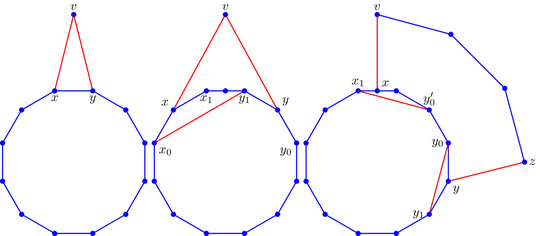
In all three cases we have a cycle longer than $C$, but this contradicts the choice of cycle $C$. It follows that the cycle $C$ is Hamiltonian.
Addition.(After 2 days)
In case (C) there are still a number of special cases: 1) $x$, $y$ are neighbors in the cycle $C$, 2) $x$, $y$ have a common neighbor in $C$.


