2

It is not difficult to show that the points of an integer lattice do not span any equilateral triangles (for example, see here).

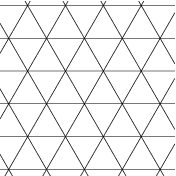
Is it also true that the points of a triangular lattice do not span any squares?

That is, a lattice that is composed of the vertices of a tiling of equilateral triangles, or equivalently: $\left\{a\cdot (1,0) + b\cdot (1/2, \sqrt{3}/2) \ \mid \mbox{ for any } a,b\in{\mathbb Z} \right\}$.

Thanks,

Adam

2 Answers2

6

With $\rho=\frac{1+i\sqrt 3}2$, we have $\rho\notin\mathbb Q[i]$ and $i\notin\mathbb Q[\rho]$

0

Suppose the square exists. Then wlog one point may be placed at the origin and another at $(x,y)=(\frac12(2a+b),\frac12b\sqrt3)$, whereupon a third point must be at $(y,-x)=(\frac12b\sqrt3,-\frac12(2a+b))=(\frac12(2a'+b'),\frac12b'\sqrt3)$.

Then

$2a'+b'=b\sqrt3$

$b'\sqrt3=-(2a+b)$

From this we get the linear combination

$2a'\sqrt3=2a+4b.$

This has a rational solution only if $a'=0$, and then $a=-2b$. But then

$(x,y)=(\frac12(2a+b),\frac12b\sqrt3)=(-\frac32b,\frac12b\sqrt3),$

which has an irrational slope and thus its only rational point is the origin itself. Thus no square with distinct vertices on the hexagonal lattice exists.

Oscar Lanzi
  • 48,208