38

If you think of the bee-hive problem, you want to make 2D cells that divide the plane of honey into chunks of area while expending the least perimeter (since the perimeter of the cells is what takes up resources/effort). The solution ends up being the hexagonal tiling.

What is the analogous "tiling" for 3D space that's optimal in a similar sense? (more volume, less surface area)

And if possible, I'd like to know the general solution for $n$-D space.

To make the problem statement clear: assume that each "cell" has a volume of at most 1. With what polyhedron should you divide the cells to minimize the ratio of surface area to volume? For example, if you tile everything with hypercubes, the ratio would be $2n$, which probably isn't optimal.

VoidGawd
  • 3,110
chausies
  • 2,438
  • 1
    In 2D, the Delaunay triangulation of some input vertices exists. The dual manifold is made up of the hexagons. Perhaps if you do a tetrahedralization in 3D, then find the dual of that? Best of luck. If you're totally stumped, try out qhull. – shawn_halayka Aug 14 '22 at 01:05
  • 4
    A search for "Kelvin problem" (thank you RavenclawPrefect for the search term) gives a few related posts on Math SE. I don't think that either of these are duplicate questions, but linking them in a comment may help to organize the site a bit: (1) (2). – Xander Henderson Aug 14 '22 at 19:34
  • 2
    See What the bees know and what they do not know https://www.ams.org/journals/bull/1964-70-04/S0002-9904-1964-11155-1/S0002-9904-1964-11155-1.pdf – Ethan Bolker Aug 14 '22 at 20:19

2 Answers2

40

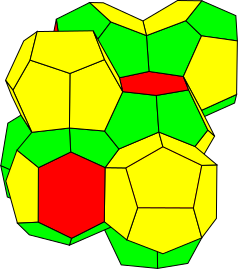
This is known as the Kelvin problem; the best known (and conjectured optimal) solution is the Weaire–Phelan structure, but proving this is likely very very hard. I don't know what the best results in $n$ dimensions are, but I'd be shocked if they were solved for $n>3$.

                                              enter image description here

  • 9
    Sometimes this sort of packing problem is hard for $n=3$ and $4$ but unexpectedly easy for $n=8$ or $n=24$. For example, the Kissing number was known for $n=24$ before it was known for $n=4$. Similarly the Kepler conjecture has been resolved for dimensions $1,2,3,8,$ and $24$. – MJD Aug 14 '22 at 20:29
  • 2
    On this page there's a SVG version. Stack Exchange pages display SVG, but Imgur doesn't currently accept it. – PM 2Ring Aug 14 '22 at 22:15
  • 1
    For exact coordinates, please see https://polytope.miraheze.org/wiki/Weaire-Phelan_structure – PM 2Ring Aug 16 '22 at 08:02
14

I'd guess that the answer is not known above 2 dimensions, but it is very likely that if the answer is known then it is known in dimensions 1, 2, 8 and 24 (1 is trivial), and possibly exactly those dimensions.

The dimensions 1, 2, 3, 8 and 24 are the ones in which we know how to maximize the number of tiles per unit volume (the packing density). The dimensions in which we know how to maximize the number of faces per tile (the kissing number) are 1, 2, 3, 4, 8 and 24. These questions are not the same as minimising the amount of surface, but they are related. The packing density in dimensions 8 and 24 was only proved in 2016 by Maryna Viazovska and a readable article is here. The 8 dimensional packing is called E8 with kissing number 240 and the 24 dimensional packing is called the Leech lattice with kissing number 196,560. I'd love to draw pictures of E8 and the Leech lattice for you, but there are obvious problems.

The point is that E8 and the Leech lattice are surprisingly good packings, so they can sometimes achieve provable bounds for packing problems. Despite the packing problem taking until 2016, the proof is actually reasonably short and simple, at these things go. It's a rare case of a proof just needing a single brilliant idea and then it all just works.

Note that the lattice (called A3) which maximises both the packing density and the kissing number in 3 dimensions is not the one which minimises the area, since it is not the lattice given in RavenclawPrefect's answer, but E8 and the Leech lattice are so good that they have a chance of solving both problems simultaneously.

  • 1
    not sure if you'll find this interesting https://math.stackexchange.com/q/4412856/284619 – uhoh Aug 15 '22 at 12:32