The original question is boxed in red. The question asks to "Prove the identities:" I have tried one method as shown below the box then another method under the squiggly but both come to an answer that I cannot simplify further to make LHS = RHS.
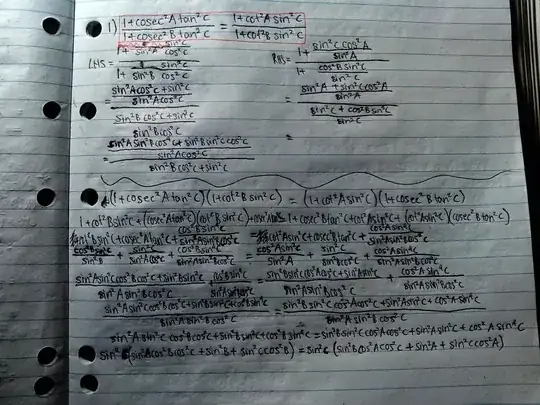
The original question is boxed in red. The question asks to "Prove the identities:" I have tried one method as shown below the box then another method under the squiggly but both come to an answer that I cannot simplify further to make LHS = RHS.
You're on the right track. This is (close to) what you did to the LHS:
$$\begin{align} \frac{1 + \csc^2 A \tan^2 C}{1+\csc^2 B \tan^2 C} &= \frac{1 + \frac{1}{\sin^2A}\frac{\sin^2C}{\cos^2C}}{1 + \frac{1}{\sin^2B}\frac{\sin^2C}{\cos^2C}} \\[6pt] &= \frac{\frac{\sin^2A\cos^2C+\sin^2C}{\sin^2A\cos^2C}}{\frac{\sin^2B\cos^2C+\sin^2C}{\sin^2B\cos^2C}}\\[6pt] &= \frac{\sin^2B\cos^2C}{\sin^2A \cos^2 C}\cdot \frac{\sin^2A\cos^2C + \sin^2C}{\sin^2B\cos^2C+\sin^2C}\\[6pt] &= \frac{\sin^2B}{\sin^2A}\cdot \frac{\sin^2A\cos^2C + \sin^2C}{\sin^2B\cos^2C+\sin^2C}\\[6pt] \end{align}$$
Note that I dealt with the "numerator's denominator" as well as the "denominator's denominator" (where you'd just done the latter), and I didn't multiply-through by $\sin^2B$ on the top.
For the RHS, I'll continue to follow your lead: $$\begin{align} \frac{1+\cot^2A\sin^2C}{1+\cot^2B\sin^2C} &= \frac{1+\frac{\cos^2A\sin^2C}{\sin^2A}}{1+\frac{\cos^2B\sin^2C}{\sin^2B}} \\[6pt] &= \frac{\frac{\sin^2A+\cos^2A\sin^2C}{\sin^2A}}{\frac{\sin^2B+\cos^2B\sin^2C}{\sin^2B}} \\[6pt] &= \frac{\sin^2B}{\sin^2A}\cdot \frac{\sin^2A+\cos^2A\sin^2C}{\sin^2B+\cos^2B\sin^2C} \\[6pt] \end{align}$$
The LHS and RHS are looking a bit more alike. If you can show $$\sin^2A \cos^2C + \sin^2 C = \sin^2A+\cos^2A\sin^2C \qquad (*)$$ to get the numerators to match (the logic is the same for the denominator), you'll be good. To prove, $(*)$, remember that when you have lots of "$\sin^2$"s and "$\cos^2$"s floating around, it often helps to just pick one and go with it; here, since there are more "$\sin^2$"s, re-write $\cos^2C$ in terms of $\sin^2 C$ on the left, and $\cos^2A$ in terms of $\sin^2A$ on the right, and watch the magic happen. (It's actually more magical to re-write $\sin^2A$ on the left, and $\sin^2 C$ on the right, but as long as you get a match, you're okay.)
Now, while converting everything to sine and cosine is a solid strategy ---it's certainly what I try first--- it's worth noting that the exercise is pretty straightforward when you're familiar with other Pythagorean identities, namely $$\sec^2\theta \equiv \tan^2\theta + 1 \qquad\qquad \csc^2\theta \equiv \cot^2\theta + 1$$
Applying the second identity to the occurrences of $\csc^2$ in the LHS, and multiplying-out, gives the opportunity to apply the first identity. Then, multiplying through by $\cos^2C$ (or factoring-out $\sec^2C$) on the top and bottom, leaves the RHS.
(If you think it's too much trouble to remember additional identities, just look at the figure I call the "Complete Triangle". You can see the above identities in the "upper" and "lower" right triangles that share the leg "$1$".)


