1

enter image description here

Consider the attached image for the diagram. I'm interested in finding the area of the 4 parts so formed as the ratio of increasing order. Here line segment BD is diagonal for square and AE is so-called median for the square as it divides the line segment DC such that DE = EC.

I tried a lot but unfortunately couldn't find it.

I was able to find the length of AE and BD to be a√5 and 2a√2 assuming each side as 2a. Can we apply heron's formula to find the area of triangles?

Can you help me? Anyone?

  • Please clarify your specific problem or provide additional details to highlight exactly what you need. As it's currently written, it's hard to tell exactly what you're asking. – Community Jan 02 '22 at 15:29
  • Find the coordinates of the point where the two lines meet. That will immediately give you the area of each triangle, using area = $\frac12$ base $\times$ height. – TonyK Jan 02 '22 at 15:31
  • Note that the two triangles appear are similar, and similar triangles are to one another in the squared ratio of their corresponding sides. (See) – ACB Jan 02 '22 at 15:33
  • Yes, sorry. Call the intersection point $O$. Then, $\triangle AOB\sim\triangle DOE$. – ACB Jan 02 '22 at 15:38
  • @Anonymous Community-Bot is not a person. It is ok to read comments by Community-Bot and follow the advices mentioned in them if possible. However, there is no point in trying to reply such comments – YNK Jan 02 '22 at 15:53
  • @ABC I was able to find the ratio of area of ∆DOE and ∆AOB which is 1:4 but how to find area of others and relate them with 1:4 ? –  Jan 02 '22 at 16:26
  • HINT. $DEO$ and $DEA$ have the same base and their altitudes are in the ratio $1:3$. – Intelligenti pauca Jan 02 '22 at 16:30
  • @Intelligentipauca how did you get that the ratio of their altitude is 1 : 3. May you reveal it please? –  Jan 02 '22 at 16:35
  • $[\triangle DOE]:[\triangle DOA]=EO:OA.$ You can take it from here. – ACB Jan 02 '22 at 16:50
  • @Anonymous Well, the altitude of $DOE$ is $AD$, which is the sum of the altitudes of $DOE$ and $ABO$. – Intelligenti pauca Jan 02 '22 at 16:58

1 Answers1

2

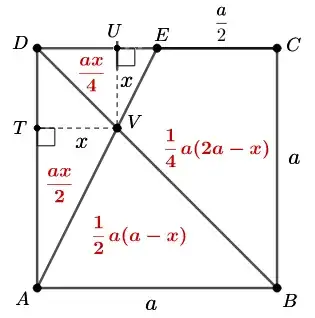
The sketch given below might help you.
TiledSquare

$\underline{\text{Added at the request of @Utkarsh}}$

Let us denote the point of intersection of $AE$ and $BD$ as $V$. We draw a line segment perpendicular to the side $AB$ through $V$ to cut the side $CD$ at $U$. Another line segment is drawn through $V$ perpendicular to the side $AD$ to meet it at $T$. For brevity, we let $AB = BC= a$, and $VT = x$.

Area of $\triangle DAV$ can be expressed as, $$\text{Area of }DAV = \frac{1}{2}ax. \tag{1}$$

The area of $\triangle ABD$ is equal to the half of that of $\square ABCD$. Therefore, $$\text{Area of }ABD = \frac{1}{2}a^2. \tag{2}$$

Using (1) and (2), we can determine the area of $\triangle ABV$ as, $$\text{Area of }ABV = \text{Area of }ABD - \text{Area of }AVD = = \frac{1}{2}a^2 - \frac{1}{2}ax = \frac{1}{2}a \left(a-x\right). \tag{3}$$

Since $V$ is located on the diagonal of $\square ABCD$, $VU = VT = x$. This let us express the area of $\triangle EDV$ in terms of $a$ and $x$ as shown below. $$\text{Area of }EDV = \frac{1}{4}ax \tag{4}$$

An expression for the area of the quadrilateral $BCEV$ can be derived using (4). $$\text{Area of } BCEV = \frac{1}{2}a^2 - \frac{1}{4}ax = \frac{1}{4}a \left(2a-x\right) \tag{5}$$

Now, we need to find $x$ in terms of $a$. To do that consider the two similar triangles $EDV$ and $ABV$. According to the theorem Euclid VI. 19., the ratio of the areas of two similar triangles is equal to the ratio of the squares on any of the three pairs of corresponding sides. Therefore, we shall write, $$\text{Area of }EDV : \text{Area of }ABV = DE^2 : AB^2 = \frac{1}{4}a^2 : a^2 = 1: 4.$$

We can express the same ratio using (3) and (4) as, $$\text{Area of }EDV : \text{Area of }ABV = \frac{1}{4}ax : \frac{1}{2}a \left(a-x\right) =x : 2 \left(a-x\right). $$

Therefore, $$\dfrac{x}{2 \left(a-x\right)}=\dfrac{1}{4} \qquad\longrightarrow\qquad x=\dfrac{1}{3}a.$$

We use this to eliminate $x$ in formulae (1), (3), (4), and (5) to get, $$\text{Area of }DAV = \dfrac{1}{6}a^2, \quad \text{Area of }ABV = \dfrac{1}{3}a^2, \quad \text{Area of }EDV =\dfrac{1}{12}a^2, \quad\text{and}\quad$$ $$\text{Area of } BCEV = \dfrac{5}{12}a^2.$$
YNK
  • 4,620