2

I'm not sure if this solution is available in closed form, but after drawing it out I do think there will be two unique solutions always. I unfortunately have no clue where to start.

Given:

  • An ellipse with x radius $a$, y radius $b$ and centre point $(0, 0)$
  • A point on that ellipse $P_1$
  • A distance $d$

Find all points $P_{2j}$ (i.e. find their coordinates) on the ellipse which satisfy the following condition (where $C$ is the chord joining $P_1$ and $P_{2j}$):

  • The distance between $C$ and a line which is tangent to the ellipse and parallel to $C$ (on the side of the smaller segment formed by $C$ i.e. the "nearer" side) is equal to $d$

In other words, the maximum distance between $C$, and the nearer side of the ellipse from $C$, must equal $d$.

The diagram I've drawn below is an example of this. $P_{21}$ and $P_{22}$ are the desired points, whereas $P_{23}$ is an example of an invalid point. (The distances are not fully accurate)

The reason I believe the solution is closed, is because as you sweep the point $P_2j$ around the ellipse, the distance (required to be $d$) increases, reaches a turning point, and then decreases.

enter image description here

  • What have you tried? You know the equation of ellipse and if the chord is $y = mx +c$, what are possible equations of the tangent given it is parallel to the chord and at a distance $d$? If you have not made an attempt, I will suggest you to make an attempt and post your progress if you get stuck. – Math Lover Dec 08 '21 at 16:52
  • If d is not too big, you will always find 2 candidates $P_{12}$ and $P_{22}$, but wht is exactly your question ? Is it to be able to find explicitly their coordinates ? – Jean Marie Dec 08 '21 at 16:54
  • @MathLover I will try make an attempt at solving - thanks for the guidance – Gary Allen Dec 08 '21 at 17:01
  • @JeanMarie yes, I need to find their coordinates. I will make that more clear now – Gary Allen Dec 08 '21 at 17:02
  • I made this thing in Desmos: https://www.desmos.com/calculator/u3bdok4scu The coordinates are basically solved but for ease of notation some intermediate variables are used. If the point P2 goes to the right of P1, you'll have to change the sign of what I called $x_0$ there. – ploosu2 Dec 08 '21 at 17:32
  • @ploosu Your diagram is very nice,. But it's hard for me to understant how you have obtained $P_2$ knowing $P_1$ and $d$. – Jean Marie Dec 09 '21 at 08:03
  • 1
    @JeanMarie Thanks. I don't obtain $P_2$. I let it vary and obtain $d$ from it and $P_1$. We would have to invert this to obtain $P_2 \mapsto d$. – ploosu2 Dec 09 '21 at 08:42
  • @GaryAllen Were you able to make an attempt? Did you get any further insight? – Math Lover Dec 09 '21 at 20:29
  • @MathLover I've been very busy and really appreciate everyone's help, but will probably only get to it this weekend. Thanks though! – Gary Allen Dec 10 '21 at 06:12

3 Answers3

2

An afterthought that looks me important (it's why I place it in front of my answer).

In fact your problem deals fundamentally with parallel (or offset) curves of an ellipse at distance $d$, as described here with parametric equations:

$$x=\left(a+\dfrac{bd}{\sqrt{a^2 \sin^2 t+b^2 \cos^2 t}}\right)\cos t, \ \ y=\left(b+\dfrac{ad}{\sqrt{a^2 \sin^2 t+b^2 \cos^2 t}}\right)\sin t$$

to which the two tangents issued from $P_1$ can/should be drawn. Getting the second point(s) $P_2$ (see my figure for notations) looks me accessible for example by using the method giving, for any point $(u,v)$ in the plane the closest point on the ellipse with equation $\dfrac{x^2}{a^2}+\dfrac{y^2}{b^2}=1$.

The big advantage of this point of view is that it gives a global understanding of the question.


Initial answer : Here is a methodology:

  1. First, a separate result : If the equation of a line $L$ in general (and of any tangent to the ellipse in particular) is written under the form

$$ u x + v y-p=0 \ \ \text{where} \ \ u^2+v^2=1, \tag{1}$$

(sometimes, one takes $u=\cos \theta, \ v=\sin \theta$ but working with angles in this context isn't necessary)

you can interpret $(u,v)$ as a unit normal vector to line $L$ and (the most important here) $p$ as the (shortest) distance of line $L$ from the origin (= the length of the shortest line segment $OH$ where $H$ belongs to the line). Therefore the ellipse's chord parallel to the tangent at distance $d$ from it has the following equation:

$$ u x + v y-(p\color{red}{-d})=0\tag{1'}$$

  1. Now, how can we obtain the equation of the general tangent to an ellipse. We start from the implicit equation of the ellipse:

$$\dfrac{x^2}{a^2}+\dfrac{y^2}{b^2}=1 \tag{1''}$$

Let us extract from (1'') the following cartesian equation of its upper part is

$$y=f(x)=\dfrac{b}{a}\sqrt{a^2-x^2}\tag{2}$$

with $$f'(x)=\dfrac{-bx}{a}\dfrac{1}{\sqrt{a^2-x^2}}\tag{3}$$

  1. Therefore, the equation of the tangent in point $(x_0,y_0=f(x_0))$ is:

$$y-f(x_0)=f'(x_0)(x-x_0)\tag{4}$$

Caution: in this perspective, $(x_0,y_0)$ aren't thought as the coordinates of $P_1$ (that I will call $(x_1,y_1)$) but the "kind of" midpoint on the future arc $P_1P_2$ where the tangent is to be taken (see figure).

which gives, by reporting (2) and (3) into (4):

$$y-\dfrac{b}{a}\sqrt{a^2-x_0^2}=\dfrac{-bx_0}{a}\dfrac{1}{\sqrt{a^2-x_0^2}}(x-x_0),\tag{4'}$$

$$(cx_0)x+y\sqrt{a^2-x_0^2}-ca^2=0 \ \text{where} \ c:=\frac{b}{a}\tag{4''}$$

then put the resulting equation under the form (1). Caution: obtaining a form $ux+vy+w=0$ isn't enough: you must have a $(u,v)$ with unit norm. If such is not the case, divide the equation by the norm $\sqrt{u^2+v^2}$

  1. Then deduce the form (1') of the chord at distance $d$ from the tangent.

  2. Express that $P_1(x_1,y_1)$ belongs to this chord by writing:

$$u x_1+ v y_1-(p-d)=0\tag{5}$$

This gives an equation constraining $x_0$ to take a certain value (in fact two values in general).

  1. Report this/these value(s) in equation (5), then find the (second) point of intersection of (5) with the ellipse by solving the system with (1) and (1'').

Here is a figure obtained with Geogebra:

enter image description here

Jean Marie
  • 88,997
  • Thanks a lot for the answer! I'm quite busy at the moment so will only be able to look at this in the next few days, but I appreciate the help! – Gary Allen Dec 09 '21 at 07:39
2

The parametric equation of the ellipse $\dfrac{x^2}{a^2} + \dfrac{y^2}{b^2} = 1 $ is

$ r = (x, y) = ( a \cos t , b \sin t ) \hspace{20pt} t \in \mathbb{R} $

Now $P_1 = (x_1, y_1) = (a \cos t_1, b \sin t_1 ) $

Suppose $Q = (a \cos s, b \sin s)$ is the point where the tangent is to be drawn.

The unit normal vector at $Q$ is

$n = \dfrac{(b \cos s , a \sin s )}{\sqrt{b^2 \cos^2 s + a^2 \sin^2 s}} $

The distance between the tangent line and the line $P_1 P_2 $ that is parallel to it is

$(P_1 Q) \cdot n = \dfrac{ ab( (\cos s - \cos t_1 ) \cos s + (\sin s - \sin t_1 ) \sin s ) }{\sqrt{b^2 \cos^2 s + a^2 \sin^2 s}} = d $

Simplifying,

$(P_1 Q) \cdot n = \dfrac{ ab( 1 - ( \cos t_1 \cos s + \sin t_1 \sin s )) }{\sqrt{b^2 \cos^2 s + a^2 \sin^2 s}} = d $

Therefore,

$ d {\sqrt{b^2 \cos^2 s + a^2 \sin^2 s}} = a b( 1- ( \cos t_1 \cos s + \sin t_1 \sin s ) ) $

Squaring,

$ d^2 (b^2 \cos^2 s + a^2 \sin^2 s ) = a^2 b^2 ( 1 + \cos^2 t_1 \cos^2 s + \sin^2 t_1 \sin^2 s + \dfrac{1}{2} \sin 2 t_1 \sin 2 s - 2 ( \cos t_1 \cos s + \sin t_1 \sin s ) ) $

After using the identities $\cos^2 s = \frac{1}{2} (1 + \cos 2 s ) $ and $\sin^2 s = \frac{1}{2} (1 - \cos 2 s)$, the last equation becomes of the form

$A \cos s + B \sin s + C \cos 2 s + D \sin 2 s + E = 0 $

where

$A = 2 a^2 b^2 \cos t_1 $

$B = 2 a^2 b^2 \sin t_1$

$C = -\dfrac{1}{2} \left((a b) ^ 2 \cos(2 t_1) - d ^ 2 (b ^ 2 - a ^ 2) \right) $

$D = -\dfrac{1}{2} a^2 b^2 \sin(2 t_1) $

$E = \dfrac{1}{2} d ^ 2 (a ^ 2 + b ^ 2) - \dfrac{3}{2} a ^ 2 b ^ 2$

Which can be solved for $s$, using the substitution $z = \tan \dfrac{s}{2} $ that results in a quartic polynomial equation in $z$.

Once $s$ is found (there will be two solutions), the equation of the line $P_1 P_2 $ is

$ n \cdot ((x, y) - P_1) = 0 $

where $n = ( b \cos s, a \sin s ) $

This line we need to intersect with the ellipse to find $P_2$. This can be done as follows. Since $(x, y)$ is on the ellipse then $P_2 =(x_2, y_2) = (a \cos t_2 , b \sin t_2)$. Substitute this into the equation of the line, you get,

$ (b \cos s , a \sin s ) \cdot ( a (\cos t_2 - \cos t_1) , b (\sin t_2 - \sin t_1) ) = 0 $

Dividing through by $ ab $,

$ \cos s (\cos t_2 - \cos t_1) + \sin s (\sin t_2 - \sin t_1 ) = 0 $

In which $t_1$ and $s$ are known, and the unknown is $t_2$. This equation is of the form

$ \cos(t_2 - s) = \cos(t_1 - s) $

Since $t_2 \ne t_1$ then

$ t_2 - s = - (t_1 - s) $

from which,

$ t_2 = 2 s - t_1 $

and $P_2 = (a \cos t_2, b \sin t_2 ) $

As a numerical example, I've taken the ellipse with $a = 10, b = 5, t_1 = \dfrac{\pi}{3}$ and the distance $d = 3 $. The figure below shows the two solutions.
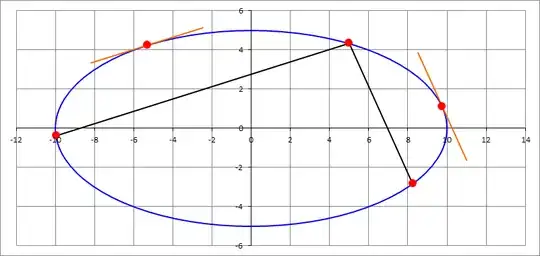
enter image description here

  • Thanks for the answer! I'll only have a chance to look at it tomorrow, but I appreciate the detailed response – Gary Allen Dec 09 '21 at 07:39
0

Here is an approach that I would take -

enter image description here

The equation of ellipse is $~ \displaystyle \frac{x^2}{a^2} + \frac{y^2}{b^2} = 1$

The locus of midpoints of a set of parallel chords $S$ is a straight line that passes through the center. The tangent $T$ to ellipse at the point where this diameter meets the ellipse is also parallel to the set $S$.

The given point is $P_1 (p, q)$. If $P_2(u, v)$ is the other end of the chord,

$b^2(u^2 - p^2) + a^2 (v^2 - q^2) = 0 \tag1$

Midpoint $P_m = \left(\frac{p + u}{2}, \frac{q + v}{2} \right)$

Equation of line through $P_1, P_2$,

$ (u-p) (y - q) = (v-q) (x-p)$
$ \implies (u-p) y = (v-q)x + qu - pv$

The perpendicular distance from the center to the chord is then,

$d_m = \dfrac{|qu - pv|}{\sqrt{(u-p)^2 + (v-q)^2}}$

As $P_2$ is a point such that $P_1 P_2$ is at distance $d$ from the nearer tangent $T$ parallel to $P_1P_2$, the distance to the tangent from the center is

$d_t = \dfrac{|qu - pv|}{\sqrt{(u-p)^2 + (v-q)^2}} + d$

And if $P_t$ is the point of tangency for tangent $T$,

$ \displaystyle P_t = (x_t, y_t) = \left( \frac{d_t}{d_m} \cdot \frac{p + u}{2}, \frac{d_t}{d_m} \cdot \frac{q + v}{2} \right) ~ $ and we know,

$ \displaystyle \frac{x_t^2}{a^2} + \frac{y_t^2}{b^2} = 1 \tag2$

Using $(1)$ and $(2)$, you can obtain $P_2(u, v)$

Math Lover
  • 52,200