0

As the title entails, I am having a problem finding a formula for reflections on a line in the complex plane. As in assume we have a line E in the complex plane, with an equation of z=x+i(mx+b), a point A with the coordinates a, how do we find a', the coordinates of A', the reflection point off the line E.

I've been trying to solve this problem with all kinds of methods, but I am having problems finding the intersection point between the line AA' and E. I believe that with finding the intersection point, we could assume a rotation that transforms A to A', with an angle pi, whose center is the intersection point between these two lines.

I tried arbitrarily assuming another point C that belongs to the line E, then simply applying the known angles to it, but this led to nowhere since the intersection point is unknown.

Voice
  • 67
  • I'm struggling to understand exactly what you mean by "how do we find a', the coordinates of A', the reflection point off the line E with an angle θ". Do you mean "How do you find the coordinates of the point A after it has been reflected in the line E, where the slope of the line is the tangent an arbitrary angle θ"? – David Sheard Aug 16 '21 at 22:59
  • Yes that is exactly what I want. Basically a formula where I can control the angle of the reflection. – Voice Aug 16 '21 at 23:18
  • Question is dupe but check out the book, Tristan Needham's visual complex analysis. First chapter is just about stuff like this – Clemens Bartholdy Aug 17 '21 at 06:57
  • A more "canonical" way to describe a line with complex coordinates is $az+b\overline{z}+c=0$, $a,b,c \in \mathbb C$. – Jean Marie Aug 17 '21 at 14:30

1 Answers1

1

I think this problem is easier if it's translated to $\mathbb{R}^2$. Let $\langle\cdot,\cdot\rangle$ be the the Euclidean inner product on $\mathbb{R}^2$, and as stated in the question, let $E$ be a line, and for now assume $E$ passes through the origin, and $A$ a point, with coordinates $\mathbf{a}$. Let $\mathbf{v}$ be a unit normal vector to $E$, then the reflection of $A$ in the line $E$ has coordinates $\mathbf{a}'$ given by $$\mathbf{a}'=\mathbf{a}-2\langle\mathbf{a},\mathbf{v}\rangle\mathbf{v}.$$ To understand why, notice that $\langle\mathbf{a},\mathbf{v}\rangle$ is the (signed) perpendicular distance between $A$ and $E$, so $\mathbf{a}-\langle\mathbf{a},\mathbf{v}\rangle\mathbf{v}$ would be the projection of $A$ to $E$, and $\mathbf{a}-2\langle\mathbf{a},\mathbf{v}\rangle\mathbf{v}$ is the point perpendicularly opposite $A$ across $E$. Hopefully this diagram helps illustrate this:
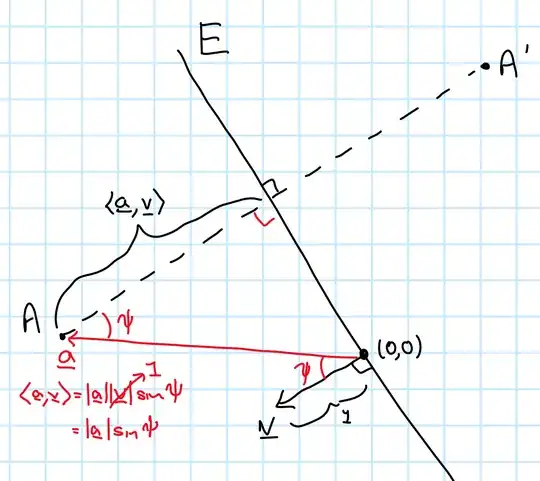
enter image description here

Now we just need to translate from the complex picture to the real picture and back again. Suppose $E$ is given by the complex equation $z=tw$, where $t$ is a real parameter, and $w$ is a fixed complex number (recall we assumed that $E$ passes through $0$). Writing $w=x+\mathrm{i}y$, the unit vector $\mathbf{v}$ has coodsinates $$\frac{1}{\sqrt{x^2+y^2}}(y,-x).$$ Now, if $\mathbf{a}$ as a complex number is $\alpha+\mathrm{i}\beta$, we can use the above expression to write $\mathbf{a}'$ as a complex number: $$\alpha+\mathrm{i}\beta-2\frac{1}{x^2+y^2}(\alpha y-\beta x)(y-\mathrm{i} x).$$

The only thing left to do is remove the assumption that $E$ passes through $0$. In general $E$ will be given by a complex equation $z=tw+w'$ where $w'$ is another fixed complex number. To get a reflection in this line, first translate the whole plane by $-w'$ so that $E$ passes through the origin, then apply the formula above, then translate the whole plane back by $w'$.

Edit:

It was pointed out in the comments that the asker wanted a description of affine reflections, not just orthogonal reflections. The answer above can be easily modified to to this more general setting by observing that any affine reflection in a line $E$ through the origin is conjugate to an orthogonal reflection in that line by an element of $\mathrm{GL}_2(\mathbb{R})$ which fixes the line. in only two dimensions it should be straightforward to compute the matrix of the conjugating transformation and apply it in the procedure above.

David Sheard
  • 2,537
  • 1
    The OP said in a comment that he wants to "control the angle of reflection" meaning that it is not always an othogonal reflection... – Jean Marie Aug 17 '21 at 14:33
  • It's not clear to me whether that comment should be interpreted as you have, or as merely saying that the reflection should be orthogonal in a line oriented at an arbitrary angle. This is the point I hoped to clarify in my comment to which the comment you mention was a response. Maybe OP can clarify? – David Sheard Aug 17 '21 at 15:02
  • yes, I sort of edited the comment to try to remove that part, but it seems but it seems my second edit didn't register for some reason. This was merely my attempt to make the answer I got actually answered the question, since it helped me understand the transformation a bit better. But yes, that was my original intent, I wanted to control the angle of reflection. – Voice Aug 17 '21 at 17:20
  • I have added an edit which I hope covers the generality of the question you asked. – David Sheard Aug 17 '21 at 17:52