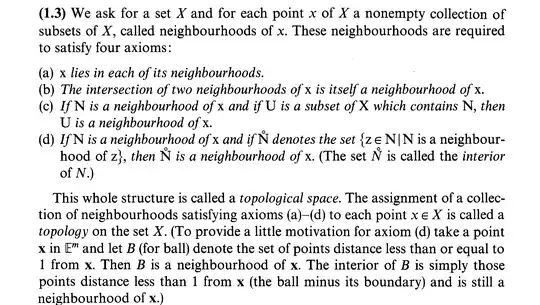
From the comments I gather ( I don't have the book) that your text starts by axiomatically defining a so-called "neighbourhood space" (as defined in this question e.g. or on Wikipedia here). This is perfectly valid (but somewhat old-fashioned). So for every $x \in X$ we have a family $\mathcal{N}(x)$ of subsets of $X$ (all containing $x$) that forms a filter and such that all $\mathcal{N}(x), x \in X$ together have some coherence condition.
As the families $\mathcal{N}(x)$ are given it makes sense to define $O$ open iff
$$\forall x \in O: O \in \mathcal{N}(x)\tag{1}$$
which is what the phrase "$O$ is a neighbourhood of each of its points" translates to, mathematically.
And $\{x\}$ is thus open iff for that $x$ we happen to have that $\{x\} \in \mathcal{N}(x)$, which indeed can be the case (it's not ruled out by the axioms and it does imply that any set $N$ that contains $x$ is also in $\mathcal{N}(x)$ as well) but this does not happen in the standard Euclidean system of neighbourhoods in $\Bbb R$ or $\Bbb Q$, say. It will depend on the neighbourhood system you're given or that has been defined.
Such $x$ where it does happen are called isolated points of $X$, and they're topologically not very interesting. If all $x \in X$ are isolated points, $X$ is discrete, and all subsets of $X$ are open, as $(1)$ then trivially implies.