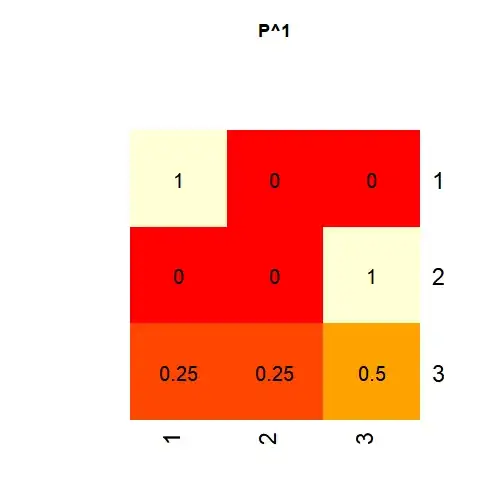
$p_{i,j}^{(n)}$ can be found from the $n^{th}$ power of the transition matrix computed with spectral decomposition of $P=V\Lambda V^{-1}$ s.t., $P^n=V\Lambda^nV^{-1}$,
Here we have
$P
= \begin{pmatrix}
1 & 0 & 0\\
0 & 0 & 1\\
\frac14 & \frac14 & \frac12
\end{pmatrix}
$
$V = \begin{pmatrix}
0.5773503 & 0 & 0\\
0.5773503 & 0.7774375 & 0.9554226\\
0.5773503 & 0.6289602 & -0.2952418
\end{pmatrix}
$
$\Lambda = \begin{pmatrix}
1 & 0 & 0\\
0 & 0.809017 & 0\\
0 & 0 & -0.309017
\end{pmatrix}
$
Value of $p_{2,2}^{(n)}$ can be obtained from $P^n(2,2)$
s.t., for n = 2,
$ P^2 = \begin{pmatrix}
1.000 & 0.000 & 0.0 \\
0.250 & 0.250 & 0.5 \\
0.375 & 0.125 & 0.5
\end{pmatrix}
$
s.t., $p_{2,2}^{(2)}=\frac1 4$ and $p_{2,3}^{(2)}=\frac1 2$
Note that 1 being the absorbing state of the Markov chain, eventually $p_{i,1}^{(n)}=1, \forall{i}$ and $p_{i,j}^{(n)}=0, \forall{j \neq 1}$ when $n \to \infty$
The following animation shows how $p_{i,j}^{(n)}$ changes with increasing $n$.