8

I have the function

$$ f(x)=\cases{\frac{1}{\sqrt{\sinh^2(a)-\sinh^2(ax)}} & $-1 \leq x \leq1$ \\ 0 & otherwise} $$

Where $a \in \mathbb{R}^+$. Here is a plot of $f$:

enter image description here

It would be very convenient if I could justify (in any way: maybe distributionally?) that

$$ f(x)=A\left[ \delta(x-1)+\delta(x+1) \right]+B+\mathcal{O}(?) \quad ; \quad a \to \infty \tag{1} $$

For some $x$ independent constants $A$ and $B$. I am uncertain of how to do this, or how to estimate the error.

What I've tried

My thought was to look at the Fourier series of $f$, and associate terms with the Fourier series of (2). By expanding (1) around $x= \pm1$, I can find a Laurent series in $(x \pm 1)$, and perform the Fourier integral term by term. The result is messy, and worse: does not allow easy comparison to the Fourier series of (2). This may not be a fruitful approach.

By looking at the wiki page about mollifiers, it seems I need to claim something like: $a f(x) \to \delta (x \pm1), \ a \to \infty$. Superficially, this appears to work, but I'm not sure how to make it concrete, or if there should be any other factors next to $af(x)$ (other than a factor to ensure normalization to unity).

Questions

  1. How can I estimate the error and find $A$ and $B$ in (1)?
  2. If $A$ and $B$ cannot be found, how can I find the ratio $A/B$?

Background

$f(x)$ will eventually appear beneath an integral with a Green's function $G$. I'd like to formulate this for arbitrary $G$. We can take some liberties about the 'niceness' of $G$, as necessary. In particular, it has a well behaved Fourier transform.

Sal
  • 4,867
  • 1
    From your comment on delta distributions being desirable, it seems fair to ask if you're interested in $f$ itself, or maybe $\int f g, dx$ as $a \rightarrow\infty$, or something else. – A rural reader Mar 05 '21 at 22:18
  • 1
    @Aruralreader Fair. Eventually, $f$ will appear under an integral with an appropriate Green's function $g$. I'd like to formulate the above (if possible) for arbitrary $g$. We can take any necessary 'niceness' conditions on $g$: it has a well behaved Fourier transform, etc. – Sal Mar 05 '21 at 22:33
  • 1
    Let $\tilde f(x) = f(x) \sinh a$. Since $\tilde f(x) \leq 1/\sqrt {1 - x^2}$ when $a > 0 \land -1 < x < 1$, we have $$\lim_{a \to \infty} (\tilde f, \phi) = \int_{\mathbb R} \lim_{a \to \infty} \tilde f(x) \phi(x) , dx = \int_{-1}^1 \phi(x) , dx,$$ which means that the distributional limit of $\tilde f$ is $[-1 < x < 1]$. The d.l. of $f$ is zero. The d.l. of $C(a) f(x)$ cannot be equal to $\delta(1 - x^2)$. – Maxim Mar 08 '21 at 13:38
  • @Maxim I understand your post until the second equality. I don't see how $\int\limits_{-1}^1 \phi(x) dx $ follows? – Sal Mar 08 '21 at 14:58
  • The pointwise limit $\lim_{a \to \infty} \tilde f(x)$ is equal to $[-1 < x < 1]$. – Maxim Mar 08 '21 at 15:47
  • @Maxim What do you mean by $[-1<x<1]$? I'm unfamiliar with such notation: to me it looks like a closed interval – Sal Mar 09 '21 at 13:47
  • @Maxim Now I understand. Your argument excludes the singular points $x= \pm 1$, right? – Sal Mar 09 '21 at 16:54
  • At which step? $f(\pm 1) = 0$ for all $a$. – Maxim Mar 09 '21 at 19:08
  • @Maxim I think I need to modify $f$ to include the points $x= \pm 1$ for this to work. The definition currently in my post is always zero there. I should have thought that through more carefully – Sal Mar 09 '21 at 19:11
  • Your new $f$ is undefined at $\pm 1$, but changing the value of $f$ at finite number of points doesn't change $\int_{\mathbb R} f(x) \phi(x) , dx$. – Maxim Mar 10 '21 at 16:04
  • @Maxim That's why I suggested a distributional interpretation. The argument in your comment doesn't hold for e.g. $\int dx \ \delta(x) \phi(x)$. If we change the 'value of $\delta$' to $0$ at $x=0$, that certainly changes the integral. – Sal Mar 10 '21 at 16:16
  • The only thing which is well-defined is $(\delta, \phi)$, $\delta(0)$ isn't, and the integral is just a notation for $(\delta, \phi)$. If your $f$ is not a regular distribution, you have to say how you define $(f, \phi)$. – Maxim Mar 10 '21 at 18:28
  • @Maxim That's exactly what I'm asking in the question! – Sal Mar 10 '21 at 18:29
  • I am not sure the question as stated is complete.Your equation (1) obviously does not make sense pointwise. So what is it that you really need? I think it is important, that you make up your mind because there are certainly endless possibilities to embed $f$ and the $\delta$s in function spaces.Most of them probably completely meaningless for your problem. I guess a good start would be to think about/explain to us what is "most convenient" about (the impossible) equation (1). – g g Mar 11 '21 at 12:46

5 Answers5

3

@Sal: Not the answer you're looking for I'm sure, and I anticipate the MSE gods will delete this in short order, but perhaps it helps you in the meantime as you continue your research.

After messing about with things a bit, analytically and numerically, a similar function has the delta-like property. Take $\phi_a(x) = \frac{2}{\pi}\frac{a\sinh(ax)}{(\sinh^2 a - \sinh^2(ax))^{1/2}}$ on $0 < x < 1$. Then completely experimentally and without proof (or perhaps fodder for another post!) it appears $\int_0^1\, g(x)\phi_a(x)\, dx \rightarrow g(1)$ as $a \rightarrow \infty$ for a smooth function $g$.

== ADDED ==

If you want to approximate $f$ by $A\delta(x + 1) + A\delta(x - 1) + B$ in some sense, you'll probably want something like \begin{equation*} \int_{-1}^{1}\, g(x)f(x; a)\, dx - A g(-1) - Ag(1) - B\int_{-1}^1\, g(x)\, dx \rightarrow 0 \end{equation*} as $a \rightarrow \infty$ to hold. Use a few examples, $g(x) = 1, x^2, x^4, \dots$ and work out what $A$ and $B$ would need to look like. For example with $g = 1$ I get $\int_{-1}^1\, f(x; 20)\, dx = 4.12252\times 10^{-9}$ and with $g(x) = x^2$, $\int_{-1}^1\, x^2 f(x; 20)\, dx = 1.37424 \times 10^{-9}$. To me this path doesn't look promising. The area under the singular portions simply isn't big enough to mimic a delta function.

3

Too long for comments.

Starting from @Han de Bruijn's answer, computing $$N(a) = \int_{-1}^{+1} \left[\frac{1}{\sqrt{\sinh^2(a)-\sinh^2(ax)}}-\frac{1}{\sinh(a)}\right] dx$$ is not so bad using elliptic integrals $$N(a) =-\frac{2 }{a}\,\text{csch}(a)\left(a+i F\left(i a\left|-\text{csch}^2(a)\right.\right)\right)$$ $$N^*(a) = N(a)\,a\,e^a=-2 e^a \text{csch}(a) \left(a+i F\left(i a\left|-\text{csch}^2(a)\right.\right)\right)$$ which approach very fast it horizontal asymptote. For $a=100$, the value is $$2.772588722239781237668928485832706272302\cdots$$ This number differs from $\log(16)$ by $5.5 \times 10^{-85}$.

2

The first thing that must be done with $f(x)$ is to make it zero for $x=0$. Redefine: $$ f^*(x)=\cases{1/\sqrt{\sinh^2(a)-\sinh^2(ax)}-1/\sinh(a) & $-1 \leq x \leq 1$ \\ 0 & otherwise} $$ The next step is to divide it by the area underneath it. With other words, $f^*(x)$ shall be normed, with a number called $N$: $$ N(a) = \int_{-1}^{+1} f^*(x)\,dx = \int_{-1}^{+1} \left[\frac{1}{\sqrt{\sinh^2(a)-\sinh^2(ax)}}-\frac{1}{\sinh(a)}\right] dx $$ Calculating the integral turns out to be a cumbersome job. It can hardly be done by hand. Therefore we have invoked a computer algebra system, MAPLE to be precise:

> f(x,a) := 1/sqrt(sinh(a)^2-sinh(a*x)^2)-1/sinh(a);
> for k from 0 to 9 do evalf(int(subs(a=k+1,f(x,a)),x=-1..+1)) end do;

It is thus ensured that the area beneath the iterands $f^*(x)/N(a)$ is always unity. The numbers $N(a)$ have been plugged into a computer program. Here is a plot of the convergents of $f^*(x)$ for these parameter values $\,a=1\cdots 10\,$. Scaling is almost the same as in the OP's picture, but the $y$-axis has been elongated to $y \le 9$, to demonstrate that the approximations do indeed "peak" near $x = \pm 1$.
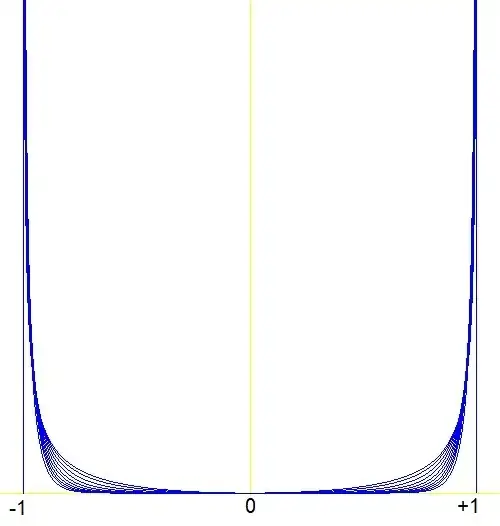
enter image description here

The function is symmetric around $x=0$. It remains to be shown that: $$ \begin{cases} \lim_{a\to\infty} f^*(x = \pm 1)/N(a) = +\infty \\ \lim_{a\to\infty} f^*(x \ne \pm 1)/N(a) = 0 \end{cases} $$ Symbolically for the first case, because that limit does not really "exist". But anyway the first case is trivial, because of the zero denominator. The second case (a "true" limit) seems to be much more difficult. Despite of the last technicality - to be repaired later eventually - we jump to conclusions: $$ \lim_{a\to\infty} \frac{f^*(x)}{N(a)} = \frac{1}{2}\left[\,\delta(x+1)+\delta(x-1)\,\right] $$ It is not possible to put this in a form as seems to be required in the question.

Later

In order to be able to proceed, we want to have an impression of the behaviour of the norming integral $N(a)$. The problem is that $N(a)$ is a (too) quickly decreasing function, spoiling the party when trying to prove that $\;\lim_{a\to\infty} f^*(x \ne \pm 1)/N(a) = 0\;$. Consider instead: $$ N^*(a) = N(a)\,a\,e^a $$ Our hope is that $\,N^*(a)\,$ is more or less a constant as a function of $a$. Numerical experiments (with MAPLE) reveal that such indeed may be the case:
> f(x,a) := 1/sqrt(sinh(a)^2-sinh(a*x)^2)-1/sinh(a);
> for k from 0 to 19 do evalf(int(subs(a=k+1,f(x,a)),x=-1..+1)*(k+1)*exp(k+1),30) end do; evalf(ln(16),30);
Resulting in a sequence of numbers that seems to converge to $2.772588722239 \approx \ln(16)$.
Next consider the series expansion of $f^*(x)$ around $x=0$:
> series(f(x,a),x=0);
Resulting in: $$ f^*(x) = \frac{1}{2}\frac{a^2}{\sinh(a)^3}x^2 + \left[\frac{1}{6}\frac{a^4}{\sinh(a)^3} + \frac{3}{8}\frac{a^4}{\sinh(a)^5}\right]x^4 + O(x^6) $$ For large $a > 0$ we know that $\,\sinh(a)\approx e^a\,$. Thus giving: $$ f^*(x) \approx \frac{1}{2}a^2 e^{-3a}x^2 + \left[\frac{1}{6} a^4 e^{-3a} + \frac{3}{8} a^4 e^{-5a}\right]x^4 + O(x^6) $$ Time to plug in our conjecturial approximation for the norming integral: $$ \frac{f^*(x)}{N(a)} = \frac{f^*(x)}{N^*(a)}a\,e^a \approx \frac{a\,e^a}{\ln(16)} f^*(x) \approx \\ \frac{a^3 e^{-2a}}{2\ln(16)}x^2 + \left[\frac{a^5 e^{-2a}}{6\ln(16)} + \frac{3 a^5 e^{-4a}}{8\ln(16)}\right]x^4 + O(x^6) $$ Which shows that $f^*(x)/N(a)$ is quickly (exponentially) decreasing to zero for $a\to\infty$ and $|x|\lt 1$, the limit that was "to be repaired later" :-)
The finishing touch is provided with contributions by DinosaurEgg and Claude Leibovici:
$\lim_{a\to\infty} N^*(a) = \ln(16)\;$ does indeed hold.

At last

This response is intended to provide a far more detailed heuristic account of the mathematical approach as employed by @DinosaurEgg in a previous answer.
The function as prescribed in the question does not converge to a delta-function in the limit $a\to\infty$. However it converges to one with appropriate modifications: $$ f^*(x)=N(a)\left[\frac{1}{\sqrt{\sinh^2(a)-\sinh^2(ax)}}-\frac{1}{\sinh(a)}\right] \\ N(a) = \int_{-1}^{+1} \left[\frac{1}{\sqrt{1-\left[\,\sinh(ax)/\sinh(a)\,\right]^2}}-1\right]\frac{dx}{\sinh(a)} $$ A good thing is performing the proposed change of variables: $$ \sinh(ax)=\sinh(a)\tanh(t) \quad \Longrightarrow \\ \frac{1}{\sqrt{1-\left[\sinh(ax)/\sinh(a)\right]^2}} = \frac{1}{\sqrt{1-\tanh^2(t)}} \\ = \frac{1}{\sqrt{\left[\cosh^2(t)-\sinh^2(t)\right]/\cosh^2(t)}}=\cosh(t) \\ \cosh(ax)=\sqrt{1+\sinh^2(ax)}=\sqrt{1+\sinh^2(a)\tanh^2(t)} $$ With implicit differentiation we get: $$ h(x,t) = \frac{\sinh(ax)}{\sinh(a)}-\tanh(t) = 0 \quad \Longrightarrow \\ dh = \frac{\partial h}{\partial x}dx + \frac{\partial h}{\partial t}dt = a\frac{\cosh(ax)}{\sinh(a)}dx - \frac{1}{\cosh^2(t)}dt = 0 \quad \Longrightarrow \\ dx = \frac{dt}{a\cosh^2(t)\cosh(ax)/\sinh(a)}= \frac{\sinh(a)}{a}\frac{dt}{\cosh^2(t)\sqrt{1+\sinh^2(a)\tanh^2(t)}} $$ Change of integration bounds: $$ \tanh(-\infty)=-1 \quad ; \quad \tanh(+\infty)=+1 $$ It follows that: $$ N(a) = \frac{1}{a}\int_{-\infty}^{+\infty} \frac{\left[\,\cosh(t)-1\,\right]dt}{\cosh^2(t)\sqrt{1+\sinh^2(a)\tanh^2(t)}} \\ = \frac{1}{a\sinh(a)}\int_{-\infty}^{+\infty} \frac{\left[\,\cosh(t)-1\,\right]dt}{\cosh^2(t)\sqrt{1/\sinh^2(a)+\tanh^2(t)}} = \frac{1}{a\sinh(a)}N^*(a) $$ By previous heuristics, it has been assumed that the following limit exists: $$ \lim_{a\to\infty} N^*(a) = \int_{-\infty}^{+\infty} \lim_{a\to\infty} \frac{\left[\,\cosh(t)-1\,\right]dt}{\cosh^2(t)\sqrt{1/\sinh^2(a)+\tanh^2(t)}} \\ = \int_{-\infty}^{+\infty}\frac{\left[\,\cosh(t)-1\,\right]dt}{\cosh^2(t)\sqrt{\tanh^2(t)}} = \int_{-\infty}^{+\infty}\frac{\left[\,\cosh(t)-1\,\right]dt}{\cosh^2(t)|\tanh(t)|} $$ Take care of the absolute value $\,|\tanh(t)|\,$! This means that the integrand is symmetric in $t$, so we can write: $$ \lim_{a\to\infty} N^*(a) = 2\int_0^\infty\frac{\cosh(t)-1}{\cosh(t)\sinh(t)}\,dt $$ We could have asked MAPLE for some help:

> 2*int((cosh(t)-1)/(cosh(t)*sinh(t)),t=0..infinity);

And the outcome is quite in agreement wth our prediction (because of $\,\sinh(a) \to e^a/2\,$): $$ \lim_{a\to\infty} N^*(a) = 2\ln(2) = \ln(16)/2 $$ But let us not be lazy and evalutate that last integral by hand. Remember l'Hôpital's rule for the last part: $$ \sinh(2t)=2\sinh(t)\cosh(t) \quad \quad \Longrightarrow \quad \sinh(t)=2\sinh(t/2)\cosh(t/2) \quad \Longrightarrow \\ \int_0^\infty\left[\frac{1}{\sinh(t)}-\frac{1}{\cosh^2(t)\tanh(t)}\right]dt = \\ \int_0^\infty\left[\frac{d(t/2)}{\tanh(t/2)\cosh^2(t/2)}-\frac{dt}{\tanh(t)\cosh^2(t)}\right]dt \\ = \left[\;\ln(\tanh(t/2))-\ln(\tanh(t))\;\right]_0^\infty = \left[\;\ln\left(\frac{\tanh(t/2)}{\tanh(t)}\right)\right]_0^\infty \\ = \ln\left(\lim_{t\to\infty}\frac{\tanh(t/2)}{\tanh(t)}\right) - \ln\left(\lim_{t\to 0}\frac{\tanh(t/2)}{\tanh(t)}\right) \\ = \ln(1)-\ln\left(\lim_{t\to 0}\frac{\tanh(t/2)}{\tanh(t)}\right)=-\ln\left(\lim_{t\to 0}\frac{(1/2)/\cosh^2(t/2)}{1/\cosh^2(t)}\right) \\ = -\ln(1/2)=\ln(2) $$

Han de Bruijn
  • 17,475
  • I do not understand the reasoning. What does "Symbolically for the first case, because that limit does not really "exist"." mean exactly? And how do you make sure your numerical calculation of $N(a)$ at nine points reflects the limit properly? And finally, even if the density at one point is infinite, how would you conclude equality to a delta distribution? – g g Mar 12 '21 at 09:36
  • @gg: Please be patient. As indicated by the word "later": I'm not finished yet. – Han de Bruijn Mar 12 '21 at 13:10
  • Well, take your time. But isn't it very confusing - maybe even a waste of our time - to post unfinished answers? – g g Mar 12 '21 at 14:36
  • @gg: No. An unfinished answer can still be useful. – Han de Bruijn Mar 12 '21 at 14:43
  • 1
    Thanks but you made the inspiring work ! Cheers :-) – Claude Leibovici Mar 13 '21 at 09:30
  • Thanks for posting this nice finishing touch ! For the last integral, if you let $t=2 \cosh ^{-1}(u)$ you face a beautiful antiderivative. Even if we have the answer, I am still playing with it. Cheers :-) – Claude Leibovici Mar 17 '21 at 11:27
  • @ClaudeLeibovici: That finishing touch is now part of the last update of my answer. Also notice the solution by hand of our last integral. – Han de Bruijn Mar 17 '21 at 11:42
  • I also made it by hand and it looks simpler since you just need to integrate $\frac{1}{2 u^3-u}$ !! – Claude Leibovici Mar 17 '21 at 11:50
  • @ClaudeLeibovici: Curious as always. You are free to update your answer. – Han de Bruijn Mar 17 '21 at 12:00
  • I shall not do but, if you wish, just use it. Cheers -) – Claude Leibovici Mar 17 '21 at 12:03
1

One way to interpret the idea behind the question is to ask how much mass concentrates in the boundaries. A clean argument interprets $f$ as density or respectively as a measure and embeds those measures in an appropriate space with a norm to define "closeness" or approximation. Accordingly, I show that the integral of $f$ converges to zero. To me this is strong indication that any definition of the limit of $f$ should not contain $\delta$ distributions. In terms of the original questions this means: $A=0.$

To avoid any worries about the singularity of the integrand we will integrate from $-1+\epsilon$ to $1-\epsilon$ and then argue about the limit $\epsilon\rightarrow 0$ and due to the symmetry of the integrand we only need to deal with the positive part.

$$ \int_{0}^{1-\epsilon}\frac{dx}{\sqrt{\sinh^2 a - \sinh ^2 ax}}=\frac{1}{a}\int_0^{a(1-\epsilon)}\frac{dz}{\sinh a\sqrt{1 - (\frac{\sinh z}{\sinh a})^2}}.$$

Now substitute $y = \frac{\sinh z}{\sinh a}$ with $z=\text{arsinh}(y \sinh a)$ and $dz = \frac{\sinh a dy}{\sqrt{1 + (y \sinh a)^2}}$ and use $\sqrt{1 + (y \sinh a )^2} \geq 1$ to obtain $$ 0 \leq \frac{1}{a} \int_0^{\frac{\sinh a(1-\epsilon)}{\sinh a}} \frac{dy}{\sqrt{1 + (y \sinh a )^2}\sqrt{1 - y^2}} \leq \frac{1}{a} \int_0^{\frac{\sinh a(1-\epsilon)}{\sinh a}} \frac{dy}{\sqrt{1 - y^2}} = \frac{1}{a}\arcsin\left(\frac{\sinh a(1-\epsilon)}{\sinh a}\right).$$

Ultimately $$\lim_{\epsilon\rightarrow 0} \lim_{a\rightarrow\infty}\frac{1}{a}\arcsin\left(\frac{\sinh a(1-\epsilon)}{\sinh a}\right) = \lim_{a\rightarrow\infty}\lim_{\epsilon\rightarrow 0}\frac{1}{a}\arcsin\left(\frac{\sinh a(1-\epsilon)}{\sinh a}\right)=0.$$

g g
  • 2,799
  • Sure. In very much the same way you can prove that $\lim_{1/\sigma\to\infty} \int_0^\infty \exp(-\frac{1}{2}x^2/\sigma^2),dx = \lim_{\sigma\to 0}\sigma\sqrt{\pi/2} = 0$. Yet it is well known that $\lim_{\sigma\to 0} \left[\exp(-\frac{1}{2}x^2/\sigma^2)/\sqrt{2\pi\sigma^2}\right]=\delta(x)$. – Han de Bruijn Mar 13 '21 at 09:16
  • The $\epsilon$ in your derivation is redundant; the primitive function doesn't have to be singular at $\pm 1$ and in fact it isn't. – Han de Bruijn Mar 13 '21 at 09:20
  • There is an error in your derivation with $\cosh(z) \leftrightarrow \cosh(y)$. – Han de Bruijn Mar 13 '21 at 09:22
  • Thanks for pointing out the error! I corrected. I do not understand your first comment though. Of course with normalisation or other changes to the function you will obtain other results. But the question of the OP was about this specific function not a scaled version. – g g Mar 13 '21 at 10:22
1

This answer is intended to provide a more complete mathematical account of the heuristic approach used by @Han de Bruijn in a previous answer.

The function as prescribed above does not converge to a delta-function in the limit $a\to\infty$. However it seems to converge to one with some appropriate modifications. Consider the modification

$$f_a(x)=N(a)\left(\frac{1}{\sqrt{\sinh^2 a-\sinh^2ax}}-\frac{1}{\sinh a}\right)$$

So far the normalization factor in front is undetermined but we will see that it is necessary for the convergence towards a distribution with the desired properties. Consider now an integral over a test function and perform the change of variables $\sinh a \tanh t=\sinh ax$

$$\int_{-1}^{1}dx\phi(x)f_a(x)=\frac{N(a)}{a}\int_{-\infty}^{\infty}\phi\left(\frac{1}{a}\sinh^{-1}(\sinh a\tanh t)\right)\frac{\cosh t-1}{\cosh^2 t\sqrt{1+\sinh^2a\tanh^2 t}}$$

Note that $\lim_{a\to\infty}\frac{1}{a}\sinh^{-1}(\sinh a\tanh t)=\text{sgn}(t)$. In order for the limit of the integrand to exist we need to assume that

$$\lim_{a\to\infty}\frac{N(a)}{a\sinh a}=L\in\mathbb{R}$$

With this determined, it is easy to see that we can use the dominated convergence theorem since the integrand is dominated by an integrable function

$$|\phi|\frac{\sinh a}{\sqrt{1+\sinh^2 a\tanh^2 t}}\frac{\cosh t -1}{\cosh^2 t}\leq M_\phi\frac{\cosh t -1}{\cosh t|\sinh t|} $$

where $M_\phi$ is the maximum of $|\phi(x)|,x\in(-1,1)$ (here we have assumed that $\phi$ is an appropriate test function).

Whenever the condition on the normalization factor is satisfied we readily see that

$$\lim_{a\to\infty}\int_{-1}^1dx \phi(x)f_a(x)=L(\phi(1)+\phi(-1))\int_0^{\infty}dt\frac{\cosh t-1}{\cosh t\sinh t}$$

where the integral can be exactly evaluated to be

$$\int_0^{\infty}dt\frac{\cosh t-1}{\cosh t\sinh t}=\log2$$

It can be shown that normalizing $f_a(x)$ by the area under it's curve naturally chooses $L=(2\log 2)^{-1}$ and is enough to guarantee the convergence to exactly $\frac{\delta(x-1)+\delta(x+1)}{2}$, as required by the fact that the area of the normalized curve is $1$.

$$$$

  • 1
    Since I have been the first with this approach, though incomplete admittedly, it would have been polite to give me some credit. – Han de Bruijn Mar 13 '21 at 09:27
  • Of course - I thought the purpose of this answer was obvious, as was the original contribution in it. – K. Grammatikos Mar 14 '21 at 08:59
  • Your exercise with the test function $\phi$ is annoying (and BTW you forgot the $dt$ in that formula). Why not simply have $,a\sinh(a)\int_{-1}^{+1}f_a(x),dx=\int_{-\infty}^{+\infty}\left[\cosh(t)-1\right]/\left[\cosh^2(t)\sqrt{1/\sinh^2(a)+\tanh^2(t)}\right],dt,$ with $,1/\sinh^2(a)\to 0,$ giving $,2\int_0^{\infty}\left[\cosh(t)-1\right]/\left[\cosh^2(t)\tanh(t)\right],dt,$ (due to absolute value of $\tanh$) and you're almost finished. – Han de Bruijn Mar 16 '21 at 20:07
  • 1
    @Han de Bruijn I thought most mathematically sound proofs are annoying :) – K. Grammatikos Mar 17 '21 at 00:30
  • 1
    No, mathematically sound proofs are enjoying! – Han de Bruijn Mar 17 '21 at 09:46