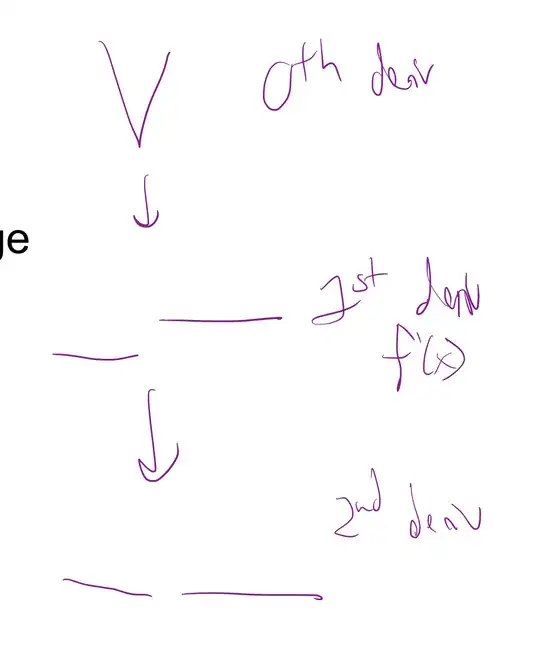
The limit of the third derivative $f'''(x)$ as $x$ approaches zero exists and is indeed zero. However, for the derivative to be continuous in this point (or even to exist in this point), it is necessary for this limit to be equal to the function ($f'''(x)$) evaluated in that point. In this case, $f'''(x)$ is not defined in $x=0$, as $f''(x)$ is also not defined in $x=0$ $(f^{(n+1)}(x)$ can only be defined at most in the intervals where $f^{(n)}(x)$ is defined), so $f'''(0)$ does not exist.
In summary, it is clear that the existence of the limit and the existence of the function are two different things. A function can be undefined in a point and yet have a limit at that point, as is the case here for $f'''(x)$.