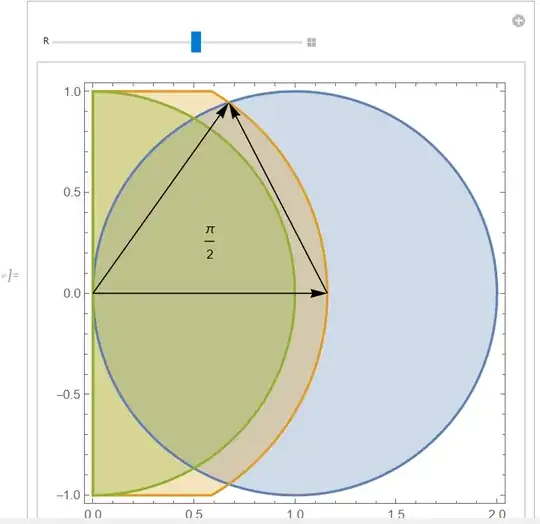
Because there is implied some complex trigonometric function algebra, use Mathematica
Manipulate[With[{},
  RegionPlot[{(x - 1)^2 + y^2 < 1 , x^2 + y^2 < R^2 ,
                     x^2 + y^2 < 1}, {x, 0, 2}, {y, -1, 1},
 Epilog -> {
 {Arrow[{{0, 0}, {R, 0}}],
  Arrow[{{0, 0}, R {R/2, Sqrt[1 - R^2/4]}} ]},
 {Arrow[{{R, 0}, R {R/2, Sqrt[1 - R^2/4]}}]}, {Text[
   Rationalize[
     NIntegrate[
      Boole[(x - 1)^2 + y^2 < 1 && x^2 + y^2 < R^2 ]/\[Pi],
        {x, 0,2}, {y, -1, 1}], 1/100] *\[Pi], {R/2, 1/4}]}}]],
  {{R, 1.16}, 0, 2}, ControlPlacement -> Top]
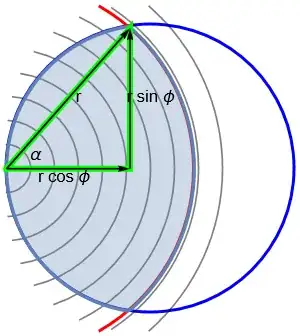
Graphics[{{Thickness[0.01], Blue, Circle[{1, 0}, 1]},
          {Thickness[0.01], Red, Circle[{0, 0}, 1.3, {-\[Pi]/3, \[Pi]/3}]},
          {Opacity[0.5],
           Array[(Circle[{0, 0}, #1/6, Cos[#/9] {-\[Pi]/2, \[Pi]/2}] &), 9]},
        RegionPlot[(x - 1)^2 + y^2 < 1 && x^2 + y^2 < 1.7 ,
           {x, 0,  2}, {y, -1, 1}][[1]],
        {Green, Thickness[0.02],
        Line[
        {x0 = {0, 0}, x1 = {1.3 Cos[0.85], 0}, x2 = 1.3 {Cos[0.85], Sin[0.85]},
         {0, 0}}]},
         {Black, Arrow@{{ x0, x1}, {x1, x2}, {x0, x2}}},
       Text["r", 1/2 {1, 1}], Text["\[Alpha]", {0.2, 0.1}],
       Text["r cos \[Phi]", {0.4, -0.05}], Text["r sin \[Phi]", {1, 0.5}]},
       PlotRange -> {{0, 2}, All}]
The two circles have the point of intersection at
$$(a\cos \phi - 1)^2 + a^2 (1 - \cos^2 \phi) \ = \ 1 \quad \leftarrow \quad \phi= \cos^{-1}\left(\frac{r}{2}\right)$$
So we have
$$\begin{align}&\text{GrazingArea}(R) \ = \ \int _0^R\int _{-\sin ^{-1}\left(\sqrt{1-\frac{r^2}{4}}\right)}^{\sin ^{-1}\left(\sqrt{1-\frac{r^2}{4}}\right)} d\phi\ \ r dr \ \\& = \ \ \frac{1}{2} R \left(\pi R-\sqrt{4-R^2}\right)-\left(R^2-2\right) \sin ^{-1}\left(\frac{R}{2}\right)
\end{align}$$
The result is showing that the non grazed area is simple
$$\begin{align}&\text{NonGrazingArea}(R) \ = \
\int _R^2\int _{-\sin ^{-1}\left(\sqrt{1-\frac{r^2}{4}}\right)}^{\sin ^{-1}\left(\sqrt{1-\frac{r^2}{4}}\right)}rd\phi dr \ \ \\& = \ \ \frac{1}{2} R \sqrt{4-R^2}-\left(R^2-2\right) \cos ^{-1}\left(\frac{R}{2}\right) \end{align}$$
The numerical solution
  fr = R /.
      FindRoot[NonGrazingAreal[R] - \[Pi]/2, {R, 1},
            WorkingPrecision -> 128, AccuracyGoal -> 128]
1.15872847301812151782823350993350914968829226649209651182069588482066
       98025591960931993216107308604381759674951803405182901392509
is surely transcendental
Partition[ContinuedFraction[fr],16]
$$\left(
\begin{array}{cccccccccccccccc}
1 & 6 & 3 & 3 & 149 & 6 & 5 & 1 & 5 & 16 & 61 & 1 & 4 & 58 & 1 & 2 \\
2 & 4 & 1 & 7 & 23 & 3 & 1 & 1 & 3 & 20 & 1 & 8 & 1 & 2 & 8 & 2 \\
2 & 1 & 2 & 1 & 1 & 1 & 1 & 1 & 1 & 1 & 5 & 1 & 2 & 1 & 1 & 1 \\
6 & 1 & 285 & 2 & 1 & 1 & 1 & 4 & 1 & 1 & 1 & 17 & 2 & 5 & 1 & 2 \\
6 & 3 & 1 & 1 & 1 & 5 & 1 & 4 & 5 & 2 & 9 & 1 & 1 & 7 & 1 & 2 \\
1 & 2 & 3 & 4 & 5 & 1 & 1 & 4 & 1 & 5 & 1 & 12 & 2 & 2 & 1 & 2 \\
5 & 91 & 4 & 2 & 1 & 3 & 2 & 2 & 1 & 2 & 7 & 3 & 1 & 9 & 2 & 2 \\
\end{array}
\right)$$


