0

I have a problem with proving the below sequent in intuitionistic logic: $$ \neg \neg A \to \neg \neg B \vdash \neg \neg (A \to B) $$ I stuck here: proof
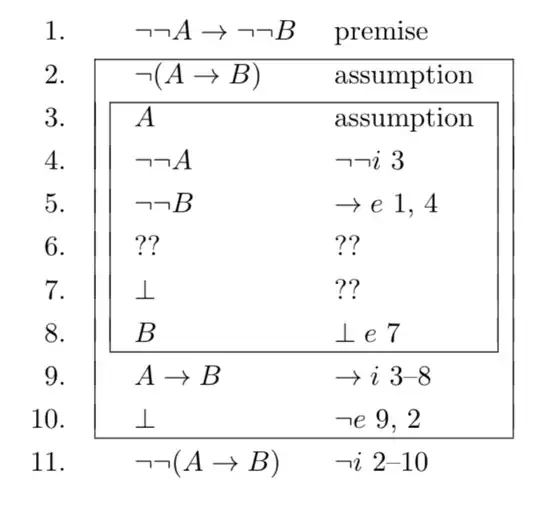
What should I put in $6th$ line? Is my approach even correct? I noticed that Generally, I have problems with proving sequents with double negation in intuitionistic logic. Is there any pattern for solving such examples?

Graham Kemp
  • 133,231
  • 1
    You should be having trouble, because it's not provable. – Zhen Lin Dec 13 '20 at 12:48
  • @ZhenLin Why is that? I was asked to solve that on the exam last week. If you are correct that would mean this exercise doesn't make sense... – damian9E Dec 13 '20 at 12:52
  • There are some variants that are provable: for example, $(A \to B) \vdash (\lnot \lnot A \to \lnot \lnot B)$, or $(\lnot \lnot A \to B) \vdash (A \to B)$. But the one you are asking about is not. Take $A = \top$; then it simplifies to $\lnot \lnot B \vdash B$, which is an intuitionistic taboo. – Zhen Lin Dec 13 '20 at 13:16
  • 1
    @ZhenLin I'm sorry, I made a mistake in the title and description... It should be $\neg \neg A \to \neg \neg B \vdash \neg \neg (A \to B)$ – damian9E Dec 13 '20 at 13:32
  • 2
    @damian9E Welcome to Math Stackexchange! The answer to your question can be found in the linked duplicate - more specifically, see the second proof in user Z.A.K.'s answer there. – Alex Kruckman Dec 13 '20 at 15:26
  • Modifying your proof:$$\tiny\def\ftch#1#2{~\begin{array}{|l}#1\\hline#2\end{array}}\ftch{~~1.~\lnot\lnot A\to\lnot\lnot B}{\ftch{~~2.~\lnot(A\to B)}{\ftch{~~3.~A}{~~4.~\lnot\lnot A\quad\lnot\lnot\textsf{i (3)}\~~5.~\lnot\lnot B\quad{\to}\textsf{e (1,4)}\\ftch{~~6.~B}{\ftch{~~7.~A}{~~8.~B\quad\textsf{reit (6)}}\~~9.~A\to B\quad{\to}\textsf{i (7-8)}\10.~\bot\quad\lnot\textsf{e (9,2)}}\11.~\lnot B\quad\lnot\textsf{i (6-10)}\12.~\bot\quad\lnot\textsf{e (11,5)}\13.~B\quad\bot\textsf{e (12)}}\14.~A\to B\quad{\to}\textsf{i (3-13)}}\15~.\lnot\lnot (A\to B)\quad\lnot\textsf{i (2-14)}}$$ – Graham Kemp Dec 14 '20 at 03:28
  • ... Of couse there should be a $\bot$ derived between 14 and 15. – Graham Kemp Dec 14 '20 at 11:32

0 Answers0