36

This question is about showing that $n!$ points resulting from applying a function (defined below) to the permutations of $n$ numbers lie on a $n-1$ dimensional hyperplane.

Let $X=\langle x_1,\cdots,x_n \rangle$ and $Y=\langle y_1,\cdots,y_n \rangle$ be vectors of positive reals and let $P=\langle p_1,\cdots,p_n \rangle$ be a permutation of the numbers $\{1,\cdots,n\}$. Let,

$$ y_i=\log\left(1+\frac{x_i}{1+\sum\limits_{p_j<\,p_i}x_j}\right) $$ be a mapping from $X,P$ to $Y$. So, for any given vector $X$, we have $n!$ (one for each permutation) output vectors $Y$. Let $Y_P$ denote a vector resulting from permutation $P$. Now, for a given $X$, create a matrix $M$ such that each row of it is $Y_P-Y_{P_1}$ for a fixed $P_1$ and for all $P$.

$$ M=\begin{bmatrix} Y_{P_1}-Y_{P_1} \\ Y_{P_2}-Y_{P_1} \\ \vdots \\ Y_{P_{n!}}-Y_{P_1} \end{bmatrix} $$

So, $M$ is a $n! \times n$ matrix. I have two questions:

  1. I guess the rank of $M$ is at most $n-1$, that is all of $Y$'s lie on a hyperplane of dimension $n-1$ (I verified it for $n=3$ and $n=4$). Is that true or not? Why?
  2. For what sort of mappings from $X,P$ to $Y$, is the answer to the previous question positive?

Edit 3:

I realized that for all of the permutations, $\sum_i y_i = \log(1+\sum_i x_i)$ and as Chris Culter commented below, this might be the solution to the problem. The proof of inequality is long but an example clears its correctness: consider $n=3$ and $P=\langle 1, 2, 3 \rangle$,

$$ \begin{align} y_1+y_2+y_3&= \log(1+\frac{x_1}{1+x_2+x_3})+ \log(1+\frac{x_2}{1+x_3})+ \log(1+\frac{x_3}{1})\\ &= \log(\frac{1+x_1+x_2+x_3}{1+x_2+x_3})+ \log(\frac{1+x_2+x_3}{1+x_3})+ \log(\frac{1+x_3}{1})\\ &= \log(1+x_1+x_2+x_3). \end{align} $$

Since any other permutation only renames $x_1$, $x_2$, and $x_3$, the output remains the same.

Edit 2:

The problem has a specific structure which may help solving it: The $n!$ points consist of $n$ ensembles of $(n-1)!$ points. Ensemble $i$ consists of all of the points $Y_P$ such that $i^{th}$ element of $P$ is 1. Therefore, all of the points in ensemble $i$ has the same $y_i$.

For example, for $n=3$, there are 3 ensembles of 2 points (6 points in total). All of the points lie on a 2D plane. The following figure shows an example in 3D:

3d example

Points in the same ensemble have a same colour. The labels beside the points denote the permutation that generates the point. So, points 123 and 132 are in ensemble 1, points 213 and 312 are in ensemble 2 (1 is the second element of their permutation), and points 231 and 321 are in ensemble 3 (1 is the third element of their permutation).

For $n=4$, there are 4 ensembles of 6 points (24 points in total). Since all of the points in 4D lie on a 3D plane, we can project the points into the 3D space. Here is an example:
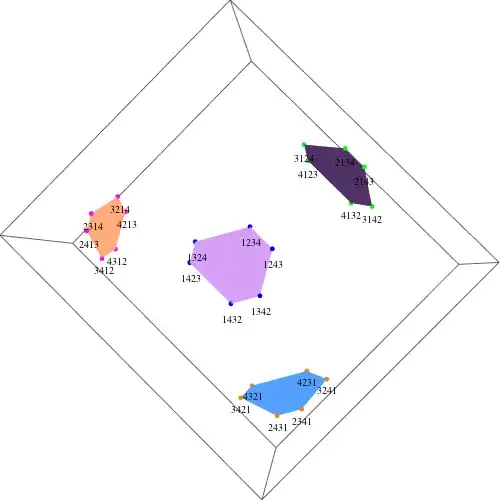
4d example

Higher dimensions are recursively constructed as described above. So, for $n=5$, there are 5 ensembles of the form shown above (in 4D). This recursive nature can be useful for solving the problem.

Edit 3:

  • I used Mathematica to verify my conjecture for $n=3$ to $8$ and it's correct. See my other question on Mathematica.SE. For $n>8$, because of the exponential running time of the algorithm, it's hard to verify the conjecture.

  • The above conjecture also holds for the following mapping functions:

$$ y_i={x_i}-{\sum\limits_{p_j<\,p_i}x_j} $$

$$ y_i={x_i}^3-{\sum\limits_{p_j<\,p_i}{x_j}^2} $$

  • But it does not hold for the following functions:

$$ y_i=\log\left(\frac{x_i}{1+\sum\limits_{p_j<\,p_i}x_j}\right) $$

$$ y_i={x_i}^3-\left(\sum\limits_{p_j<\,p_i}x_j\right)^2 $$

Helium
  • 732
  • 1
    What is «it» in the second question? – Harald Hanche-Olsen May 10 '13 at 08:31
  • 5
    The rank of a matrix can never be any higher than its smallest dimension-you might see this by considering the row reduction. – Kevin Carlson May 10 '13 at 08:43
  • Note that $i$ is now a column index; rows are indexed by $p$. For $n=2$ I get $\begin{pmatrix} \log(1+x_1) & \log(1+\frac{x_2}{1+x_1}) \ \log(1+x_1) & \log(1+\frac{x_2}{1+x_2}) \end{pmatrix}$ whose rank in general is $2$, not${}\leq1$. For instance for $x_1=1,x_2=2$ it gives $\begin{pmatrix} \log(2) & \log(2) \ \log(2) & \log(5/3) \end{pmatrix}$ which is clearly full-rank. In other words your guess seems wrong. It would be good to show what you did actually check for $n=3$. – Marc van Leeuwen May 10 '13 at 09:39
  • Hi there! I made the corrections and removed my comments. I also edited the question and added some new details and observations. I think the question is solvable now. Could you please have another look at it and give it another try. My feeling is that the answer is like this is obvious because ..., but I don't know the because part! – Helium May 19 '13 at 04:32
  • 1
    FWIW, the diagrams are reminiscent of permutohedra. – Chris Culter Aug 22 '13 at 00:54
  • @ChrisCulter: that's a great comment. Do you have any idea or reference describing why "The permutohedron of order $n$ lies entirely in the $(n − 1)$-dimensional hyperplane"? – Helium Aug 22 '13 at 01:04
  • @Mohsen Sure, as Wikipedia explains, every vertex $x$ of the permutohedron has the same sum-of-coordinates: $\sum x_n=\sum n$. Note that $\sum x_n$ is the dot product of $x$ with the vector of all $1$s. This $1$-dimensional constraint defines an $(n-1)$-dimensional hyperplane. – Chris Culter Aug 22 '13 at 01:12
  • @ChrisCulter: Wow! My problem has quite the same nature since $\sum y_i = \log(1+\sum x_i)$ for all of the points. This must be the solution or isn't it? – Helium Aug 22 '13 at 01:24
  • @Mohsen I can't tell at a glance... The formula for $y_i$ looks rather complicated. How did you arrive at $\sum y_i = \log(1+\sum x_i)$? – Chris Culter Aug 22 '13 at 01:32
  • @ChrisCulter: I updated the question and added some detail. It's not a complete proof but I think it's enough to convince the reader. Could you please write your comments as an answer with more details if you think this is the correct one. – Helium Aug 22 '13 at 02:06
  • @Mohsen Hmm, well... the rows of the matrix may lie on an $(n-1)$-dimensional hyperplane, but that hyperplane doesn't pass through the origin, so they might still span the full $n$-dimensional vector space. – Chris Culter Aug 22 '13 at 03:02
  • @ChrisCulter: You are right. I made a mistake in my last edit to the question which is now corrected. I actually meant $(n-1)$-dimensional hyperplane, not space. But, it's not clear to me yet why a permutohedron is in $(n-1)$-dimensional space while it may not pass the origin too. – Helium Aug 22 '13 at 13:24
  • I tested this using the identity permutation, $p_i=i$, and starting in $x=[1,\ldots,1]$ for $n=3,4$, and in all cases points $P_1,\ldots,P_{n+1}$ fail to lie on a hyperplane. So the hypothesis is wrong, as has already been suggested. However, since $\sum y_i=\ln(1+\sum x_i)$, the points will converge towards the plane $\sum x_i=0$. – Einar Rødland Apr 24 '14 at 14:50

1 Answers1

1

Answer to the first question As Chris Culter guessed, the answer is YES and this is because $\sum_{i}y_i=\ln(1+\sum_{i} x_i)$. The proof of this last identity is not difficult, it is basically a change of indices and a careful use of notation (see below). What you have here is a telescoping sum (or product, depending on the way in which you look at it), but disposed according to a random order (depending on the permutation $p$).

$$ \begin{array}{lcl} e^{\prod_{i=1}^n y_i} &=&\prod_{i=1}^n e^{y_i} \\ &=& \prod_{i=1}^n \frac{1+x_i+\sum_{p(j)<p(i)}x_j}{1+\sum_{p(j)<p(i)}x_j} \\ &=& \prod_{I=1}^n \frac{1+x_{p^{-1}(I)}+\sum_{J<I}x_{p^{-1}(J)}} {1+\sum_{J<I}x_{p^{-1}(J)}} \ \text{(where we put } I=p(i),J=p(j) \text{)} \\ &=& \prod_{I=1}^n \frac{1+z_I+\sum_{J=1}^{I-1}z_J} {1+\sum_{J=1}^{I-1}z_J} \ \text{(where we put } z_I=x_{p^{-1}(I)} \text{)} \\ &=& \prod_{I=1}^n \frac{t_I} {t_{I-1}} \ \text{(where we put } t_I=1+\sum_{J=1}^{I}z_J \text{)} \\ &=& \frac{t_N} {t_0}=1+x_1+x_2+\ldots +x_n. \end{array} $$

Partial answer to the second question

When $y_i$ is of the form $A(x_i)-\sum_{p(j)<p(i)}B(x_j)$ where $A$ and $B$ are functions, your conjecture still holds, because

$$ \sum_{i}B(x_i)y_i=\sum_{i}A(x_i)B(x_i)-\frac{1}{2}\sum_{I\neq J}B(x_I)B(x_J) $$

When $A(x)=x$ and $B(x)=x$, you get $y_i=x_i-\sum_{p(j)<p(i)}x_j$.

When $A(x)=x^3$ and $B(x)=x^2$, you get $y_i=x_i^3-\sum_{p(j)<p(i)}x_j$.

Ewan Delanoy
  • 63,436