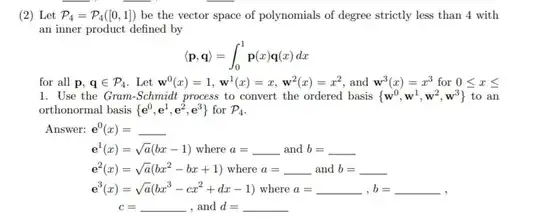
SUMMARY:Given an (ordered) basis we can create the Gram matrix $G$ of inner products of basis vectors. An orthonormal basis is given as the columns of a square matrix $W$ such that $W^T GW = I.$ That is, the coefficients (in the original basis) of an orthonormal basis are the columns of $W.$
ORIGINAL: Given a symmetric matrix $H,$ there are methods for finding an invertible matrix $P$ such that $P^T HP = D$ is diagonal. In your case, the matrix is the Gram matrix of inner products of basis vectors.
$$
\left(
\begin{array}{rrrr}
1 & \frac{1}{2} & \frac{1}{3} & \frac{1}{4} \\
\frac{1}{2} & \frac{1}{3} & \frac{1}{4} & \frac{1}{5} \\
\frac{1}{3} & \frac{1}{4} & \frac{1}{5} & \frac{1}{6} \\
\frac{1}{4} & \frac{1}{5} & \frac{1}{6} & \frac{1}{7} \\
\end{array}
\right)
$$
This is Hilbert's matrix, or at least a square upper left corner of the infinite matrix, and constructed by precisely Hilbert's manner. https://en.wikipedia.org/wiki/Hilbert_matrix
I multiplied by $420$ to get a matrix of integers, then went through the method I asked about at reference for linear algebra books that teach reverse Hermite method for symmetric matrices
$$ P^T H P = D $$
$$\left(
\begin{array}{rrrr}
1 & 0 & 0 & 0 \\
- \frac{ 1 }{ 2 } & 1 & 0 & 0 \\
\frac{ 1 }{ 6 } & - 1 & 1 & 0 \\
- \frac{ 1 }{ 20 } & \frac{ 3 }{ 5 } & - \frac{ 3 }{ 2 } & 1 \\
\end{array}
\right)
\left(
\begin{array}{rrrr}
420 & 210 & 140 & 105 \\
210 & 140 & 105 & 84 \\
140 & 105 & 84 & 70 \\
105 & 84 & 70 & 60 \\
\end{array}
\right)
\left(
\begin{array}{rrrr}
1 & - \frac{ 1 }{ 2 } & \frac{ 1 }{ 6 } & - \frac{ 1 }{ 20 } \\
0 & 1 & - 1 & \frac{ 3 }{ 5 } \\
0 & 0 & 1 & - \frac{ 3 }{ 2 } \\
0 & 0 & 0 & 1 \\
\end{array}
\right)
= \left(
\begin{array}{rrrr}
420 & 0 & 0 & 0 \\
0 & 35 & 0 & 0 \\
0 & 0 & \frac{ 7 }{ 3 } & 0 \\
0 & 0 & 0 & \frac{ 3 }{ 20 } \\
\end{array}
\right)
$$
When we divide back again by the same 420, we find
$$\left(
\begin{array}{rrrr}
1 & 0 & 0 & 0 \\
- \frac{ 1 }{ 2 } & 1 & 0 & 0 \\
\frac{ 1 }{ 6 } & - 1 & 1 & 0 \\
- \frac{ 1 }{ 20 } & \frac{ 3 }{ 5 } & - \frac{ 3 }{ 2 } & 1 \\
\end{array}
\right)
\left(
\begin{array}{rrrr}
1 & \frac{1}{2} & \frac{1}{3} & \frac{1}{4} \\
\frac{1}{2} & \frac{1}{3} & \frac{1}{4} & \frac{1}{5} \\
\frac{1}{3} & \frac{1}{4} & \frac{1}{5} & \frac{1}{6} \\
\frac{1}{4} & \frac{1}{5} & \frac{1}{6} & \frac{1}{7} \\
\end{array}
\right)
\left(
\begin{array}{rrrr}
1 & - \frac{ 1 }{ 2 } & \frac{ 1 }{ 6 } & - \frac{ 1 }{ 20 } \\
0 & 1 & - 1 & \frac{ 3 }{ 5 } \\
0 & 0 & 1 & - \frac{ 3 }{ 2 } \\
0 & 0 & 0 & 1 \\
\end{array}
\right)
= \left(
\begin{array}{rrrr}
1 & 0 & 0 & 0 \\
0 & \frac{ 1 }{ 12 } & 0 & 0 \\
0 & 0 & \frac{ 1 }{ 180 } & 0 \\
0 & 0 & 0 & \frac{ 1 }{ 2800 } \\
\end{array}
\right)
$$
To get the identity matrix, we now multiply on the far left and far right by diagonal matrix
$$
\left(
\begin{array}{rrrr}
1 & 0 & 0 & 0 \\
0 & 2 \sqrt 3 & 0 & 0 \\
0 & 0 & 6 \sqrt 5 & 0 \\
0 & 0 & 0 & 20 \sqrt 7 \\
\end{array}
\right)
$$
Finally, the desired orthonormal basis are the COLUMNS of
$$
\left(
\begin{array}{rrrr}
1 & - \frac{ 1 }{ 2 } & \frac{ 1 }{ 6 } & - \frac{ 1 }{ 20 } \\
0 & 1 & - 1 & \frac{ 3 }{ 5 } \\
0 & 0 & 1 & - \frac{ 3 }{ 2 } \\
0 & 0 & 0 & 1 \\
\end{array}
\right)
\left(
\begin{array}{rrrr}
1 & 0 & 0 & 0 \\
0 & 2 \sqrt 3 & 0 & 0 \\
0 & 0 & 6 \sqrt 5 & 0 \\
0 & 0 & 0 & 20 \sqrt 7 \\
\end{array}
\right)
$$
as coefficients for the original ordered basis $(1,x,x^2, x^3).$
These give
$$ \color{red}{ 1,} \; \;
\color{blue}{
\sqrt 3 \cdot (2x-1) ,} \; \;
\color{green}{
\sqrt 5 \cdot (6 x^2 -6x+1),} \; \;
\color{magenta}{
\sqrt 7 \cdot (20 x^3 - 30 x^2 + 12 x -1)} $$