4

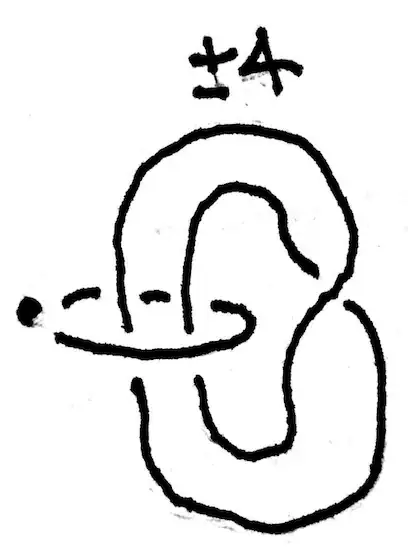
Are the following two links equivalent (orientation preserving isotopies)?enter image description here

The two links have the same linking number. The only difference is the crossing that in one case is positive while in the other negative. In other words, the writhe of the curled component is different (but the writhe is not invariant under the first Reidemeister move).

The most naive approach would be to rotate part of the picture but these kind of transformations cannot change the writhe.

Motivation: This kind of pictures pop up in studying Kirby diagrams of $\mathbb{D}^2$ bundles over $\mathbb{RP}^2$. In particular I expect them to be equivalent.

Overflowian
  • 6,020
  • Have you tried computing their Jones polynomials or similar? – Qiaochu Yuan Sep 03 '20 at 19:34
  • 1
    I made a model of the link on the right out of paper and have been trying to manipulate it into the one on the left. No luck so far! – Qiaochu Yuan Sep 03 '20 at 20:02
  • 1
    I don't trust my computations yet but I think the Jones polynomials are different. – Qiaochu Yuan Sep 03 '20 at 20:57
  • They are mirror images of each other. The Jones polynomials depend a bit on orientations of components (due to writhe), but ignoring that both are, up to mirror image, L4a1 in the LinkInfo tables (a.k.a. the $T(2,4)$ and $T(2,-4)$ torus links). I computed the Jones polynomials with https://kmill.github.io/knotfolio/ by pasting in the image of the diagrams. The Jones polynomials are related by $t \mapsto t^{-1}$. – Kyle Miller Sep 04 '20 at 01:03
  • 1
    While the links are not isotopic, there is an orientation-preserving homeomorphism between their exteriors. The moves that have to do with 1/n surgeries on unknots let you go from one to the other (with the surgery being done on either component). – Kyle Miller Sep 04 '20 at 01:14

1 Answers1

0

I've also been reading about Kirby calculus recently and I think I have a solution using Kirby calculus. I'm new to this sort of thing, so perhaps somebody more knowledgeable can comment on whether this approach is correct. I'm sure this is also overkill.

Maybe the first thing to note is that the components of both links are symmetric, so we don't have to be careful about specifying which components correspond after an isotopy. If it were the case that the first link was isotopic to the second one, then we'd have that the following 4-manifolds were diffeomorphic:

With $+4$ framing we get the $D^2$-bundle over $\mathbb{R}\mathrm{P}^2$ with Euler number $+2$, and with $-4$ framing we get Euler number $-6$. However these two can be distinguished using the fact that the former can be embedded in $S^4$ while the latter cannot. Indeed the Euler number of [the normal bundle of] any emedded $\mathbb{R}\mathrm{P}^2$ in $S^4$ must be $\pm 2$ [c.f. Gompf & Stipsicz Exercise 5.5.7(a)].

Hrhm
  • 3,555