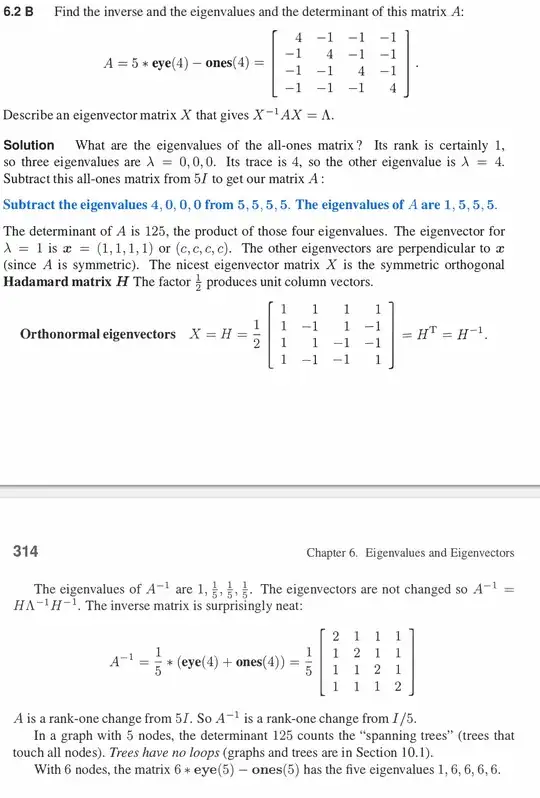
In the blue bolded line, the author claims that because $A = 5 eye(4) - ones(4)$, \begin{gather*} eigenvalues(A) = eigenvalues(5 eye(4)) - eigenvalues(ones(4))\\ Ax = \lambda_A x\\ (5eye(4) - ones(4)) x = \lambda_A x\\ (\lambda_{5eye(4)} - \lambda_{ones(4)})x = \lambda_A x \end{gather*} The jump between the previous two equalities is only possible if the eigenvectors corresponding to the eigenvalues of $5eye(4)$ and $ones(4)$ are the same, right? So why didn't the person who wrote this solution make that argument? I do not think in general it is possible to add eigenvalues of summands to get the eigenvalues of a sum like the solution author is doing.


