7

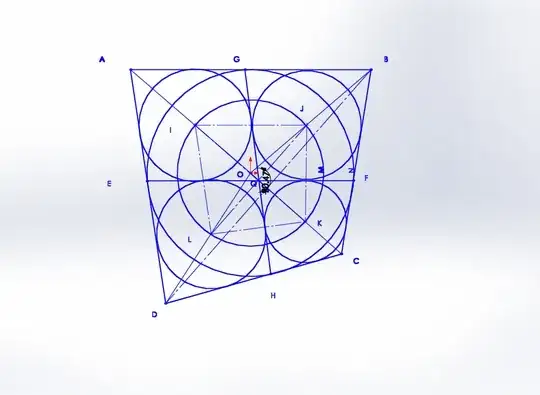
I found this problem online, where it was asked to prove EF = GH.

enter image description here

I was able to prove that, but got intrigued by how the four smaller inscribed circles could be constructed in the first place.

That is, given the fact that AD + BC = AB + CD (i.e. an inscribed circle can be constructed for ABCD), how can we contruct EF and GH, such that for each smaller quadrilateral, an incribed circle can be constructed?

Also, given a fixed quadrilateral with AD + BC = AB + CD, are the positions of EF and GH unique?

Any hints would be appreciated.

yomayne
  • 360
  • I think the key is just to mark a lot of contact points and give a lot of names to the segments. There will be many segments with same size and you will eventually break lines $GH$ and $EF$ in the same sum. – hellofriends Aug 14 '20 at 10:19
  • The question isn't about proving EF = GH. It's about the construction - how can those four circles be constructed in the first place? – yomayne Aug 15 '20 at 07:00
  • oh sorry, the question is much cooler than I thought – hellofriends Aug 15 '20 at 13:09

2 Answers2

4

We're going to use

Graves-Chasles Theorem (G-C) $\quad$ Let $ABCD$ be a convex quadrilateral such that all its sides touch a conic $\alpha$. Then the following four properties are equivalent:

  1. There exists a circle inscribed into $ABCD$.
  2. The points $A$ and $C$ lie on a conic confocal with $\alpha$.
  3. The points $B$ and $D$ lie on a conic confocal with $\alpha$.
  4. The intersections of opposite sides lie on a conic confocal with $\alpha$.

Graves-Chasles

Let the foci $F_1,F_2$ be the intersections $AB\cdot CD$ and $AD\cdot BC$ respectively. We let conic $\alpha$ be the degenerate ellipse with foci $F_1,F_2$ and eccentricity $1$. By G-C, $A,C$ lie on an ellipse $\beta$ (blue) confocal with $\alpha$, and $D,B$ lie on a hyperbola $\gamma$(green) confocal with $\alpha$.

Let $P$ be the intersection of $\beta$ and $\gamma$, and let the lines $PF_1$ and $PF_2$ cut the quadrilateral in $E,F,G,H$.

By G-C, the four sub-quads are tangential (i.e. have an incircle). For example, for $DEPH$, properties $3,4 \implies 1$.

Much more detail, including a proof of G-C, can be found in Akopyan & Bobenko, Incircular nets and confocal conics. Notably, this construction can be recursed and generalized to create so-called incircular nets. G-C is Theorem 2.5 in the paper.

brainjam
  • 9,172
  • awesome answer. We lack a bit of the ruler compass details, for example: point $P$ of intersection of the conics is indeed the midpoint of the incenter of $ABCD$ with it's diagonals meeting. So it can probably be translated, but it's good enough for me. Thanks. – hellofriends Jun 26 '21 at 03:40
  • 1
    Yes, it looks like $P$ is on the line joining incenter and diagonals meeting. But it is distinct from the midpoint (although very close). – brainjam Jun 26 '21 at 05:07
  • I think it is possible to construct the intersection of the conics with ruler and compass, since we have the focii. If I find anything I will post here. – hellofriends Jun 26 '21 at 06:20
  • 1
    Ruler and compass constructions of conic intersections tend to be impossible, but this one works: https://math.stackexchange.com/questions/1906795/non-trivial-questions-about-confocal-ellipses. Don't know if it's helpful for this scenario. Maybe calculate analytically and if it requires solving or cubic or higher then you're in trouble. – brainjam Jun 26 '21 at 22:15
  • Nice, maybe this can show exactly who the point $P$ is. – hellofriends Jun 26 '21 at 22:17
  • I almost forgot, but there is one way to construct the meetings of an hyperbola and a line with ruler and compass. If it is true that $P$ is on the line joining the incenter with the diagonals meeting, then one can construct it https://math.stackexchange.com/questions/4185613/given-the-two-foci-and-the-vertices-of-an-hyperbola-and-a-random-line-how-can-on – hellofriends Sep 14 '21 at 03:14
0

enter image description here

Hint:

Use this fact:

ُThe center of four circle I, J, K and L are on a circle (M) concentric with inscribed circle N at O and Lines AO, BO, CO and DO which connect vertices of quadrilateral to the center (O) of inscribed circle.

Now follow this rule:

1- Draw AO. BO, CO and DO.

2-draw AC and BD, they intersect on P.

3-Connect OP.

4- find the midpoint of OP and mark it as Q. Q is the intersection of EF and GH (in your figure P).

5- Draw a line parallel with BD, it intersect BO and DO on J and L respectively.these are the center of two opposite circles.They also define the measure of the radius (M).

6- Draw circle (M), it intersect AO and CO on I and K respectively. these are the centers of other two opposite circles.

7- Draw four cicles.

8- draw common tangents of adjacent circles, they will intersect on Q( in your figure P) and you get EF and GH.

The reason for taking Q as the midpoint of OP is that if equilateral is regular, points P and O and Q will be coincident. If it is not regular , they will have a distance like OP and the intersection of common tangents locates on its midpoint Q.

sirous
  • 12,694
  • very nice, it seems like point $Q$ is a constant even if the diagonals are not perpendicular. – hellofriends Aug 16 '20 at 23:56
  • @hellofriends, thank you for correcting me. You are right , the diagonals must not necessarily be perpendicular . I edited my answer.. – sirous Aug 17 '20 at 08:18
  • oh, no. I think just point $Q$ is fixed regardless the angle of the diagonals. The centers of the circles do NOT lie on a circle if the diagonals are not perpendicular, but it seems to me that $EF \cap HG = Q$ in all cases. – hellofriends Aug 17 '20 at 09:04
  • "The center of four circle I, J, K and L are on a circle (M) concentric with inscribed circle N at O" - this doesn't seem true. Please check this – yomayne Aug 18 '20 at 09:07
  • @yomayne, my method works if you ABCD. What you did is not due to points ABCD. You have gone the reverse direction and constructed an quadrilateral ABCD according to the common tangents of circles. Every one could do that. If it is not so. describe your method in " answer your question" so that we can see that interesting method. – sirous Aug 18 '20 at 10:59
  • @sirous Did you check the image? It contradicts the first fact that you shared. Also, I'm here because I don't know the answer to the question. I didn't construct that figure using any method - found it on a website. – yomayne Aug 18 '20 at 12:58
  • @yomayne, I checked it and it shows that it is possible. I can tell you how to draw that kind of figures that contradicts the fact.(just draw three lines from one point which have acute angles, draw a line connecting three lines, draw two circles each tangent to three lines, then draw their common tangent to connect three lines. continues this, the third connecting line completes the quadrilateral) But it is certainly not what you asked. You said we have a quadrilateral ABCD. Where as I said if you first draw the circle you can make many figures that contradicts the fact. – sirous Aug 18 '20 at 15:03
  • @yomayne, Moreover, if you take the quadrilateral of you figure and follow my method, the measure of circles will be different with those of your figure. You will get absolutely different figure, – sirous Aug 18 '20 at 15:18