27

Let $f\in C^{3}[0,1]$such that $f(0)=f'(0)=f(1)=0$ and $\big|f''' (x)\big|\le 1$.Prove that $$\left|30240\int_{0}^{1}x(1-x)f(x)f'(x)dx\right|\le1 .$$

I couldn't make much progress on this problem. I thought that maybe I should try using polynomial interpolation since I have a bound for $|f'''|$, but I can't determine the interpolation polynomial and I am quickly stuck (there is also the problem that I am dealing with both $f$ and $f'$ under the integral). Apart from this, I don't think that there is much we can do, the solution probably relies on this technique, but I can't make further progress.

  • Try integration by parts – Integrand Aug 07 '20 at 13:13
  • 2
    @Integrand I most certainly would, but the result looks horrendous to me. Do you have any specific idea? – JustAnAmateur Aug 07 '20 at 13:20
  • 2
    Integrating by parts once (to get $f^2$ in the integrand instead of having $ff'$) and then use polynomial interpolation on $f$ you can easily get bounds like 5/110592/5 or 101/2580480 instead of 1/30240, but it is also clear those are unattainable. I can't think of a way to get 30240 at this point. – user10354138 Aug 07 '20 at 15:58
  • 5
    at least the equality is attained when $f(x) = \pm\dfrac{x^3-x^2}{6}.$ I will try to work out a solution in a couple days. – dezdichado Aug 09 '20 at 20:56
  • 1
    Another question: https://artofproblemsolving.com/community/c7h1951001p13467104 – River Li Aug 10 '20 at 03:13
  • if we add the condition $f'(1)=0$ the problem does not change under the substitution $x=1-y$ – Barackouda Aug 10 '20 at 15:50
  • Following dezdichado I think that $\frac{x^n-x^{n-1}}{n!}$ is valid .Maybe it's the only one . – Barackouda Aug 10 '20 at 16:21
  • Well there is another one $\frac{x\sin(\pi x)}{32}=f(x)$ – Barackouda Aug 10 '20 at 16:41
  • I can only claim that $x (1 - x) f(x) f'(x) = o(x^2)$ as $x \to 0$ by Taylor's theorem with the Peano form of the remainder. The given conditions $f(1) = 0$ and $|f'''(x)| \le 1$ are not used. Can this direction be helpful ? – taiwanjizhan Aug 10 '20 at 19:43
  • Prove this for polynomials, then use Stone Weierstrass to approximate and obtain your result, perhaps (in which case the upper bound will be given exactly by @dezdichado's suggestion) – RSpeciel Aug 10 '20 at 22:00
  • Also, @user698573, I don't think that either of your suggestions actually reach equality (via Mathematica) – RSpeciel Aug 10 '20 at 22:01
  • Just out of interest where did you find this problem? –  Aug 16 '20 at 10:49
  • @user I found it here https://artofproblemsolving.com/community/u150054h2090303p15104143, but since there was no solution I decided to post it here too. I also tried contacting the OP from AoPS, but he hasn't responded yet. – JustAnAmateur Aug 16 '20 at 12:00
  • 1
    @JustAnAmateur Many thanks! –  Aug 16 '20 at 12:05

4 Answers4

10

At first,

$$I=\int_0^1x(1-x)f(x)f'(x)\text{d}x \,\overset{IBP}{=\!=\!=}\,\frac12x(1-x)f^2(x)\bigg|_0^1+\frac12\int_0^1 (2x-1)f^2(x)\text{ d}x,$$ $$I=\frac12\int_0^1 (2x-1)f^2(x)\text{ d}x.\tag1$$

The given conditions mean that $f(x)$ has a root of multiplicity $2$ at $x=0$ and a simple root at $x=1.$

Taking in account the Besou theorem and assuming the condition $|f'''(x)| = 1,$ one can get $$|f_{opt}(x)| = a(x-0)^2(1-x) = a(x^2-x^3),\quad a = \frac16,\tag2$$

$$|I|\le\dfrac1{72}\int_0^1(2x-1)(x^2-x^3)^2\text{ d}x = \dfrac1{30240}.$$

$\color{green}{\textbf{EDIT of 12.08.20.}}$

Let us integrate the given inequality $$-1\le f'''(x) \le 1\tag{1n}$$ under the given conditions on the interval $(0,x),$ then $$ \begin{cases} -x\le f''(x) - f''(0)\le x\\[4pt] -\frac12x^2 \le f'(x) - xf''\left(0\right) \le \frac12x^2\\[4pt] -\frac16x^3 \le f(x) - \frac12x^2f''\left(0\right) \le \frac16x^3._{\Large\mathstrut} \end{cases}\tag{2n}$$

From $(2n.3)$ should $$|6f(x)-3f''(0)x^2| \le x^3,\quad -1\le -3f''(0)\le1,$$ $$6|f(x)|\le |x^3+ax^2|,\quad |a|\le 1,\quad f(1)=0,$$ $$6|f(x)|\le x^2-x^3 = h(x).$$

This confirms formulas $(2).$

Similarly, from $(2n.2)$ $$|f'(x)| \le \frac12 x^2 -\frac13x = h'(x),$$ wherein $h'(x)$ is synchronized with $h(x).$

Therefore, $$|I| \le \left|\int_0^1 x(1-x) h(x) h'(x) \text{ d}x\right| = \frac1{30240}.$$

  • Thank you! Could you please elaborate on how you came up with (2)? I initially thought that you used the estimate for the interpolation error from here https://en.wikipedia.org/wiki/Polynomial_interpolation#Interpolation_error, but it doesn't look like it – JustAnAmateur Aug 10 '20 at 23:11
  • @JustAnAmateur You are welcome! $x^2-x^3 = x^2(1-x).$ Quadratic factor provides the conditions near $0,$ and the second factor near $1.$ – Yuri Negometyanov Aug 10 '20 at 23:13
  • Oh, I see. And this basically made you think about considering the auxiliary function $g(x)=f(x)-x^2+x^3$ and that's how you got the inequality. – JustAnAmateur Aug 10 '20 at 23:16
  • It seems that there is some more work to do before finally getting (2), I will look into it tomorrow since now it is late here. – JustAnAmateur Aug 10 '20 at 23:22
  • 3
    I am curious how you derived $(2).$ Taylor's remainder gives $6f(x) = ax^2+b_xx^3$ with $|a|, |b_x|\leq 1$ and the triangle inequality gives $|f(x)|\leq\dfrac{1}{6}(x^2+x^3).$ – dezdichado Aug 11 '20 at 00:59
  • @JustAnAmateur Thank you for the comments! Just edited. – Yuri Negometyanov Aug 11 '20 at 06:44
  • @dezdichado Thank you for the comment. Clarified. – Yuri Negometyanov Aug 11 '20 at 06:46
  • 1
    I still don't see how things would be this immediate. The Bezout I know only concerns polynomials and it says nothing about the derivatives. – dezdichado Aug 11 '20 at 06:51
  • @dezdichado I agree with you. I tried to develop on my comment from last night and it isn't possible to prove that inequality in the usual manner with the derivative(s) of that auxiliary function – JustAnAmateur Aug 11 '20 at 07:07
  • @dezdichado 1) Besou's theorem had applied 3 times; 2) The polynomial bounds the function. – Yuri Negometyanov Aug 11 '20 at 07:07
  • 1
    But you need your function to be polynomial in the first place in order to apply Bezout. Besides, that is not even the interesting part - the interesting part is how in the world the third derivative come out so cleanly whilst there is no second derivative in your estimation. – dezdichado Aug 11 '20 at 07:13
  • @YuriNegometyanov I think that where both me and dezdichado have our doubts is why the polynomial bounds the function. Could you please develop on this? I tried to prove it in the straightforward way, but it didn't work out, I would need some bounds on $f''$, so I am curious to see how you got the inequality, it doesn't seem to be so obvious. – JustAnAmateur Aug 11 '20 at 07:14
  • @JustAnAmateur Detalized. – Yuri Negometyanov Aug 11 '20 at 21:30
  • @dezdichado Detalized. – Yuri Negometyanov Aug 11 '20 at 21:31
  • 2
    The part until $|a|\le 1$ looks OK, but I don't see how you go from $|a|\le 1$ to your final bound – MoonKnight Aug 11 '20 at 21:49
  • 4
    Another point. Even if $|f(x)| \le x^2-x^3$, why the integral takes the maximum when $|f(x)|$ takes the maximum? especially noticing that $(2x-1)$ is negative in the first half the integral and positive in the second half of the integral – MoonKnight Aug 11 '20 at 22:45
  • @MoonKnight Thank you for the comments. New edit is ready. – Yuri Negometyanov Aug 12 '20 at 12:28
  • 1
    This solution should be right, but the use of notation $b'(x)$ is confusing. Just call it $c(x)$ or something and this will be easier to read at the end. Nice work. – Jake Mirra Aug 12 '20 at 13:04
  • @JakeMirra Thank you for advice! $h(x)$ looks the best choice. – Yuri Negometyanov Aug 12 '20 at 13:22
  • @dezdichado New edit is ready. – Yuri Negometyanov Aug 12 '20 at 13:24
  • @JustAnAmateur New edit is ready. – Yuri Negometyanov Aug 12 '20 at 13:29
  • 2
    @YuriNegometyanov. Thanks, it makes more sense now. But I am still confused about one step. Starting from $|6f(x) + ax^2|\le x^3$ and $|a|\le 1$. But how did you get $6|f(x)| \le x^2 - x^3$ from here? I can only get $6|f(x)| \le x^2 + x^3$. You may argue that $f(x)$ should have the same sign of $f''(0)$ (which is $a/3$) when $x$ is small. But why $f(x)$ cannot change sign? – MoonKnight Aug 12 '20 at 14:33
  • 2
    Yeah i had the same concern since the beginning. – dezdichado Aug 12 '20 at 15:30
  • 3
    Another tricky point here, $f'(x)$ must change sign somewhere as $f(0)= f(1)=1$. So changing the integral from IBP (which involves $2x-1$ part that changes the sign) back to the original form (which has a $f'(x)$ part that changes the sign) does not resolve the issue. The upper bound you set for $|f'(x)|$ is not correct, since $x/3-x^2/2$ is actually negative around $x=1$. – MoonKnight Aug 12 '20 at 16:17
  • 4
    now I am surprised by the fact that this answer keeps getting upvoted. The flaw here seems not rectifiable and similar questions here and here have very complicated solutions whilst only having much smaller coefficients, $4860$ and $1920$, and only having to deal with second order derivatives. – dezdichado Aug 14 '20 at 23:29
  • @dezdichado The optimal function is correct, the assuming can be refined (see the new answer). I think, this answer is a step in the right direction. – Yuri Negometyanov Aug 15 '20 at 08:04
9

First, using integration by parts, and noting that $f(0)=f'(0)=0$ we get $$ f(x)=\frac{x^2}{2}f''(0)+\frac{1}{2}\int_0^x(x-t)^2f^{(3)}(t)dt\tag{1} $$ And from $f(1)=0$ we get also $$ 0=f(1)=\frac{1}{2}f''(0)+\frac{1}{2}\int_0^1(1-t)^2f^{(3)}(t)dt $$ Hence $$\eqalign{ 0&=\frac{x^2}{2}f''(0)+ \frac{1}{2}\int_0^xx^2(1-t)^2f^{(3)}(t)dt\cr &+ \frac{1}{2}\int_x^1x^2(1-t)^2f^{(3)}(t)dt \tag{2}} $$ Subtracting from $(1)$ from $(2)$ we get $$f(x)=-\int_0^1k(x,t)f^{(3)}(t)dt\tag{3}$$ with $$k(x,t)=\cases{\dfrac{x^2(1-t)^2-(x-t)^2}{2}& if $t\leq x$\cr \dfrac{x^2(1-t)^2}{2}& if $ x\leq t$ }$$ (Note that $k(x,t)\ge 0$ for $0\leq x,t\leq 1$).

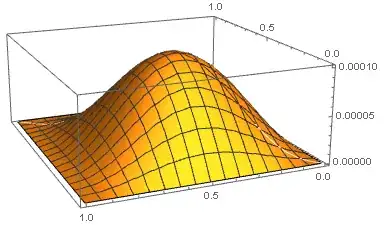
Now, we note that $$\eqalign{I&=\int_0^1x(1-x)f(x)f'(x)dx=\int_0^1\left(x-\frac{1}{2}\right)(f(x))^2dx\\ &=\int_0^1\int_0^1\int_0^1\left(x-\frac{1}{2}\right)k(x,t)k(x,s)f^{(3)}(t)f^{(3)}(s)dtdsdx\\ &=\int_0^1\int_0^1H(t,s)f^{(3)}(t)f^{(3)}(s)dtds\tag{4} } $$ with $$H(t,s)=\int_0^1\left(x-\frac{1}{2}\right)k(x,t)k(x,s)dx\tag{5}$$ Now, $H(s,t)=H(t,s)$ and for $0\leq t\leq s\leq 1$ we find $$H(t,s)=\frac{1}{240} (s-1)^2 t \left(s^4 (t-2)+s^3 (t+2)+s^2 (1-4 t)+s t+(t-1) t^4\right)$$ It is not very easy but we can show (see the remark below,) that $H$ is nonnegative, and this is the crucial point. As it is depicted in the next figure

1

It follows from the condition $|f^{(3)}|\leq 1$ that $$|{I}|\leq \int_0^1\int_0^1H(t,s)dtds=\frac{1}{30240}.$$

Remark. Let me add a proof of the positivity of $H(t,s)$. Indeed, It is a matter of verification that for $0<t\leq s\leq 1$ we have $$\eqalign{\frac{240 }{(1-s)^2 t}H(t,s)&= (1-t) \left(s^2-t^2\right)+2 s^2 (1-s) (s-t)\\& +s (s+1) (1-s)^2 t+(1-t)^2 t^2 (t+1)}$$

which is a sum of positive terms.

Omran Kouba
  • 29,112
  • 1
    +1. now this is an answer. – dezdichado Aug 16 '20 at 19:32
  • 1
    @Omran Kouba congratulations, this looks correct to me, you will most likely receive the bounty :) – JustAnAmateur Aug 16 '20 at 19:51
  • 1
    Your solution is impressive. I used Maple to check it. (+1 already) – River Li Aug 17 '20 at 05:38
  • 2
    @Omran Kouba I am curious, what was the intuition behind your solution? – JustAnAmateur Aug 17 '20 at 07:23
  • 4
    @JustAnAmateur, (1) The basic difficulty in this problem is the $2x-1$ changes sign on $[0,1]$ and direct majorization obliges us to replace it with $|2x-1|$ and this is not recommended here. (2) We need to express $f$ in terms of $f^{(3)}$ and here comes Taylor's formula with integral rest. This leads to the kernel $k(x,t)$, (3) Interchanging the order of integration will hopefully help us get rid of (2x-1). (4)So, we obtain $I$ with a kernel $H(t,s)$, and win if this kernel is positive. First, I made a plot, to be sure, This I proved that. Glad that you found it interesting. – Omran Kouba Aug 17 '20 at 12:51
  • 1
    @OmranKouba, this kernel trick is eye-opening for me. Thanks! – MoonKnight Aug 17 '20 at 16:42
  • 1
    @OmranKouba I know it's been a while, but I was rereading this solution and I have a little bit of a hard time understanding how you found that kenel. Could you please develop more on this? – JustAnAmateur Aug 25 '20 at 22:29
  • 2
    @JustAnAmateur, I made an edit, maybe it is clearer now. – Omran Kouba Aug 26 '20 at 16:59
  • 2
    @JustAnAmateur Can we write it as follows: ... we get $f(x) = -\int_0^1 \frac{x^2(1-t)^2}{2} f'''(t) \mathrm{d} t + \int_0^x \frac{(x-t)^2}{2} f'''(t) \mathrm{d} t.$ (see next comment). – River Li Aug 27 '20 at 00:57
  • 2
    @JustAnAmateur Let $u(x, t) = \left{ \begin{array}{cc} \frac{(x-t)^2}{2} & t \le x \ 0 & t > x \ \end{array} \right.$ Then $\int_0^x \frac{(x-t)^2}{2} f'''(t) \mathrm{d} t = \int_0^1 u(x, t) f'''(t) \mathrm{d} t$. – River Li Aug 27 '20 at 00:57
  • 2
    @JustAnAmateur Then $f(x) = -\int_0^1 (\frac{x^2(1-t)^2}{2} - u(x, t)) f'''(t) \mathrm{d} t$. Let $k(x, t) = \frac{x^2(1-t)^2}{2} - u(x, t)$. Then $f(x) = -\int_0^1 k(x,t) f'''(t) \mathrm{d} t$. – River Li Aug 27 '20 at 00:59
  • 1
    Thank you, now it is clearer! – JustAnAmateur Aug 27 '20 at 09:56
  • 2
    @JustAnAmateur You are welcome. – River Li Aug 27 '20 at 09:57
  • Wonderful answer +1 – Felix Klein Aug 02 '21 at 21:21
4

Just an idea put $f(x)=\frac{g(x^2(1-x)^2)}{x(1-x)}$ we have :

$$f'(x)=-\frac{(2x-1)(2(x-1)^2x^2g'((x-1)^2x^2)-g((x-1)^2x^2))}{x^2(1-x)^2}$$

So we have :

$$f'(x)f(x)x(1-x)=-\frac{(2x-1)(2(x-1)^2x^2g'((x-1)^2x^2)-g((x-1)^2x^2))}{x^2(1-x)^2}x(1-x)\frac{g(x^2(1-x)^2)}{x(1-x)}$$

Or :

$$f'(x)f(x)x(1-x)=-(2x-1)\Big(2g'((1-x)^2x^2)g((1-x)^2x^2)-\frac{g^2(x^2(1-x)^2)}{x^2(1-x)^2}\Big)$$

Now we can integrate by parts but I can't go further .

Update :

As I'm stuck with the substitution above I propose another one :

Put :

$$f(x)=g(\ln(x)-\ln(1-x))$$

Then :

$$f'(x)f(x)x(1-x)=g(\ln(x)-\ln(1-x))g'(\ln(x)-\ln(1-x))$$

Now we can make the substitution $y=\ln(x)-\ln(1-x)$ or $x=\frac{e^y}{e^y+1}$ in the integral . Another substitution and we see that there is a link with the Laplace transform .

Update 2:

It's really my last idea on this problem .

We have the condition :

$$|f'''(x)|\leq 1\quad (1)$$

but :

$$1=(x+(1-x))^n$$

So we can use binomials theorem to expand the terms .

Now we put :

$$f(x)=\operatorname{B}_{i,n}(x)$$

Where we speak about the Bernstein polynomials .

See here (3.1) for the derivative of a Bernstein polynomial

Remains to compare the two quantities .

If it's really useless I shall delete .

Hope it inspire someone .

Barackouda
  • 3,879
1

$\color{green}{\textbf{Version of 15.08.20.}}$

At first,

$$I=\int_0^1x(1-x)f(x)f'(x)\text{d}x \,\overset{IBP}{=\!=\!=}\,\frac12x(1-x)f^2(x)\bigg|_0^1+\frac12\int_0^1 (2x-1)f^2(x)\text{ d}x,$$ $$I=\frac12\int_0^1 (2x-1)f^2(x)\text{ d}x.\tag1$$

Let $$x = \frac{y+1}2,\quad \text{ d}x = \frac12\text{ d}y,\quad y = 2x-1,\quad g(y) = f\left(\frac{y+1}2\right), \tag2$$

then $$f(x) = g(2x-1) = g(y),\quad f'''(x) = 8g'''(2x-1) = g'''(y),\tag3$$ $$I = \frac14\int\limits_{-1}^{1} y g^2(y)\text{ d}y,\tag4$$ under the conditions $$g(-1) = g'(-1) = g(1) = 0,\quad |g'''(y)| \le \frac18.\tag5$$

Decomposition to the even and the odd parts $$g(y)=g^\,_+(y)+g^\,_-(y),\quad g^\,_\pm(y) = \frac12(g(y)\pm g(-y)),\quad g^\,_\pm(-y) = \pm g^\,_\pm(y),\tag6$$ gives $$I = \int\limits_{0}^{1} y g^\,_+(y)\,g^\,_-(y)\text{ d}y.\tag7$$

In accordance with the Shwartz inequality, $$I^2 \le \int\limits_{0}^{1} \big(y g^\,_+(y)\big)^2\text{ d}y\cdot \int\limits_{0}^{1} g^2_-(y)\text{ d}y,\tag8$$

wherein $(8)$ becames the equality if $$|g^\,_-(y)| = y\,g^\,_+(y).$$ Then from $(5)$ should $$g^\,_+(y) = (1-y^2)h(y),\quad \big|g^\,_-(y) \big| =(y-y^3)h(y)\tag{9}$$ Therefore, the function $$g(y)=(1+y)(1-y^2) h(y)$$ maximizes $|I|$ under the conditions $(5)$ near $y=\pm1.$

Taking in account the rest of the conditions, one can get $h(y) = \text{constant} =\frac1{48},$ $$g(y) = \frac1{48}(1+y)(1-y^2),\tag{10}$$

$$48^2I_{opt} = \int\limits_0^1 (y^3-y)^2\text{ d}y = \int\limits_0^1 (y^6-2y^4+y^2)\text{ d}y = \frac17-\frac25+\frac13 = \frac8{105},\tag{11}$$ $$\color{brown}{\mathbf{|I| \le \frac1{30240}}},$$ $$f_{opt}(x) = \pm g_{opt}(2x-1) = \pm \frac16 (x^2-x^3).$$

  • 1
    @JustAnAmateur, refined version is there – Yuri Negometyanov Aug 15 '20 at 08:14
  • 1
    @MoonKnight refined version is there. – Yuri Negometyanov Aug 15 '20 at 08:17
  • 6
    sorry but again that sentence between $(7)$ and $(8)$ is the meat of the proof and it has no justification. Look, I do want this problem to have simple solution. However, we are talking about optimizing a functional $I(f) = \int_0^1x(1-x)f(x)f'(x)dx$ over $C^3([0,1])$ and but you just kind of hand-wave your way through proving that the suspected value is indeed the maximum. A person of your reputation on this site surely must know what a complete proof would be. – dezdichado Aug 15 '20 at 16:33
  • 1
    @dezdichado You are right. Appendium added. – Yuri Negometyanov Aug 16 '20 at 10:25
  • 2
    There isn't a reason to assume why $\theta$ would be a constant and moreover $|g'''|$ wouldn't be differentiable, unless $g$ does not change sign, in which case the problem is almost trivial. – dezdichado Aug 16 '20 at 17:49