24

I want to know if there exists a set $A \subseteq \mathbb{N}$ such that $$ \lim_{x\to\infty} x^2 e^{-x} \sum_{n\in A} \dfrac{x^n}{n!}=1 $$

More generally, the question will be the existence of a set $A$ that $$ \lim_{x\to\infty}\operatorname{poly}(x) e^{-x} \sum_{n\in A} \dfrac{x^n}{n!}=1 $$


When $A$ is finite, it is obvious that the limit must be $0$. But when $A$ is infinite, the structure of $A$ can be very complex, and I don't know how to proceed further.

FFjet
  • 5,124
  • Great question! I don't think $A$ can contain arithmetic progressions, else the series looks like a multisection of $e^x$, one term of which is a factor of $e^x$ which is not cancelled in the limit. – Integrand Jun 21 '20 at 18:02
  • Note that if $g(x)=(1-x)^{-1}$ is the sum of the geometric series, for $|x|<1$, if $\text{poly}(x) = a_d x^d +\cdots +a_0$, we have $\lim_{x\to\infty} \text{poly}(x) \cdot 1/ g(x) \cdot g(x^{d+1}) = a_d$. This is because the geometric series sums to a rational function, which behaves better than exponentials here... – Integrand Jun 21 '20 at 18:15
  • What methods have you tried to find the structure of $A$? Could you show your progress explicitly? – Ѕᴀᴀᴅ Jun 23 '20 at 14:49

3 Answers3

14

No such $A$ exists. Clearly such an $A$ would have to be infinite. Note that $m^2e^{-m}\frac{m^m}{m!} \sim m^2e^{-m}\frac{m^m}{\frac{m^m}{e^m}\sqrt{2\pi m}} = \frac{1}{\sqrt{2\pi}}m^{3/2}$, so restricting to $x=m \in A$ and just looking at the term $n=m$ shows the limit is infinity along $x \in A$.

mathworker21
  • 35,247
  • 1
  • 34
  • 88
  • 3
    +1, nice proof, but I don't like your presentation, I had to rewrite it entirely on my own to convince myself it's correct. Here's how I would have put it : let $f(x)=x^2e^{-x}\sum_{n\in A}\frac{x^n}{n!}$. As you said $A$ is infinite, put $A=\lbrace a_k\rbrace_{k\geq 1}$ where $(a_k)$ is increasing. As you explained, $f(a_k)\geq g(a_k)$ where $g(m)=m^2e^{-m}\frac{m^m}{m!}$. Since $\lim_{+\infty}g=+\infty$, we cannot have $\lim_{+\infty}f=1$ (note that we haven't shown that $\lim_{+\infty}f=+\infty$ though). – Ewan Delanoy Jun 24 '20 at 10:13
  • @EwanDelanoy um... i literally just gave an infinite sequence along which $f$ goes to infinity. there's really nothing going on – mathworker21 Jun 24 '20 at 14:30
4

For each subset $A$ of $\mathbb{N}_0 = \{0, 1, 2, \dots\}$, we define

$$ f_A(x) := \sum_{n \in A} \frac{x^n}{n!}. $$

1. @mathworker21's proof essentially shows that, for any infinite subset $A$ of $\mathbb{N}_0$,

$$ \limsup_{x\to\infty} \sqrt{x}e^{-x}f_A(x) \geq \frac{1}{\sqrt{2\pi}}. $$

So, for any non-constant polynomial $p(x)$, we must have

$$ \limsup_{x\to\infty} |p(x)|e^{-x}f_A(x) = \infty $$

and the OP's condition cannot be satisfied.


2. Based on the above observation, we may formulate another interesting question:

Question. Let $0 \leq \alpha \leq \frac{1}{2}$ and $\ell > 0$. Is there $A \subseteq \mathbb{N}_0$ such that $$ \lim_{x\to\infty} x^{\alpha} e^{-x}f_A(x) = \ell $$

Case 1. When $\alpha = 0$, we necessarily have $\ell \in (0, 1]$ for an obvious reason. Now we claim that any values of $\ell \in (0, 1]$ can be realized.

  • Let $m \geq 1$ and $R \subseteq \{0, 1, \dots, m-1\}$. Then $$ \lim_{x\to\infty} e^{-x} \sum_{q=0}^{\infty}\sum_{r\in R} \frac{x^{qm+r}}{(qm+r)!} = \frac{|R|}{m}. $$ This lemma is an easy consequence of the following explicit computation \begin{align*} \sum_{q=0}^{\infty} \frac{x^{qm+r}}{(qm+r)!} &= \frac{1}{m}\sum_{k=0}^{m-1} e^{-\frac{2\pi i k r}{m}} \exp\left(e^{\frac{2\pi i k}{m}}x\right) \\ &= \frac{e^x}{m} + \mathcal{O}\left(\exp\left(x \cos(\tfrac{2\pi}{m})\right)\right) \qquad\text{as}\quad x \to \infty. \end{align*} So, the case of rational $\ell$ is resolved.

  • When $\ell$ is irrational, define $A$ by as follows: Set $$ A_1 = \begin{cases} \{0\}, & \text{if $\ell \in (0,\frac{1}{2}]$}; \\ \{0,1\}, & \text{if $\ell \in (\frac{1}{2}, 1]$}. \end{cases} $$ Next, suppose that $A_k$ is defined and contains $\lceil 2^k \ell \rceil$ elements. Consider the set $A_k \cup (2^k + A_k)$. This set contains $2\lceil 2^k \ell \rceil$ elements. Then by removing its last element if necessary, reduce the number of its elements to $\lceil 2^{k+1}\ell \rceil$. Denote the resulting set by $A_{k+1}$. Finally, set $A = \cup_{k=1}^{\infty} (2^k + A_k)$. It can be shown that this set achieves the desired property.

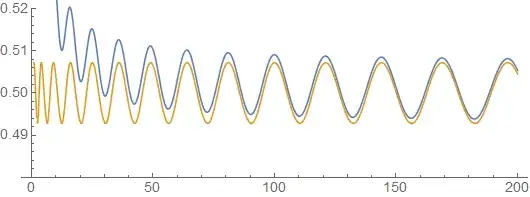
Case 2. When $\alpha = \frac{1}{2}$, I suspect that no such $\ell$ exists. I have a couple of heuristic arguments for this guess, mainly based on the case $A = \{n^2 : n \in \mathbb{N}_0\}$. A heuristic computation suggests that

$$ \sqrt{x}e^{-x} \sum_{n=0}^{\infty} \frac{x^{n^2}}{(n^2)!} \sim \frac{1}{\sqrt{2\pi}} \sum_{k=-\infty}^{\infty} e^{-\frac{(2k-r)^2}{2}}, \qquad r = \frac{x-\lfloor\sqrt{x}\rfloor^2}{\sqrt{x}} $$
Comparison

$$ \textbf{Figure.} \ \text{ A comparison of the left-hand side (blue) and the right-hand side (orange).}$$

which oscillates as $x\to\infty$. The main mechanism of this oscillatory behavior is that, if $x$ is large, then each term $\frac{x^n}{n!}$ with $n = x + \mathcal{O}(x^{1/2})$ will contribute to $\sqrt{x}e^{-x}f_A(x) $. I am currently trying to formalize this idea to prove my conjecture.

Case 3. When $0 < \alpha < \frac{1}{2}$, I propose the following conjecture:

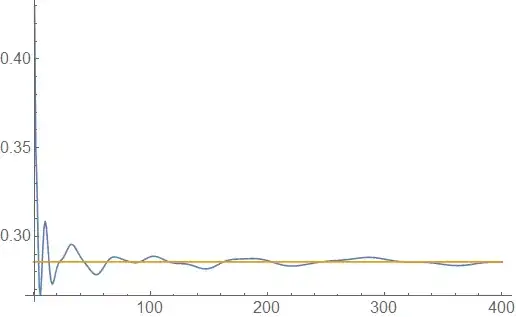
  • Conjecture. Let $\beta = \frac{1}{1-\alpha}$ and $c > 0$, and define $A$ by $$ A = \{ \lfloor (cn)^{\beta} \rfloor : n \geq 0 \}. $$ Then $$ \lim_{x \to \infty} x^{\alpha} e^{-x} f_A(x) = \frac{1}{\beta c}. $$

For instance, the following example illustrates the case of $\alpha = \frac{1}{7}$ and $c = 3$:
Comparison

$$ \textbf{Figure.} \ \text{ $x^{\alpha}e^{-x}f_A(x)$ (blue) and its limit $\frac{1}{\beta c}$ (orange) when $\alpha = \frac{1}{7}$ and $c = 3$}$$

For the remaining portion of this part, we sketch the proof of this conjecture when $0 < \alpha < \frac{1}{6}$. The main idea is that the sum can be truncated:

  • Lemma. Fix a function $\lambda = \lambda(x) \geq 0$ such that $\lambda \to \infty$ and $\frac{\lambda}{\sqrt{x}} \to 0$ as $x \to \infty$. Then there exists a constant $C > 0$, depending only on $\lambda$, such that $$ e^{-x} \sum_{|n - x| > \lambda\sqrt{x}} \frac{x^n}{n!} \leq \frac{C}{\lambda}. $$

Now we further assume that $\frac{\lambda}{x^{1/6}} \to 0$ as $x \to \infty$. Then using the above lemma, we can show:

$$ e^{-x}f_A(x) = \frac{1 + \mathcal{O}(\lambda^3/\sqrt{x})}{\sqrt{2\pi x}} \sum_{\substack{|m - x| \leq \lambda\sqrt{x} \\ m \in A}} e^{-\frac{(m-x)^2}{2x}} + \mathcal{O}\left(\frac{1}{\lambda}\right). $$

For each $m \in A$, let $n_m$ be defined by $m = \lfloor (c n_m)^{\beta} \rfloor$, and write $t_m = n_m - c^{-1}x^{1/\beta}$. Then we can show that, uniformly in $x$ and $m \in A \cap [x-\lambda\sqrt{x}, x+\lambda\sqrt{x}]$,

$$ \frac{(m-x)^2}{2x} = \frac{1}{2} \biggl( \frac{\beta c t_m}{x^{\frac{1}{2}-\alpha}} \biggr)^2 + o(1). $$

So, if in addition $\lambda$ is chosen that $x^{\alpha}/\lambda \to 0$ (which is possible by letting $\lambda(x) = x^{\gamma}$ for some $\gamma \in (\alpha, \frac{1}{6})$), then

$$ x^{\alpha} e^{-x}f_A(x) = \frac{1 + o(1)}{\sqrt{2\pi}} \sum_{\substack{|m - x| \leq \lambda\sqrt{x} \\ m \in A}} \exp\biggl[ - \frac{1}{2} \biggl( \frac{\beta c t_m}{x^{\frac{1}{2}-\alpha}} \biggr)^2 \biggr] \frac{1}{x^{\frac{1}{2}-\alpha}} + o(1), $$

which converges to

$$ \frac{1}{\sqrt{2\pi}} \int_{-\infty}^{\infty} e^{-\frac{(\beta c u)^2}{2}} \, \mathrm{d}u = \frac{1}{\beta c} $$

as $x \to \infty$.


3. For different lines of questions regarding the asymptotic behavior of $f_A(x)$, see:

Sangchul Lee
  • 181,930
  • Hi. reading through your answer now. u agree there are more cases than case $1$ and case $2$, right? – mathworker21 Jun 28 '20 at 01:29
  • @mathworker21, Indeed. I am currently playing with the intermediate case $0 < \alpha < \frac{1}{2}$ to see what I can expect. I guess that we may find such $A$'s in this case, although I have not enough supporting evidences to this. – Sangchul Lee Jun 28 '20 at 01:34
  • where does $1/6$ come in to play? – mathworker21 Jun 28 '20 at 06:48
  • @mathworker21, It is rather a technical reason. The estimations used in my proof requires that both $\lambda/x^{1/6}$ and $x^{\alpha}/\lambda$ converges to $0$ as $x\to\infty$, which forces $\alpha < \frac{1}{6}$. But both the numerical experiments and my gut are telling that the conjecture should be true for all $\alpha \in (0, \frac{1}{2})$. – Sangchul Lee Jun 28 '20 at 07:05
  • By treating the case $\alpha=0$ you completely solved the OP question, maybe it's worth opening a new post for $\alpha>0$. I think it's amazing that for $\ell \in (0,1)$ you found $A$ satisfying precisely $\lim_n \lvert A \cap {0,1,2,\dots n-1}\rvert/n = \ell$. Wow! – FormulaWriter Jun 28 '20 at 09:37
  • @FormulaWriter, Thank you, that is a great suggestion. I actually plan to write up a document containing more detailed arguments and observations that I made so far. I will then try to post a question about my guess about the case $\alpha>0$ when the file is ready. Also, I was also happy when I found how to construct $A$. Although this might not be the easiest construction, the main point of this one is that it allows easy squeezing argument using the rational case! – Sangchul Lee Jun 28 '20 at 09:51
0

This is a partial answer to the more general case. I'll use mathworker21 argument again. Suppose $A$ is infinite. Define: \begin{equation} h(x):=e^{-x} \sum_{n\in A} \dfrac{x^n}{n!} \end{equation} Then for every $m\in A$ we have \begin{equation} h(m)=e^{-m} \sum_{n\in A} \dfrac{m^n}{n!} \geq e^{-m} \dfrac{m^m}{m!} \end{equation} We know $e^{-m} \dfrac{m^m}{m!}\sim \dfrac{1}{\sqrt{2\pi m}}$ as $m\to\infty$ thanks to Stirling formula. Let p(x) be a polynomial of degree $\geq 1$. Evaluating $p(x)h(x)$ along $A$ we get: \begin{equation} \limsup_{x\to + \infty} |p(x)h(x)| = +\infty \end{equation} This shows that a polynomial $q(x)$ satisfying: \begin{equation} \lim_{x\to\infty} q(x) e^{-x} \sum_{n\in A} \dfrac{x^n}{n!}=1 \end{equation} must be a constant polynomial.

EDIT. Following mathworker21 suggestion, I'll extend this answer. The general problem can be restated in what follows:

Given a constant $C>0$, does a set $A \subseteq \mathbb{N}$ exist satisfying: \begin{equation} \lim_{x\to +\infty} e^{-x} \sum_{n\in A} \dfrac{x^n}{n!}=C \end{equation} ?

I currently don't have a general answer. What one can say is that, since $\sum_{n\in A} \dfrac{x^n}{n!} \leq e^x$ such a $C$ must be $\leq 1$. More over, for some specific values of $C$ it is possible to build a corresponding $A$ satisfy the problem. For $N \in \mathbb{N}-\{0\}$ , set $\alpha:=e^{2\pi i/N}$, $A:=N\mathbb{N}$. We have:

\begin{equation} \sum_{n\in A} \dfrac{x^n}{n!} = \sum_{k=0}^{\infty} \dfrac{x^{kN}}{(kN)!} = \dfrac{\sum_{k=1}^{N} e^{\alpha^k x}}{N} \sim \dfrac{e^{x}}{N} \end{equation} as $x\to +\infty$. This shows the answer is yes for $C=1/N$.

  • Not to be rude, but I think all of this was already implicit in my answer. Also, doesn't taking $A$ to be the evens and $q(x) = 2$ work? – mathworker21 Jun 27 '20 at 22:12
  • @mathworker21 If the general problem is: "given a polynomial $q(x)$, is there a suitable $A$ satisfying $ \lim_{x\to\infty} q(x) e^{-x} \sum_{n\in A} \dfrac{x^n}{n!}=1$ ?" then I simply pointed out, exploiting your answer, that a necessary condition on $q$ in order to find a suitable $A$ is that $q$ must be constant. It's your idea though, maybe I should have commented your answer instead. Should I delete the answer? – FormulaWriter Jun 27 '20 at 22:48
  • Yes I know. What I was saying is that it is pretty immediate that my answer implies $q$ must be constant. You can keep your answer if you want. Maybe you can try to add a proof that if $q(x)$ is a constant greater than $1$, then an $A$ does exist. For example, if $q(x) \equiv n$ an integer $n \ge 1$, then you can take $A$ to be all multiples of $n$. I think what I just said is true; I'm not $100%$ sure. – mathworker21 Jun 27 '20 at 22:51