This is my first post here and I searched the internet for things like "can u substitution yield an invalid result when finding an antiderivative?" and "manual integration and maxima produce different results" but this didn't find any useful links, which is why I'm posting here.
Background
I have a rather simple expression of which I want to find the indefinite integral/antiderivative of:
$$\frac{1}{y - \frac{115}{3}}$$
For context, this is part of a problem, where I am asked to solve the following ODE without using a SolveODE command:
$$\frac{dy}{dt} = -\frac{3}{50} \; \left(y - \frac{115}{3} \right)$$
Looking at the solution provided with the problem, I see that integrating the expression described at the beginning of this question should result in the following:
$$ \ln \left( \left|x - \frac{115}{3}\right| \right) + C $$
However, when solving using GeoGebra CAS to calculate the Integral (my exact input was Integral(1 / (x - 115 / 3))), I get the following output:
$$\ln \left( \left|3 \; x - 115\right| \right) + C$$
Using external help
Because I think that the antiderivative included in the official solution does not equal the one calculated by the Integral command in GeoGebra, I went to Integral-Calculator.com (the link leads to my calculation on the website) to find out what I did wrong.
I typed in my expression (1 / (y - 115 / 3)) and told it to solve for $y$.
A surprising result
Integral-Calcularot.com found both of the solutions.
Its results section has two parts: One describing a "manual" solve (whatever that means) and one which displays the solution calculated by the Maxima software:
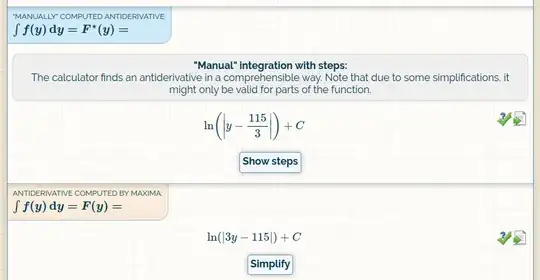
Several questions arise
- How can there be two different (and conflicting) solutions to one math problem?
- What did I miss?
- Is one of the two solutions invalid?
- Are the two solutions actually equal?
PS
AFTER typing my entire question, this website provided me with the following other (simular) question:
Different results when integrating 1/(x^2-9) with computer tools
I'm not sure if this would be considered a "duplicate" of the other one, but it doesn't help me understand my issue better; i.e. the two answers (or that question in and of itself) doesn't completely cover what I'm trying to do.
Thanks for reading!
Update
I've been testing and fiddling around a bit more and noticed the following:

It turns out flipping the fraction on its head and using $^{-1}$ leads to the desired behaviour. Any idea why?

