If you assume $g'(t)\ne 0$ in $(a,b)$ then either $g'>0$ or $g'<0$ in $(a,b).$ In either of these cases, the curve $(g(t),f(t))$ will always look like the graph of a first semester calculus example, something like $y=h(x), a'\le x \le b'.$ One $y$ for each $x,$ etc.
Consider now $g(t)=\cos t, f(t)=\sin t,$ $0\le t\le 3\pi/2.$ The curve traced out is $3/4$ of the unit circle, where we move counter-clockwise from $(1,0)$ to $(0,-1).$ That can't be fit into the $y=h(x)$ format, simply because for $-1<x<0$ there are two $y$-values for each $x.$ Note that here $g'(\pi)=0.$
What does the Cauchy MVT say about this example? It says there exists $c\in (0,3\pi/2)$ such that
$$(\sin(3\pi/2)-\sin 0)g'(c) = (\cos (3\pi/2)-\cos 0)f'(c).$$
I.e., $-\sin c= \cos c.$ That implies $c=3\pi/4.$
Here is something worthwhile to know: The equality
$$(f(b)-f(a))g'(c)=(g(b)-g(a))f'(c)$$
says exactly that the vector $(g(b)-g(a), f(b)-f(a))$ is a scalar multiple of the tangent vector $(g'(c),f'(c)).$
Let's apply this idea to the more interesting curve $(\cos(5\pi t),\cos (3\pi t)),$ $ 0\le t\le 1.$ Here is the curve traced out:
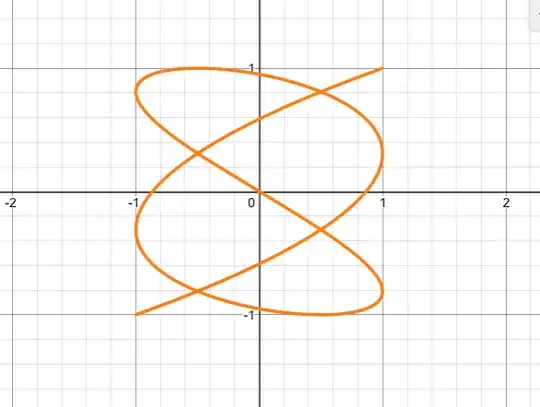
As $t$ increases from $0$ to $1,$ the curve starts at $(1,1)$ and moves down and to the left, swirls around a bit, and finally dives to its final destination at $(-1,-1).$ In this case the vector $(g(b)-g(a), f(b)-f(a)) = (-2,-2).$ How many values of $c$ will give a tangent vector that is a scalar multiple of $(-2,-2)?$ Looking at the curve, I would guess four such $c's.$ In other words, I see four points on the curve where the tangent line has slope $1.$ These would be be the $c$'s that figure into Cauchy's MVT.


