0

I picked this up from a Reddit post and a corresponding TED-Ed video about Pascal's triangle.

There was a fact in that video that surprised me. There were more but I had figured those out already. Link to the video here. https://youtu.be/XMriWTvPXHI

Eliminating all odd numbers in the Pascal's triangle yields a fractal, more specifically Sierpinski's triangle. I tried to wrap my head around that fact but I couldn't.

Is it possible to tell what patterns form from binomial coefficients that aren't divisible by $2$ and how do these patterns repeat ever so symmetrically. That's my question. Any help would be appreciated.
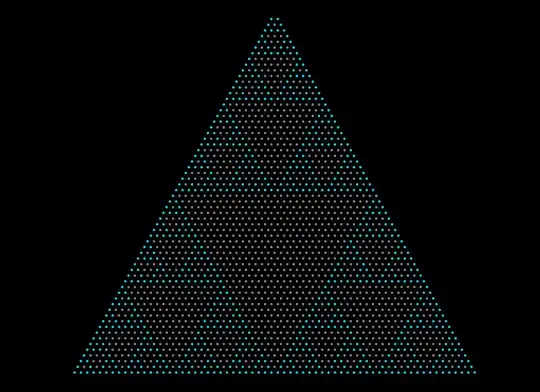
enter image description here

Each dot is a number in the triangle.

Nεo Pλατo
  • 1,745
  • 8
  • 19
  • 1
    Kummer's Theorem, https://en.wikipedia.org/wiki/Kummer%27s_theorem may be helpful here. – Gerry Myerson Apr 08 '20 at 13:06
  • 1
    Also Lucas's theorem https://en.wikipedia.org/wiki/Lucas%27s_theorem – GEdgar Apr 08 '20 at 13:27
  • So either one of these theorems can tell the placement of odd or even numbers in Pascal's triangle. – Nεo Pλατo Apr 08 '20 at 13:30
  • I posted a solution to "this" question last days... have to search for it... – dan_fulea Apr 08 '20 at 13:33
  • 1
    Is this the "same question"? https://math.stackexchange.com/questions/3569826/analytically-why-does-sierpinskis-triangle-appear-in-pascals-triangle/3575576#3575576 I.e. is the present question a duplicate of that one?! If not, please try to point the difference... – dan_fulea Apr 08 '20 at 13:37
  • If one of the answers proves the formation of a Sierpinski's triangle yes, this is a duplicate. – Nεo Pλατo Apr 08 '20 at 13:39
  • @Plato There is only one answer in loc. cit., it is written to answer exactly the "(analytic) proof" aspect of that question. My answer there does not give the proof, but as much details on the structure to be able to make them formally work. (That question has 3 upvotes, my answer has only one vote, so i did something wrong, although i spent a long time in elaborating and writing down arguments in a short path...) – dan_fulea Apr 08 '20 at 13:44
  • @ dan_fulea It is a good answer though. Maybe I can work with rows of $2^n$ and see what I come up with. – Nεo Pλατo Apr 08 '20 at 13:46
  • Rather off topic, but please insert my nick name with an at-sign, else i cannot ever see the comments written (also) for me, in case i no longer have the page open... – dan_fulea Apr 08 '20 at 13:46

0 Answers0