As kimchi lover (nice name :)) suggests, I think interleaving digits is a good and practical method. That means we get an injection $f:(0,1)^2\to(0,1)$ by:
$$
f:(x,y) = (0.a_1a_2a_3\!\ldots, 0.b_1b_2b_3\!\ldots) \mapsto 0.a_1b_1a_2b_2a_3b_3\!\ldots
$$
This is unique (i.e. well-defined) and injective, if we choose a convention for numbers with repeating 9's or 0's. It is practical, because we can just take however many digits we want.
This is easily transformed to an injection $\mathbb R^2\to \mathbb R$ by using a bijection $(0,1)\to\mathbb R$, say $g:x\mapsto \log\left(\frac1x-1\right)$. Then we have:
$$
h(x,y) := g\circ f\big(g^{-1}(x),g^{-1}(y)\big)
$$
is an injection $\mathbb R^2\to\mathbb R$.
Note that this method can be made bijective as shown in this answer.
EDIT:
I realised that we can easily extend $f$ to $\mathbb R_+^2 \to \mathbb R_+$ like this:
$$
f:(x,y) = (\ldots\!A_2A_1.a_1a_2\!\ldots, \ldots\!B_2B_1.b_1b_2b_3\!\ldots) \mapsto \ldots\! A_2B_2A_1B_1.a_1b_1a_2b_2\!\ldots
$$
For example $f(1.23,456.789) = 40516.273809$. I don't see an immediate extension to the whole plain, other than doing a similar trick as before with a bijective function $\mathbb R_+\to \mathbb R$.
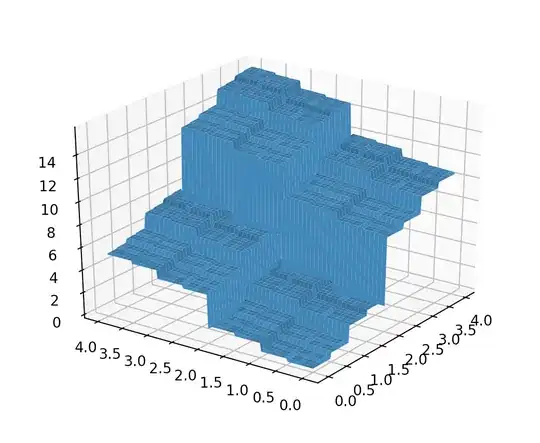
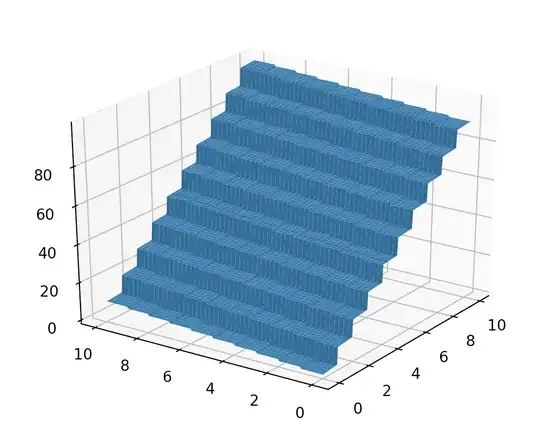
I went ahead and plotted $f$. I quite like the fractal shape, combined with nice regularity! This is honestly a nicer function than I would have thought would be easy to find. I can share the (unpolished) code, if you want. In decimal:
In binary: