Solving the problem with 5 and 10 steps gives the table
x=1.40,  y_1= 0.49177, y_2= 0.69178,  c(1.4)=-1.00004
x=1.80,  y_1= 1.03763, y_2= 1.32076,  c(1.8)=-1.41567
x=2.20,  y_1= 1.45513, y_2= 2.03157,  c(2.2)=-2.88222
x=2.60,  y_1= 2.27899, y_2= 2.48297,  c(2.6)=-1.01988
x=3.00,  y_1= 3.21908, y_2= 3.81554,  c(3.0)=-2.98229
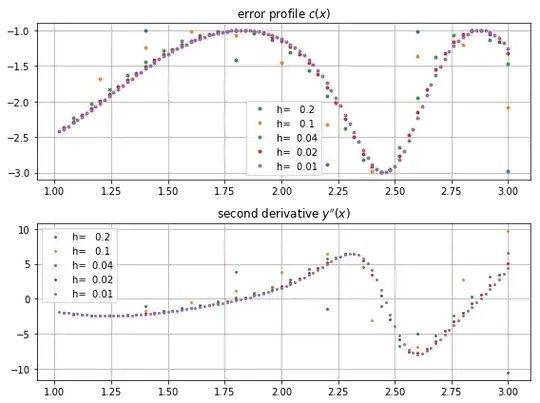
where $y_1=y_{2h}(x)$ are the values for $5$ steps with $2h=0.4$, $y_2=y_h(x)$ the corresponding values for a solution with $h=0.2$ and $c(x)=(y_{2h}(x)-y_h(x))/h$ is the estimate for the leading coefficient in $$y_h(x)=y_{\rm exact}(x)+c(x)h+O(h^2).$$ So with $|c(x)|\le 3$ one would need $h=10^{-3}/3$ for the goal of the task.
The theoretical bound will lead to a radically smaller bound for $h$.
(after the discussion in comments below the question)
The value you get from the cited formula is correct, I got the same value for my last remark above. Note that the theoretical bound is in all steps of its derivation strictly pessimistic to apply to all possible situations. In practice the contributions are not always maximum and some local errors may have opposite sign and thus partially cancel out.
With some care one can show that $|y′′(x)|≤12$, but that improves the bound only by a factor of about $3$. At all points $f(x,y)\in[1,3]$, so for any solution $x-1\le y(x)-y_0\le 3(x-1)$, next $y''(x)=Df(x,y)=f_x+f_yf=-\cos(xy)(y+xf(x,y))$, so on this wedge you get $Df\in [-1,1]\cdot([-0.5,5.5]+[1,2]\cdot[1,3])\subset[-11.5,11.5]$.
My answer contains an a-posteriory estimate of the error behavior, essentially extrapolated from 2 points, but still surprisingly accurate. Plotting the estimates for a range of step sizes shows how stable this estimate is and how it evolves with $x$. As one can see, there is no visible exponential growth in this span of the solution.


You can assume that the exact solution fulfills |y''(x)| ≤ 40. Or what I need to do with that information – DFielding96 Feb 17 '20 at 16:20
$will format as math formula, using\in function names will render them as function names,$f(x,y) = 2-\sin(xy)$ and $L=3$=> $f(x,y) = 2-\sin(xy)$ and $L=3$. – Lutz Lehmann Feb 17 '20 at 16:29