Suppose an hypothesis, say H, implies a contradiction, say (A&~A), which means that the conditional : H ---> (A&~A) is true.
Is it possible H to be true?
If H is true, the antecedent of the conditional ( namely H itself) is true and the consequent of the conditional ( namely : A & ~A) is false.
But such a conditional is false by definition ( as one can see when looking at the defining truth table of the " if ..then" operator).
So, H must be false.
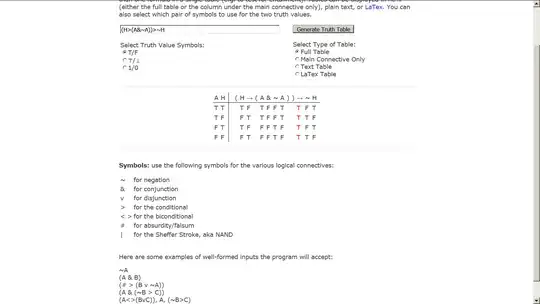
Another justification is provided by the fact that the conditional
[ H --> (A & ~A)] --> ~H
is a tautology, which justifies the validity of the following reasoning :
H implies a contradiction, therefore H is false.
A third reason is that, if you allow the hypothesis H to remain in your theory , even though it implies a contradiction, your theory will contain all possible propositions whithout exception. Indeed, H implies a contradition and a contradiction implies anything ( as one can verify using a truth table). And since implication is a transitive relation, H will ( indirectly) imply anything, even its own negation ( ~H).