5

Update: Thanks to Paul Frost, I realized there were mistakes in the question and my former proof. I moved the former proof to my answer below and modified the question.


This is exercise 1.2.18(b) in page 55-56 of Hatcher's book Algebraic topology.

In this question: $X=\{0,1,\frac{1}{2}, \frac{1}{3},\cdots\}$, $SX$ is suspension and $\Sigma X$ is reduced suspension, where the suspension $SX$ is the quotient of $X\times I$ obtained by collapsing $X\times\{0\}$ to one point and $X\times\{1\}$ to another point and reduced suspension $\Sigma X$ is obtained from $SX$ by collapsing the segment $\color{blue}{\{0\}\times I}$.

Note: Reduced suspension depends on the choice of basepoint.

In this question, if we obtain reduced suspension from $SX$ by collapsing the segment $\{0\}\times I$, we get Hawaiian earring/The Shrinking Wedge of Circles in figure (4).

If we obtain reduced suspension from $SX$ by collapsing the segment $\{1\}\times I$, we get a space in figure (3) which is homotopy equivalent to $SX$.

Picture of SX and ΣX

Question:

Let $C$ be the mapping cone of the quotient map $SX→ΣX$.

Show that $π_1(C)$ is uncountable by constructing a homomorphism from $π_1(C)$ onto $∏_∞ \mathbb Z/\bigoplus_∞ \mathbb Z$.

Thanks for your time and effort.

Andrews
  • 4,293
  • When you say not “continuous at 1,” it isn’t clear to me which point 1 refers to, especially as you removed some of the context from before the proof. At first you say $f$ is made of loops around the $B_i.$ Then you say sometimes it is loops around the $A_i.$ It feels a bit confused to me but it’s possibly salvageable. In the line that starts “if $[f]=[g]$ ...” I think it is just written in a confusing way. I’d try “If $[f]=[g]$ then $[f\cdot\bar g]$ is contractible so $\varphi([f\cdot\bar g])=0$ so ...” but you haven’t actually proved that statement. I will update my answer. – Dan Robertson Dec 01 '19 at 12:23
  • I disagree that the statement $q\circ\widetilde f=f$. Specifically by $=,$ you mean path-homotopic (I guess this is fine though), and your $a_i$ are not sufficient to describe $f$ up to path homotopy because the path which goes clockwise around $B_1,$ then $B_2,$ then anti-clockwise around $B_1$ is not path-homotopic to a path which goes clockwise around $B_2$ (ie $q(\textrm{a path which goes clockwise around }A_2).$) – Dan Robertson Dec 01 '19 at 18:35
  • I don’t understand what “continuous on $I$” means. Are you just trying to say $\widetilde f$ is continuous? – Dan Robertson Dec 01 '19 at 18:37
  • I feel like instead of the statement with the red bit, you just want to prove that if $\varphi([f])\ne\varphi([g])$ then you really have $[f]\ne[g]$. But perhaps they are equivalent. – Dan Robertson Dec 01 '19 at 18:48
  • I think this has reached the point where I can neither help find problems or be confident in saying that the proof is correct. – Dan Robertson Dec 01 '19 at 18:49
  • @DanRobertson For $\tilde f$, as I edited, should be considered that wraps $A_n$ the same way as $f$ wraps $B_n$. $\tilde f$ is defined initially a map from $I=[0,1]$ to $SX$, to make it into a loop, it needs continuity. – Andrews Dec 02 '19 at 06:36
  • perhaps we disagree on the definition of a map. In topology I normally take “map” to mean continuous function (and in groups a homomorphism). – Dan Robertson Dec 02 '19 at 20:33

3 Answers3

5

You seem to claim that $SX$ is homotopy equivalent to the second space in your picture (which I shall denote by $S'X \subset \mathbb R^2$). This is not true. The yellow circle does not belong to $S'X$, thus $S'X$ is not compact. If you have any map $f : SX \to S'X$, then its image is compact and therefore must be contained in some $S'_n = \bigcup_{i=1}^n A_i$. This is a finite wedge of circles. We have $f = i_n f_n$ where $f_n : SX \to S'_n$ is the restriction of $f$ and $i_n : S'_n \to S'X$ denotes inclusion. If $g : S'X \to SX$ would be a homotopy inverse of $f$, then the identity on $\pi_1(SX)$ would factor through $\pi_1(S'_n)$ which is false.

However, there is no reason to replace $SX$ by another space. By the way, note that $\Sigma X$ is known as the Hawaiian earring. In Hatcher's Example 1.25 it is denoted as "The Shrinking Wedge of Circles".

As basepoint for $SX$ choose the midpoint $x_0$ of the black line segment and as basepoint for $\Sigma X$ choose the cluster point $y_0$ of the circles $B_i$. We have obvious pointed retractions $r_i : SX \to A_i$ (which project $A_j$ to the black line segment for $j \ne i$) and $s_i : \Sigma X \to B_i$ (which map $B_j$ to $y_0$ for $j \ne i$). This gives us group homomorphisms

$$\phi : \pi_1(SX,x_0) \to \prod_{i=1}^\infty \pi_1(A_i,x_0) = \prod_{i=1}^\infty \mathbb Z, \phi(a) = ((r_1)_*(a), (r_2)_*(a),\ldots),$$ $$\psi : \pi_1(\Sigma X,y_0) \to \prod_{i=1}^\infty \pi_1(B_i,y_0) = \prod_{i=1}^\infty \mathbb Z, \psi(b) = ((s_1)_*(b), (s_2)_*(b),\ldots) .$$ It is easy to see that $\psi$ is surjective, but $\phi$ is not. In fact, $\text{im}(\phi) = \bigoplus_{i=1}^\infty \mathbb Z$. This is true because all but finitely many $(r_i)_*(a)$ must be zero (otherwise the path representing $a$ would run infinitely many times through both endpoints of the black line segment, thus would have infinite length).

Obviously we have $\psi \circ q_* = \phi$, where $q : SX \to \Sigma X$ is the quotient map.

Now let us apply van Kampen's theorem. Write $C = U_1 \cup U_2$, where $U_1$ is obtained from $C$ by removing the tip of mapping cone and $U_2$ by removing the base $\Sigma X$. Both $U_k$ are open in $C$. We have

  1. $U_1 \cap U_2 \approx SX \times (0,1) \simeq SX$ (thus $U_1 \cap U_2$ is path connected)

  2. $U_1 \simeq \Sigma X$ (in fact, $\Sigma X$ is a strong defornation retract of $U_1$)

  3. $U_2$ is contractible.

We conclude that $\Phi : \pi_1(U_1) * \pi_1(U_2) = \pi_1(\Sigma X) * 0 = \pi_1(\Sigma X) \to \pi_1(C)$ is surjective. Its kernel $N$ is the normal subgroup generated by the words of the form $(i_1)_*(c)(i_2)_*^{-1}(c)$, where $i_k : U_1 \cap U_2 \to U_k$ denotes inclusion and $c \in \pi_1(U_1 \cap U_2)$. Since $(i_2)_*^{-1}(c) = 0$, we see that $N$ is the normal closure of the image of the map $(i_1)_* : \pi_1(U_1 \cap U_2) \to \pi_1(U_1)$. But under the identifications $U_1 \cap U_2 \simeq SX$ and $U_1 \simeq \Sigma X$ we see that $(i_1)_*$ corresponds to $q_* : \pi_1(SX) \to \pi_1 (\Sigma X)$.

Hence $\pi_1(C) \approx \pi_1 (\Sigma X)/ N'$, where $N'$ is the normal closure of $\text{im}(q_*)$.

The surjective homomorphism $\psi' : \pi_1(\Sigma X) \stackrel{\psi}{\rightarrow} \prod_{i=1}^\infty \mathbb Z \to \prod_{i=1}^\infty \mathbb Z / \bigoplus_{i=1}^\infty \mathbb Z$ has the property $\psi' \circ q_* = 0$, thus $\text{im}(q_*) \subset \ker(\psi')$. Since $\ker(\psi')$ is a normal subgroup, we have $N' \subset \ker(\psi')$, thus $\psi'$ induces a surjective homomorphism $\pi_1(C) \approx \pi_1 (\Sigma X)/ N' \to \prod_{i=1}^\infty \mathbb Z / \bigoplus_{i=1}^\infty \mathbb Z$.

Andrews
  • 4,293
Paul Frost
  • 87,968
  • Thanks for pointing out my $S'X$ is not homotopy equivalent to $SX$. I was trying to collapse the black line segment in $SX$ into a point to compute $\pi_1(SX)$. Is there any way to modify this? Maybe I should collapse the pink line segments on the right into a point, so the green line segments will become the "lower bound" circle and the black segments will become the "upper bound" circle? – Andrews Dec 09 '19 at 15:13
  • You can collapse the pink line segments and obtain a quotient space which looks like your second picture without the pink circle and the yellow circle being replaced by the black line segment with identified end points. But what is the benefit? – Paul Frost Dec 09 '19 at 15:39
  • It's easier to compute its fundamental group as long as we know how to compute $\pi_1(\bigvee_\infty S^1)$. They can be solved in the same way. – Andrews Dec 09 '19 at 15:45
1

Your construction of $\varphi$ looks right to me (in the sense that I think it could appear in a full proof). I don’t think you have sufficiently proven that it is well-defined. I think this is the tricky part you felt you were missing.

I think you could perhaps add a few more words as to why the paths you use to show $\varphi$ is surjective are not contractible.

Edit:

The question changed. I feel like it’s a bit confused and it’s not really at all clear to me that $\varphi$ is well-defined. I feel like there’s too much if $x$ then $y$ otherwise $z$ (especially as sometimes this is used to split up cases and sometimes for an argument by contradiction). Perhaps a better way to structure this would be as follows:

  1. Define the function $\psi$ mapping $\pi_1(\Sigma X)$ to $\prod_\infty \Bbb Z$
  2. Show that it is a well-defined surjective homomorphism
  3. Let $r : \prod_\infty\Bbb Z\to \prod_\infty\Bbb Z/\bigoplus_\infty\Bbb Z$ be the quotient map
  4. Prove that $r\psi$ may be extended to a well-defined homomorphism $\phi : \pi_1(C_q)\to \prod_\infty\Bbb Z/\bigoplus_\infty\Bbb Z$.
  5. You get surjectivity from step 2

But actually I feel like you should be able to use some theorem for this instead. The theorem I am imagining is one which would say something like $\pi_1(C_q) = \pi_1(\Sigma X)/\pi_1(SX)$ and then you need the theorem from groups that a homomorphism $f: G \to H$ induces a homomorphism $G/N \to G/f(N)$. Maybe you don’t have that theorem but do you have Seifert-van Kampen yet? Maybe you could use that to your advantage here.


Edit 2:

I looked up the exercise in Hatcher. The exercise is in the first block after the proof and statement of van Kampen’s theorem (which I have perhaps confusingly referred to as Seifert-van Kampen). I think the exercise wants you to use the theorem. You should take one set to be $\Sigma X$ plus the mapping cylinder of $q,$ and the other to be $CSX$, so the intersection is $S X$. My guess is that the point of the exercise is practicing van Kampen’s theorem (and I guess a bit about how it relates to mapping cones and these spaces).

Dan Robertson
  • 3,094
  • 12
  • 14
  • Hatcher gives the existence of homomorphism $\rho: \pi_1(\Sigma X) \to \prod_\infty \mathbb Z$. What I did before is intended to give an explicit expression of $\rho$ and show it maps $\pi_1(SX)$ to $\bigoplus_\infty \mathbb Z$. Since $\pi_1(C_q)\cong \pi_1(\Sigma X)/\pi_1(SX)$, $\rho$ induces a homomorphism $\pi_1(\Sigma X)/\pi_1(SX) \to \prod_\infty \mathbb Z/\bigoplus_\infty \mathbb Z$. – Andrews Dec 02 '19 at 08:57
  • That looks like a pretty promising way to prove this. I would guess that the point of the exercise is the bit where you have to back up the “Since $\pi_1(C_q)\cong\dots”$ If you have a construction for $\rho$ then surely you can use that to get the statement you want for $SX$. But maybe you don’t have the construction. – Dan Robertson Dec 02 '19 at 20:40
0

Alternative method:

Let $U=C(SX)$, $V$ be mapping cylinder of $q$, $V=SX \times I \sqcup \Sigma X /\sim$, i.e. $(x,1)\sim q(x)$ for $x\in SX$.

Let $W$ to be space by gluing $U$ and $V$ along $SX$.

$V$ deformation retracts to $\Sigma X$, so $C_q=\Sigma X \cup_q C(SX) \simeq W$.

$\pi_1(U)=0$. Let $i_1: SX \hookrightarrow C(SX)=U$, $i_2: SX \hookrightarrow V$.

$i_{1*}=0$, $i_{2*}:\pi_1(SX)\to\pi_1(V)\cong\pi_1(\Sigma X)$.

From van Kampen's theorem, $\pi_1(W)\cong\pi_1(U)*\pi_1(V)/N$, $N$ is generated by $i_{1*}(w)i_{2*}(w^{-1})$ for all $w\in \pi_1(SX)$. $\pi_1(W)\cong \pi_1(\Sigma X)/\pi_1(SX)$.

Let $\rho$ be the surjective homomorphism $\pi_1(\Sigma X) \to \prod_\infty \mathbb Z$ given in page 49 of Hatcher.

$\color{red}{\text{$\rho$ maps $\pi_1(SX)$ to $\bigoplus_\infty \mathbb Z$} \ (*) }$ , so $\rho$ induces a surjective homomorphism

$\pi_1(\Sigma X)/\pi_1(SX) \to \prod_\infty \mathbb Z/\bigoplus_\infty \mathbb Z$. $\quad\Box$

Claim $(*)$ in red is remained to check.

I tried to give an explicit expression of $\rho$ to prove claim $(*)$ in the question, but I couldn't fully prove the well-defineness of the $\rho$ I constructed.


My former proof (wrong):
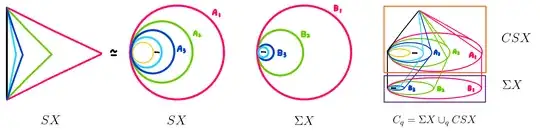
Picture of SX, ΣX

$1$. Yellow circle doesn't belong to $SX$. It means the lower bound of circles in $SX$.

Circles in $\Sigma X$ have no such lower bound. Region containing "$\cdots$" means there're countably many circles in it.

From outside to inside, circles in $SX$ and $\Sigma X$ are denoted by $A_n$ and $B_n$ with common point $x_0$ and $y_0$.

Quotient map is $q:SX \to \Sigma X$, mapping cone $C_q=\Sigma X \cup_q CSX$.

$2$. Choose basepoint of loops at $x_0\sim y_0$. $A_i\sim B_i$, so loop around $A_i$ can be considered as loop around $B_i$.

For $[f]\in \pi_1(C_q)$, if $f$ wraps $a_n$ times around circle $B_n$ clockwise, let $\tilde f: I \to SX$ wrap $a_n$ times around circle $A_n$ clockwise the same ways as $f$. Note that $q \circ\tilde f=f$.

Define $\varphi: \pi_1(C_q)\to \prod_\infty \mathbb Z/\bigoplus_\infty \mathbb Z,\ [f]\mapsto \overline{(a_n)_{n=1}^{\infty}}$.

$3$. If $(a_n)_{n=1}^{\infty} \in \bigoplus_\infty \mathbb Z$, then only finite $a_n$ is nonzero and $\tilde f$ is continuous on $I$, so $\tilde f$ is indeed a loop in $C_q$.

$[\tilde f]=[q\circ \tilde f]=[f]$. Note that $A_n\subset SX \subset CSX$ is contractible, so $[\tilde f]=0=[f]$, $f$ is nullhomotopic. $\pi_1([f])=\overline 0$.

This is consistent with $\overline{(a_n)_{n=1}^{\infty}}=\overline 0$ in $\prod_\infty \mathbb Z/\bigoplus_\infty \mathbb Z$.

If $(a_n)_{n=1}^{\infty} \in \prod_\infty \mathbb Z - \bigoplus_\infty \mathbb Z$, then $\tilde f$ is not continuous at $1$, so it's not a loop in $SX$ and $\color{red}{\text{ $f$ isn't nullhomotopic}}$.

$3$. $\varphi: \pi_1(C_q)\to \prod_\infty \mathbb Z/\bigoplus_\infty \mathbb Z$ is well-defined.

If $[f]=[g]$ in $\pi_1(C_q)$, $f, g$ wraps $a_n, b_n$ times around circle $B_n$ clockwise, then $f\circ g^{-1}$ wraps $a_n - b_n$ times around circle $B_n$ clockwise.

$f\circ g$ is nullhomotopic, so $(a_n-b_n)_{n=1}^\infty\in \bigoplus_\infty \mathbb Z$.

$\varphi([f])=\overline{(a_n)_{n=1}^{\infty}}=\overline{(a_n-b_n+b_n)_{n=1}^{\infty}}=\overline{(a_n-b_n)_{n=1}^{\infty}}+\overline{(b_n)_{n=1}^{\infty}}=\overline{(b_n)_{n=1}^{\infty}}=\varphi([g])$.

$\varphi$ is a well-defined surjective homomorphism. $\quad\Box$

Andrews
  • 4,293