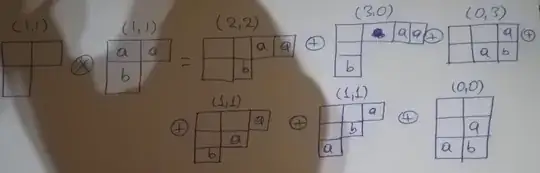
We can represent a tensor with $(n, m)$ where $n$ are the upper indices and $m$ the lower ones. If I get the direct product of $(n,m)\otimes (n', m') $ then I will have irreducible representation. Let's say that I have $(1,1)\otimes(1,1)$. This decomposes to $$(1,1)\otimes(1,1)=(2, 2)\oplus(3,0)\oplus(0,3)\oplus(1,1)\oplus(1,1)\oplus(0,0) $$ and the dimension of each representation is respectively $$8\otimes8=27\oplus10\oplus{\bar{10}}\oplus8\oplus8\oplus1$$ because $$dim(n, m) =\frac{1}{2}(n+1)(m+1)(n+m+2) $$ In class we also did the decomposition with the Young Tableaux method(We worked on SU(3)).The result was this(12.14)
(Sorry for the inconvenience but I have been trying to upload the image and I cannot). My teacher then wrote above each diagram the tensor representation, which are just the same and in the same order as before. But the representation for (1,1) has two Young diagrams.
My question is: Can we find a representation of a tensor that has two different young diagrams and is there a general rule that given a representation of a tensor $(n, m) $ we can write down its young tableaux? Also, I know how to decompose the direct product of two young diagrams and to find their multiplicity(dimension). Thanks.