5

I want to show the following distributivity of Heyting algebra

$x \rightarrow (y \land z) = (x \rightarrow y) \land (x \rightarrow z) \tag{0}$

using only the below four laws

$x \rightarrow x = 1 \tag{1}$ $x \land (x \rightarrow y) = x \land y \tag{2}$ $y \land (x \rightarrow y) = y \tag{3}$ $(x \rightarrow (y \land x)) = x \rightarrow y \tag{4}$

and the fact derived from the lattice which have 0 and 1.

How to show the distributivity (0)?

J.-E. Pin
  • 42,871
konyonyo
  • 189
  • in what context did you encounter this problem? – wlad Nov 16 '19 at 07:44
  • @jkabrg I'm reading the book "Mathematical concepts" (Juergen Jost) and encountered the difficult point. The author said that a Hyting algebra is a lattice with 0 and 1 which carries a binary operation $\rightarrow$ satisfying (1) to (4). And it is written that form (1) to (4) $x \land (y \rightarrow z) = x \iff x \land y \land z = x \land y$ can be derived. But I couldn't derive that without assuming (0). – konyonyo Nov 16 '19 at 11:00
  • @jkabrg I feel difficult to prove Lemma 2.1.7 in https://books.google.co.jp/books?id=H5WKCgAAQBAJ&pg=PA29&lpg=PA29&dq=jost+heyting+algebra&source=bl&ots=q0m0msKbEs&sig=ACfU3U0ub-rZGY01vkiu-EFrNFr1Y0G6Mg&hl=ja&sa=X&ved=2ahUKEwjn7pit9O3lAhVEyosBHWfKDpcQ6AEwA3oECAcQAQ#v=onepage&q=jost%20heyting%20algebra&f=false – konyonyo Nov 16 '19 at 11:06
  • Usually, the identity (0) you mention is taken instead of (4) (see e.g. here). I can also not follow his proof, and I think it might just be simply wrong. – Mark Kamsma Nov 16 '19 at 12:59
  • @MarkKamsma Thank you for commenting. I will use (0) instead of (4). – konyonyo Nov 16 '19 at 13:12
  • If you take the categorical approach, (0) is the exponential property $(y \times z) ^ {x} = y^x \times z^x $. There's a good section on Heyting Algebras and IPC in Steve Awoday's textbook. – Gustavo Labegalini Nov 22 '19 at 14:10

1 Answers1

2

(I wasn't able to access the book you linked to, but I'm answering the question as posted.)

Consider the pentagon $N_5 = \{0,a,b,c,1\}$, with $0<a<b<1$, $0<c<1$ and $c$ incomparable to $a$ or $b$ (see it, for example, here), and define $\to$ by the table below.
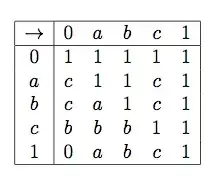
enter image description here

It is immediate that $x \to x = 1$, and it is not difficult to see that properties (2), (3) and (4) are satisfied as well.

For example, to verify (2), one has to check that the meet of the element on the head of each row with the element on the head of each column coincides with the the meet of the head of that row with the element in the cell that is the cross of that row and that column.

(3) is similar, but even easier.

To check (4), star by noticing that if $x\leq y$ then $x\to y=1$.
Thus, if $x\leq y$, (4) reduces to $x\to x = x \to y$, which is true since both are $1$;
if $x \geq y$, we get $x\to y = x \to y$, which is obvious;
if $x=1$, we get $1\to y = 1 \to y$;
and if $y=0$, we get $x \to 0 = x \to 0$.
So there are only four pairs $(x,y)$ to check: $(a,c),(b,c),(c,a),(c,b)$, and that is easy.

But this algebra doesn't satisfy property (0).
Indeed, $$b\to(0\wedge a) = b\to 0 = c \neq 0 = c \wedge a = (b\to 0) \wedge (b\to a).$$

So this means that axiom (0) cannot be derived from axioms (1)—(4), and perhaps there is a wrong result in that book, as someone also suspected, in a comment.

amrsa
  • 13,992