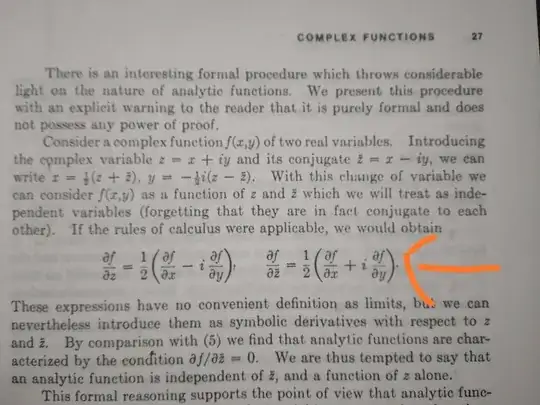
How did they achieve this equation ? How did they use chain rule in this ?
How did they achieve this equation ? How did they use chain rule in this ?

Let me expand Daniel Fischer's hint.
$z = x + iy \rightarrow \bar{z} = x - iy$ which gives $x = \frac{1}{2}(z + \bar{z})$ and $y = \frac{1}{2i}(z - \bar{z})$. So we may consider the function $f(x,y)$ as a function of $z$ and $\bar{z}$.
Differentiating the relations we shall get $\frac{\partial{x}}{\partial{z}} = \frac{1}{2}$, $\frac{\partial{y}}{\partial{z}} = \frac{1}{2i}$, $\frac{\partial{x}}{\partial{\bar{z}}} = \frac{1}{2}$ and $\frac{\partial{y}}{\partial{\bar{z}}} =\frac{-1}{2i}$
Now use chain rule
$$\frac{\partial{f}}{\partial{z}} = \frac{\partial{f}}{\partial{x}}\frac{\partial{x}}{\partial{z}} + \frac{\partial{f}}{\partial{y}}\frac{\partial{y}}{\partial{z}} = \frac{1}{2}\left(\frac{\partial{f}}{\partial{x}} - i\frac{\partial{f}}{\partial{y}}\right)$$
Similarly applying the chain rule for $\bar{z}$ you shall get another result.
Here we shall assume that all the rules of calculus applied here are applicable.
