Residue Solution
Note that for
$$\newcommand{\Res}{\operatorname*{Res}}
g_n(z)=\frac{n/z}{z^n-1}
$$
we have
$$
\Res_{z^n=1}(g_n(z))=1\tag1
$$
and
$$
\Res_{z=0}(g_n(z))=-n\tag2
$$
Partial fractions gives
$$
\begin{align}
f(z)
&=\frac{1+z}{1-z+z^2-z^3}\\
&=\frac{(1+z)^2}{1-z^4}\\
&=-\frac1{z-1}+\frac1{2(z-i)}+\frac1{2(z+i)}\tag3
\end{align}
$$
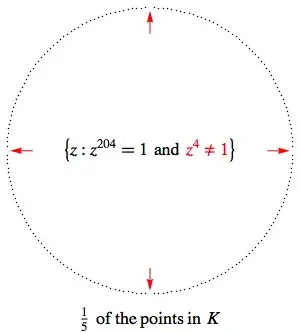
For $g(z)=g_{1020}(z)-g_4(z)$, we not only have $\Res\limits_{z\in K}(g(z))=1$ and $\Res\limits_{z=0}(g(z))=-1016$, but also
$$
\begin{align}
\lim_{z^4\to1}g(z)
&=\lim_{z^4\to1}\left(\frac{1020/z}{z^{1020}-1}-\frac{4/z}{z^4-1}\right)\\[6pt]
&=\lim_{z^4\to1}\left(\frac{1020}{z^{1021}-z}-\frac{4\left(1+z^4+z^8+\dots+z^{1016}\right)}{z^{1021}-z}\right)\\[6pt]
&=\lim_{z^4\to1}\frac{1016-4\left(z^4+z^8+\dots+z^{1016}\right)}{z^{1021}-z}\\[6pt]
&=-\frac{4+8+\dots+1016}{255z}\tag{L'Hôpital}\\[6pt]
&=-\frac{508}z\tag4
\end{align}
$$
Thus,
$$
\begin{align}
\Res_{z=0}(f(z)g(z))
&=f(0)\Res_{z=0}(g(z))\\
&=1\cdot-1016\\[6pt]
&=-1016\tag5
\end{align}
$$
and
$$
\begin{align}
\Res_{z=1}(f(z)g(z))
&=g(1)\Res_{z=1}\left(\color{#C00}{-\frac1{z-1}}+\frac1{2(z-i)}+\frac1{2(z+i)}\right)\\
&=-508\cdot\color{#C00}{-1}\\[6pt]
&=508\tag6
\end{align}
$$
and
$$
\begin{align}
\Res_{z=i}(f(z)g(z))
&=g(i)\Res_{z=i}\left(-\frac1{z-1}\color{#C00}{+\frac1{2(z-i)}}+\frac1{2(z+i)}\right)\\
&=508i\cdot\color{#C00}{\frac12}\\[6pt]
&=254i\tag7
\end{align}
$$
and
$$
\begin{align}
\Res_{z=-i}(f(z)g(z))
&=g(-i)\Res_{z=-i}\left(-\frac1{z-1}+\frac1{2(z-i)}\color{#C00}{+\frac1{2(z+i)}}\right)\\
&=-508i\cdot\color{#C00}{\frac12}\\[6pt]
&=-254i\tag8
\end{align}
$$
and
$$
\begin{align}
\Res_{z\in K}(f(z)g(z))
&=f(z)\Res_{z\in K}(g(z))\\
&=f(z)\tag9
\end{align}
$$
Since $f(z)g(z)\sim\frac4{z^7}$ as $|z|\to\infty$, the sum of the residues vanishes:
$$
\begin{align}
0
&=\sum_{\alpha\in\{0,1,i,-i\}\cup K}\Res_{z=\alpha}(f(z)g(z))\\[6pt]
&=\sum_{\alpha\in\{0,1,i,-i\}}\Res_{z=\alpha}(f(z)g(z))+\sum_{\alpha\in K}\Res_{z=\alpha}(f(z)g(z))\\[6pt]
&=-508+\sum_{z\in K}f(z)\tag{10}
\end{align}
$$
which means
$$
\bbox[5px,border:2px solid #C0A000]{\sum_{z\in K}\frac{1+z}{1-z+z^2-z^3}=508}\tag{11}
$$
Mathematica Verification
Using the code
N[Plus@@((1+z)/(1-z+z^2-z^3)/.Complement[Solve[z^1020==1],Solve[z^4==1]]),20]
we get
508.00000000000000000 + 0.*10^-18 I
Notational Clarification
In the preceding, $\Res\limits_{z^n=1}(f(z))$ means the residue at any point $z$ so that $z^n=1$. This may be a function of the root of $z^n=1$ chosen.
Also, $\lim\limits_{z^4\to1}f(z)$ means the limit at any point $z$ so that $z^4=1$. This may be a function of the root of $z^4=1$ chosen.


