Let's try to see (purely formally) that homotopy equivalence is the right notion of equivalence for what we are studying. When doing mathematics, we are often interested in how objects behave up to some notion of isomorphism. The standard notion of isomorphism in a topological space is that of a homeomorphism, but this turns out to be too restrictive. While homeomorphism preserves ALL the topological data of a space, we are only interested in preserving the topological data which we can detect with certain methods.
As a crude example, let's say that we're only interested in studying the homology of a space. Here homeomorphism is clearly not the right notion of equivalence, because there are lots of spaces which look the same as far as homology is concerned, but which are not homeomorphic. Can we find a better notion of equivalence?
You say in the comments that you're happy with the notion of a homotopy between paths. This is a way of saying that two paths are equivalent, so maybe we can beef it up to show that two spaces are equivalent in a similar way.
Say $f, g : I \to A$ are paths from $a$ to $b$.
(That is, $I = [0,1]$ is the unit interval, $f(0) = g(0) = a$ and $f(1) = g(1) = b$)
We say they are homotopy equivalent if there is a function $H : I^2 \to A$ with $H(x,0) = f(x)$ and $H(x,1) = g(x)$. The picture, which I'm sure you're familiar with, is shown below (shamelessly stolen from this website):
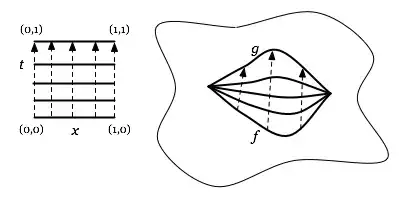
Intuitively, we can "fill the space" bounded by $f$ and $g$ with a copy of the unit square $I^2$.
Ok, let's beef this definition up one step at a time. A path is just a function, so maybe we can find some way of viewing functions as equivalent in a way that extends the definition of path equivalence.
Well, let's say that $f, g : A \to B$. How might we view them as equivalent? Why not do the same thing? Say $H : A \times I \to B$ is a homotopy connecting $f$ and $g$ iff $H(a,0) = f(a)$ and $H(a,1) = g(a)$.
If we fix $a$, then we are saying that $H(a,t)$ gives a path between $f(a)$ and $g(a)$, which clearly generalizes our old notion of equivalence of paths!
Ok, so we have some way of viewing functions as "the same", because there is a way to connect the outputs in such a way that we can "deform" $f$ into $g$ (by moving each point along the homotopy $H$). Does this notion of function equivalence actually buy us anything?
Yes! Recall we are only interested in homology, and we know that $f : A \to B$ induces a map $f_* : H_n(A) \to H_n(B)$. It isn't hard to show that if $f$ and $g$ are homotopic, then $f_* = g_*$! Notice I'm not saying the induced maps are homotopic, I'm saying the induced maps are the same.
Now it's not hard to see that $id_A : A \to A$ satisfies $(id_A)_* = id_{H_n(A)}$.
It takes a little bit more work to see that if $f : A \to B$ and $g : B \to C$, then
$(g \circ f)_* = g_* \circ f_*$. Both of these points have been shown countless times on MSE, so I won't bother showing them here.
Of course, with this under our belt, the definition of homotopy equivalence falls into our lap! If we want to know that $A$ and $B$ have the same homology, then we need to show that $H_n(A) \cong H_n(B)$.
So we want to consider $A$ and $B$ equivalent if some $f : A \to B$ induces $f_*$ an isomorphism between $H_n(A)$ and $H_n(B)$.
So $f_*$ should have an inverse $g_*$ such that $f_* \circ g_* = id_{H_n(B)}$ and $g_* \circ f_* = id_{H_n(A)}$. But we know how to guarantee this!
By the two properties above, it is enough to show that $f \circ g$ is homotopic to $id_B$ and $g \circ f$ is homotopic to $id_A$! This is exactly the notion of a homotopy equivalence between $A$ and $B$!
Ok, so homotopy equivalence is enough, but why is it better than homeomorphism? The answer is because it makes computations easier. It is much easier to show that two spaces are homotopy equivalent than to show they are homeomorphic, and with this new (weaker) notion of equivalence, we can compare the homology of spaces that aren't homeomorphic. I.e. $R^n$ is homotopic to a point, and it is easy to see that a point has trivial homology. If we insisted on using homeomorphism as our notion of isomorphism, we would not be able to make this comparison, and we would have to re-compute the homology of $R^n$ (or use homotopy equivalence as a theorem all over the place, which is basically what we're doing anyways, we're just honest about the fact that it's all we care about, so we take it as a definition of equivalence).
So we see now that, in our quest to have a weak (and therefore useful) notion of equivalence of spaces, we have quickly found our way to the notion of a homotopy equivalence. What is perhaps more surprising is that this same notion of equivalence falls out, whether we are trying to be invariant under homology, or under many of the countless other constructions in algebraic topology.
This is what makes the definition seem its most natural to me personally. The fact that trying to preserve a variety of different constructions always gives rise to the same notion of equivalence shows that we are onto something which is important. It is the farthest thing from arbitrary I can think of.
I hope this helps ^_^


